When an Uncontacted Tribe Walked Out of the Amazon
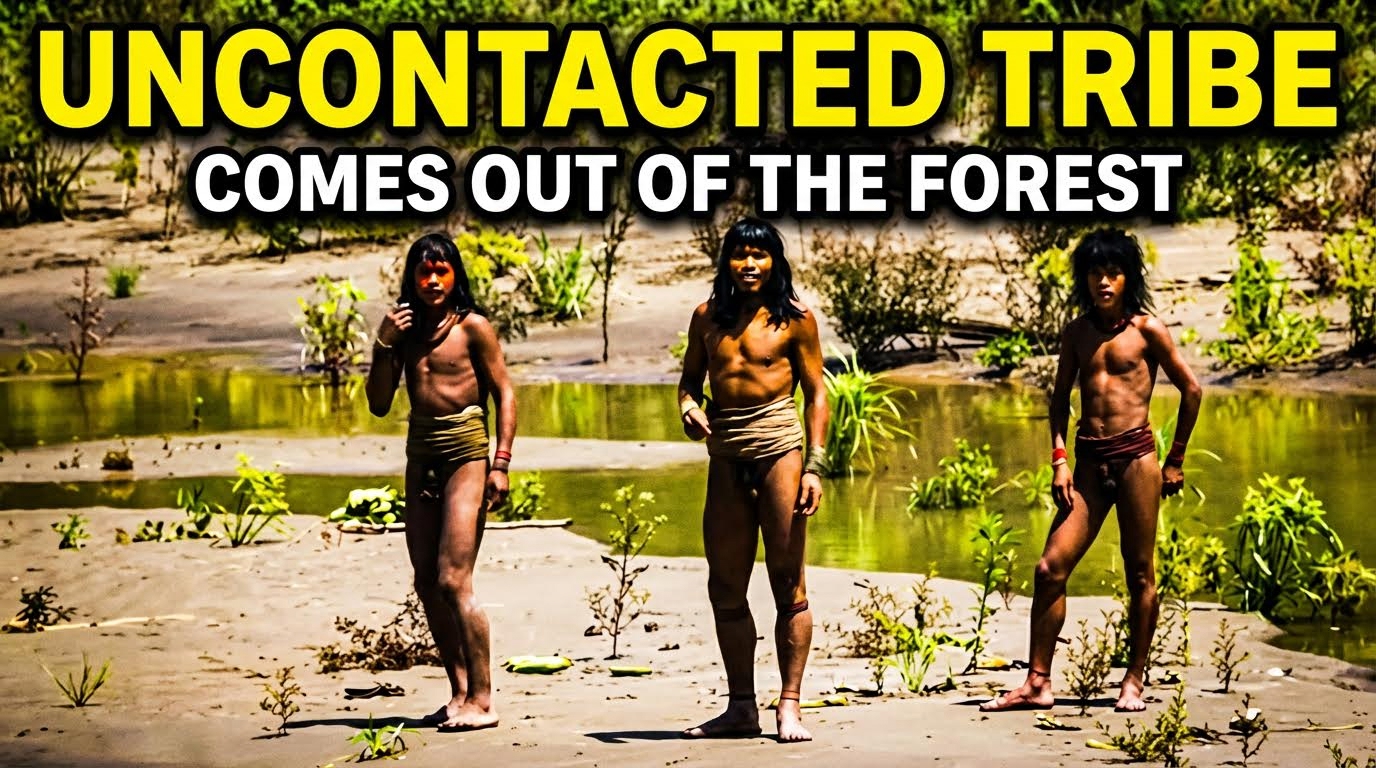
When an uncontacted tribe emerged from the forest, two worlds briefly met.
I don’t think most people understand how big the Amazon really is.
It’s almost the size of the continental United States. Imagine flying from Ohio to California. Now imagine that entire stretch covered in dense jungle. Incredible stuff.
The river system alone carries more water than any other on Earth. Roughly one out of every five gallons of river water that reaches the ocean flows through it.
I genuinely think the Amazon should get more credit than it gets. After all, people call it the lungs of the Earth!
It’s so vast that there are areas no modern human has ever stepped into. Entire stretches remain untouched. Millions of species live there — plants we haven’t cataloged, insects we haven’t named. And yes… people.
People who have never left.
Paul Rosolie
Paul is someone I deeply respect. His courage and commitment alone make you pay attention. He’s spent nearly twenty years in the Amazon — living in it, studying it, now actively protecting it from loggers, traffickers, illegal operations, and corporate expansion.
He genuinely loves that forest and understands how important it is to all of us, whether we think about it or not.
His new book Jungle Keepers, dives into that mission.
About a year ago, something happened that he’s only recently been able to speak about publicly. He witnessed — and filmed — an encounter with an uncontacted tribe.
Something to note... nobody was really looking for them… they just walked out of the forest on their own terms.
The first thing that came to mind was that scene from Children of the Corn — if you know, you know.
"A tribe is coming... get here now"
That was the message.
Men emerged from the forest and approached the edge of a neighboring indigenous community.
They carried bows. And let me tell you about these “cute” bows.
The arrows were six or seven feet long — taller than most people, definitely taller than me (which isn’t hard, I suppose). Razor-sharp bamboo tips. Built to travel across a river with force. A serious weapon.
Try to picture standing on one bank of a river while someone across from you holds something longer than your own height and aims it in your direction.
There were no women or elders present. Just young men.
We’re always saying, “I wonder what it was like a thousand years ago.”
Well… here you go.
This is about as close as it gets. A living, breathing time capsule — the way Paul describes it.
Communication was limited. There’s a tiny fraction of language overlap between the local indigenous group and this uncontacted tribe. Enough to pass simple meaning…but also enough for things to get confused quickly.
One message came through clearly. Food.
They wanted bananas and plantains.
A boat was pushed across with bunches piled high. The men rushed forward and grabbed what they could. It was obvious they were hungry.
Paul later talked about why releasing footage like this is complicated. When something feels rare or mysterious, people chase it. When outsiders show up, they bring bacteria and viruses with them. Even common illnesses can be devastating to isolated populations.
For generations, groups like this have made one thing clear: they want to be left alone. That part is hard for us to come to grips with.
Our instinct is to think they need saving. We see no electricity, no medicine cabinet, no grocery store. We imagine the bugs, the snakes, the humidity. We think, “Why would anyone choose this?"
But from their perspective, we’re the ones cutting down trees and showing up with loud engines.
And the local indigenous communities know something we don’t: these encounters are serious. They are not friendly village meet-and-greets. They can turn violent quickly, and sometimes without warning — at least without warning that we can understand.
The next day proved that.
Paul’s guide, George, was driving a boat around a bend in the river when a large group appeared again — Paul estimated around 200 people.
Arrows started flying.
Everyone on the boat dropped and took cover. George couldn’t. He had to steer. One of those seven-foot arrows entered above his shoulder blade and exited near his abdomen. He was airlifted out and somehow survived.
Paul doesn’t tell the story with blame or theatrics. He admits that we don’t really know what triggered it. Maybe the sound of the motor startled them. Maybe the boat coming around the bend felt like an invasion. Nobody knows... which is why these encounters are extremely rare and avoided.
When you don’t share language, culture, or history, everything unfamiliar can look like a threat.
And protecting your people is universal… if that’s even what it was.
Wrap Your Head Around This
These are human beings whose timeline never merged with ours.
Their world unfolded without: – World War II – The Great Depression – 9/11 – The internet – The stock market – Rent – Corporate earnings calls – COVID
Those events never entered their story.
Their days revolve around land, food, family, and the boundaries they defend. Money doesn’t organize their world. The rhythm of life is tied to the river, the forest, and the people beside them.
This way of living has continued on its own terms for generations. It’s still there.
The word “normal” starts to feel slippery after a story like this. What we call normal is usually just the version of life we were handed. Shift geography, shift history, shift culture — and normal moves with it. At that point, you start to wonder whether the word means anything fixed at all. Normal is inherited.
In our world, normal means social media, status, money, meetings, retirement accounts, insurance deductibles, endless notifications, and always pushing toward the next goal.
In theirs, normal looks like hunting, sharing food, knowing exactly where your land begins and ends, living shoulder to shoulder with your community, and... violence.
I don’t want to live in the Amazon rainforest, trying to survive off the land every day and shooting 7-foot arrows.
But I also don’t think constant accumulation and optimization is the peak of human living.
There’s something deeply honest about a life centered around food, safety, land, and belonging.
There’s also something undeniably powerful about medicine, technology, and knowledge.
When I look at those two worlds side by side, I just start thinking about how much we’ve piled onto our lives. All this extra stuff. And somewhere along the way we let certain things thin out. Real food. Knowing the land you live on. Understanding plants because you’ve grown up around them, and knowing how to heal yourself from nature.
The indigenous communities still hold that knowledge very close and pass it down to the next generation.
Deep in the Amazon, humanity kept going without us. That should humble you.
Amazing perspective was brought to 4K...pretty cool. If you want to watch the footage, you can here: Watch Footage
Thanks for reading. The fact that you spend a few minutes here makes this worth doing. I would love to hear your thoughts about this.
Onward and upward.
Nick George CFP®, IWA®, ChFC®, Founder | CERTIFIED FINANCIAL PLANNER® Practitioner ClearMind Capital