The conversation almost always starts the same way. An owner with fifteen or twenty employees says they have been meaning to look at a 401(k) for two or three years. Every time they get close, it feels like something built for companies four times their size, so it slides another quarter.
The version of the math they are carrying around is from about 2018. It has changed a lot since then, mostly in the direction of the federal government helping pay for it.
No jargon in this one. If a term needs explaining, it gets explained.
The short answer
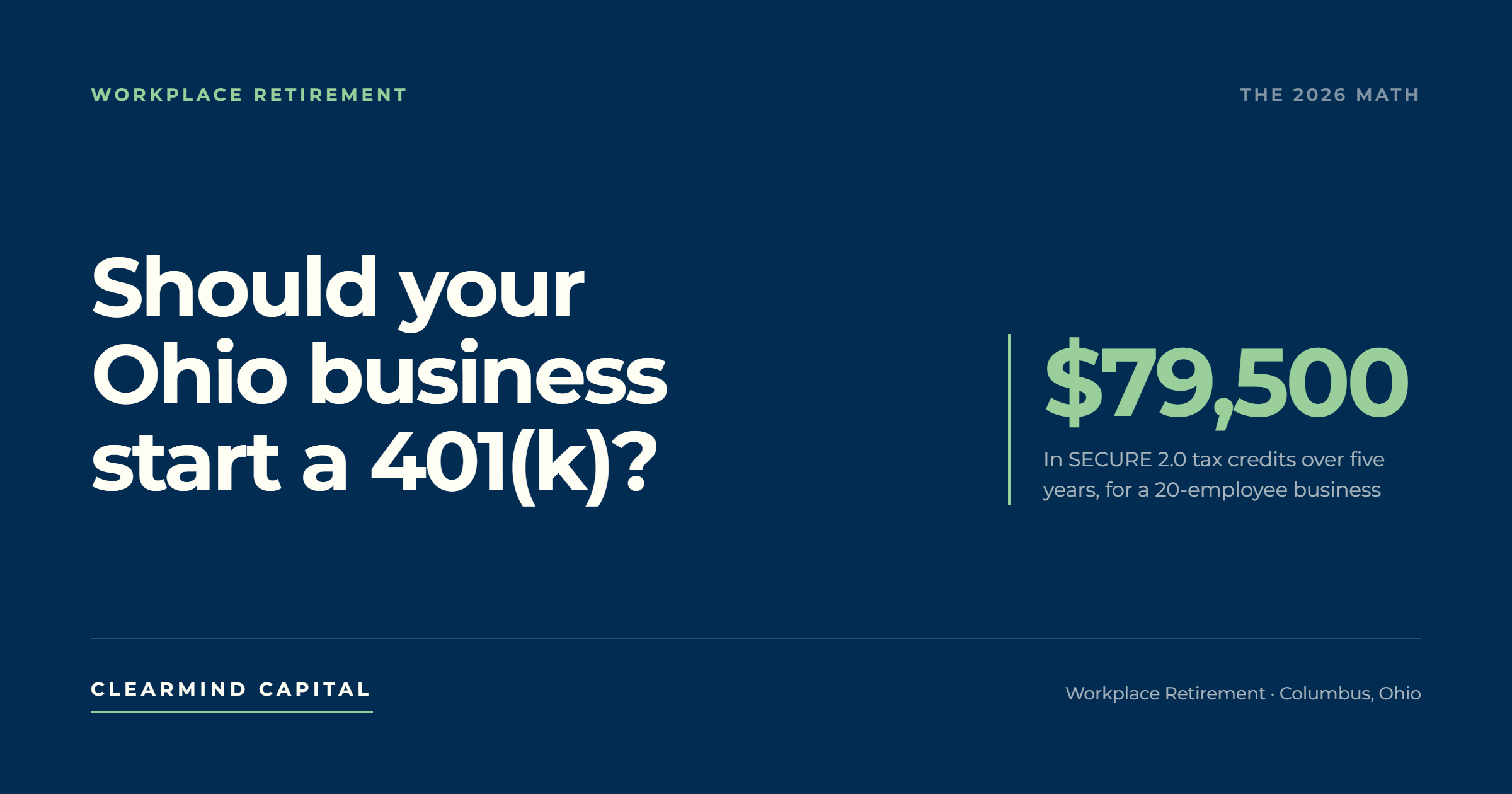
If your business has 50 or fewer employees and has never had a retirement plan, federal tax credits can cover 100% of your startup costs, up to $5,000 a year for three years, plus $500 a year for adding automatic enrollment and up to $1,000 per employee for money you contribute on their behalf. Meanwhile you can personally put away up to $72,000 in 2026 and deduct the employer portion. For a profitable small business, the first few years often cost far less than owners expect.
First, what a 401(k) is
Skip this part if you already know it.
A 401(k) is a retirement savings account your business sets up so employees can save straight out of their paychecks, before taxes come out. Someone earning $70,000 who puts in $7,000 is taxed as if they earned $63,000 that year. The money grows without being taxed along the way, and they pay income tax when they take it out in retirement.
You, the employer, can add money too. A match, where you put in some amount based on what they put in, or profit sharing, where you contribute regardless. Both are deductible business expenses, the same as payroll.
You are not investing anyone's money yourself. A company called a recordkeeper runs the account plumbing, and each employee picks from a menu of investment options. Your job is choosing a good provider and a good menu, then keeping an eye on both.
The three tax credits, and how they stack
A tax credit is better than a deduction. A deduction lowers the income you get taxed on. A credit comes straight off the tax bill itself, dollar for dollar.
A 2022 law called SECURE 2.0 created three of them for small employers starting a plan. They stack on top of each other, and you claim them on IRS Form 8881.
#### Credit 1: Startup costs, up to $5,000 a year for three years
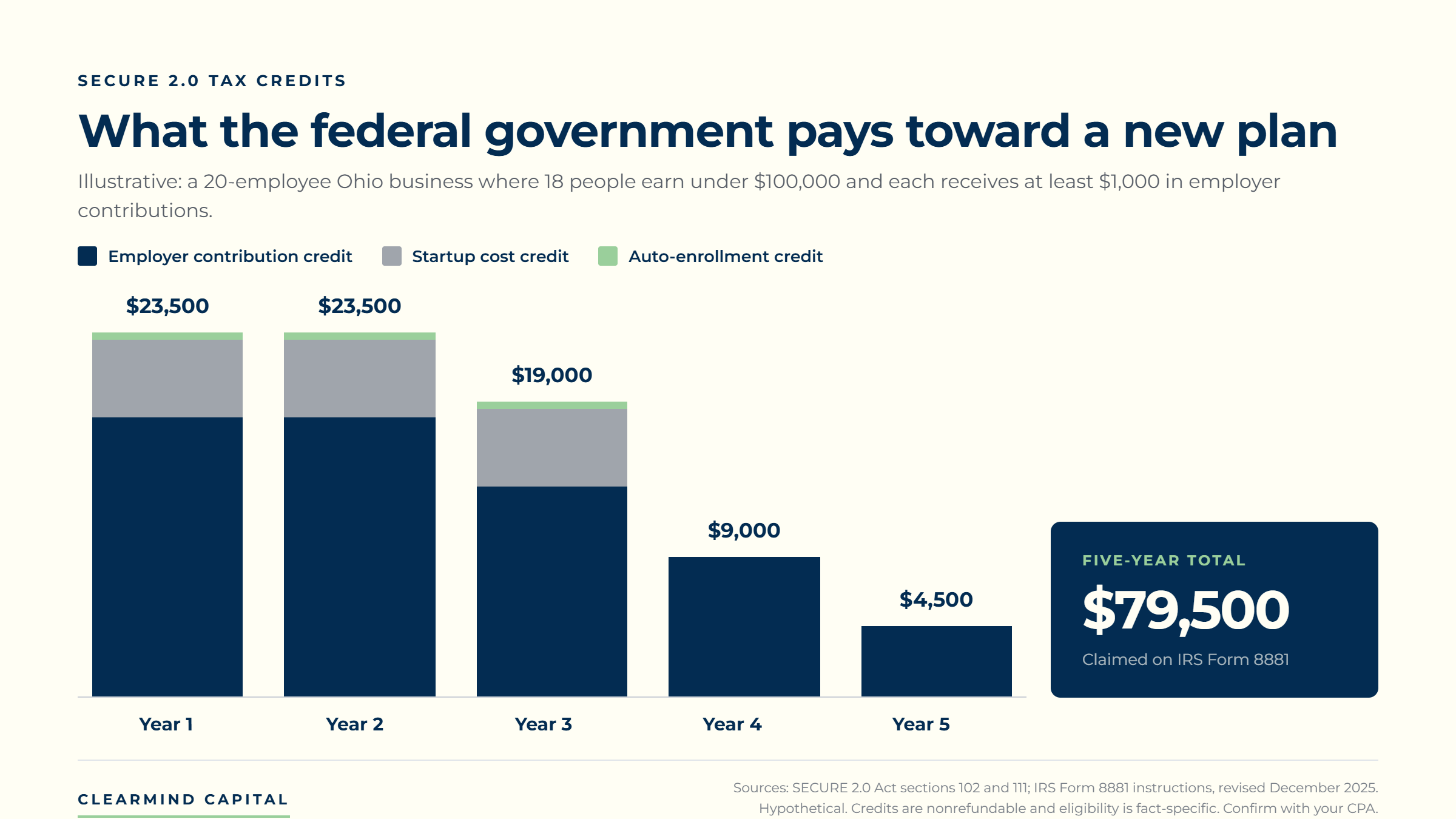
With 50 or fewer employees, this covers 100% of what it costs to get the plan running: setup, administration, and educating your team about it. With 51 to 100 employees, it covers half.
The cap is figured at $250 per rank-and-file employee covered by the plan, so once about 20 of them are in, you are at the full $5,000.
#### Credit 2: Automatic enrollment, $500 a year for three years
Automatic enrollment means new hires are signed up by default at some contribution rate and have to opt out rather than opt in. New plans generally have to do this anyway, and it reliably gets more people saving. The credit is $1,500 total for a setting you were likely turning on regardless.
#### Credit 3: Money you contribute for employees, up to $1,000 each
This is the one owners have usually never heard of. When you contribute for an employee earning $100,000 or less, you can claim a credit of up to $1,000 for that person.
With 50 or fewer employees, it runs at full value for two years, then steps down to 75%, 50%, and 25% before it ends. Employers with 51 to 100 employees get a reduced version.
Put it together for a 20-person company where 18 people earn under $100,000 and you are matching at least $1,000 each: $5,000 for startup, $500 for auto-enrollment, and up to $18,000 for the contributions. That is up to $23,500 in year one.
Two honest caveats. These are nonrefundable credits, meaning they reduce tax you owe but will not generate a refund on their own. And you are not eligible if you sponsored another retirement plan for substantially the same employees in the previous three years. Your CPA should run the real number for your situation before you commit to anything.
What everyone can put away in 2026
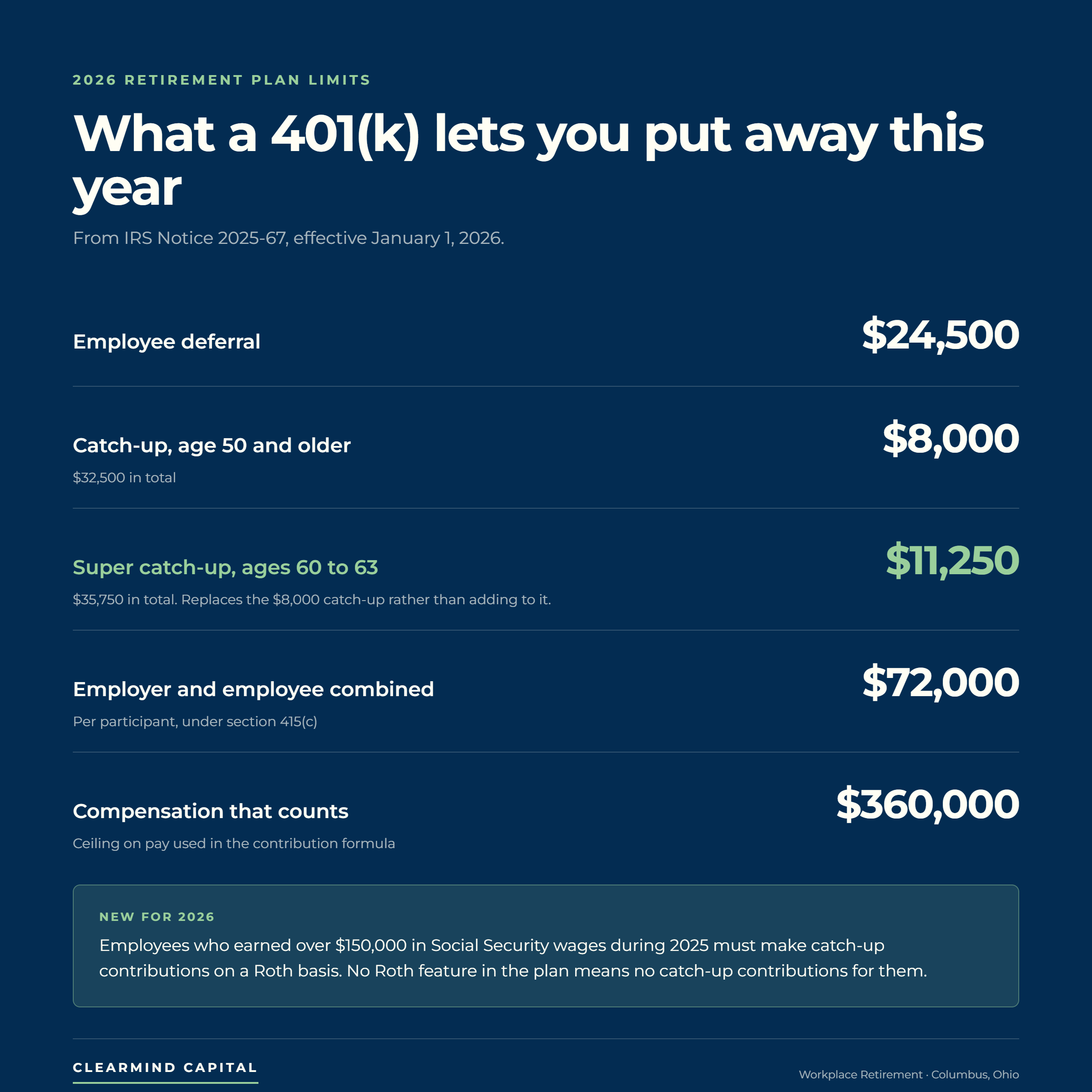
The IRS resets these every year. For 2026:
- $24,500 is what an employee can put in from their own pay.
- $8,000 extra if they are 50 or older, so $32,500 total. This is called a catch-up contribution.
- $11,250 extra for anyone turning 60, 61, 62, or 63 during the year, so $35,750 total. Note that this replaces the $8,000 rather than adding to it.
- $72,000 is the ceiling on everything going into one person's account for the year, their own money plus yours.
- $360,000 is the most pay that can be counted when calculating a match or profit sharing.
One change to raise with your payroll provider now: starting in 2026, employees who earned over $150,000 in Social Security wages during 2025 have to make their catch-up contributions as Roth, meaning after-tax. If your plan does not offer a Roth option, those employees cannot make catch-up contributions at all. Worth a phone call.
What is in it for you personally
This is usually the part that moves the decision, and it deserves to be said plainly: a 401(k) is one of the larger personal tax tools available to a profitable small business owner.
Picture an owner, 52 years old, paying herself $250,000 out of an S corporation that had a good year. She puts in $24,500 of her own pay plus the $8,000 catch-up, so $32,500 comes off her taxable income right away. The company then makes a profit-sharing contribution to her account, deductible to the business, and between the two she can work up toward that $72,000 ceiling.
There is a catch, and it is a real one. The IRS does not let a plan exist mainly to benefit the owner, so it runs an annual check comparing what the owners and highly paid people put in against what everyone else puts in. If the gap is too wide, the plan has to refund money back to the owners. That test is why plan design matters.
Two common ways around it. A safe harbor design skips the test entirely in exchange for you committing to a required contribution for employees, usually around 3% to 4% of pay. A new comparability profit-sharing formula lets you direct a larger share toward owners within limits. Which one fits depends on your payroll and your goals, and it is a decision worth making deliberately rather than accepting whatever the provider defaults to.
What you are signing up to run
Fair is fair. A 401(k) is an ongoing commitment, and here is the honest shape of it.
- An annual compliance test, run by your provider.
- A yearly government filing called a Form 5500.
- Notices that have to go to employees on a schedule.
- Payroll integration that has to be right every single pay period.
- A legal responsibility, called a fiduciary duty, for choosing the investment menu and watching what it costs your employees.
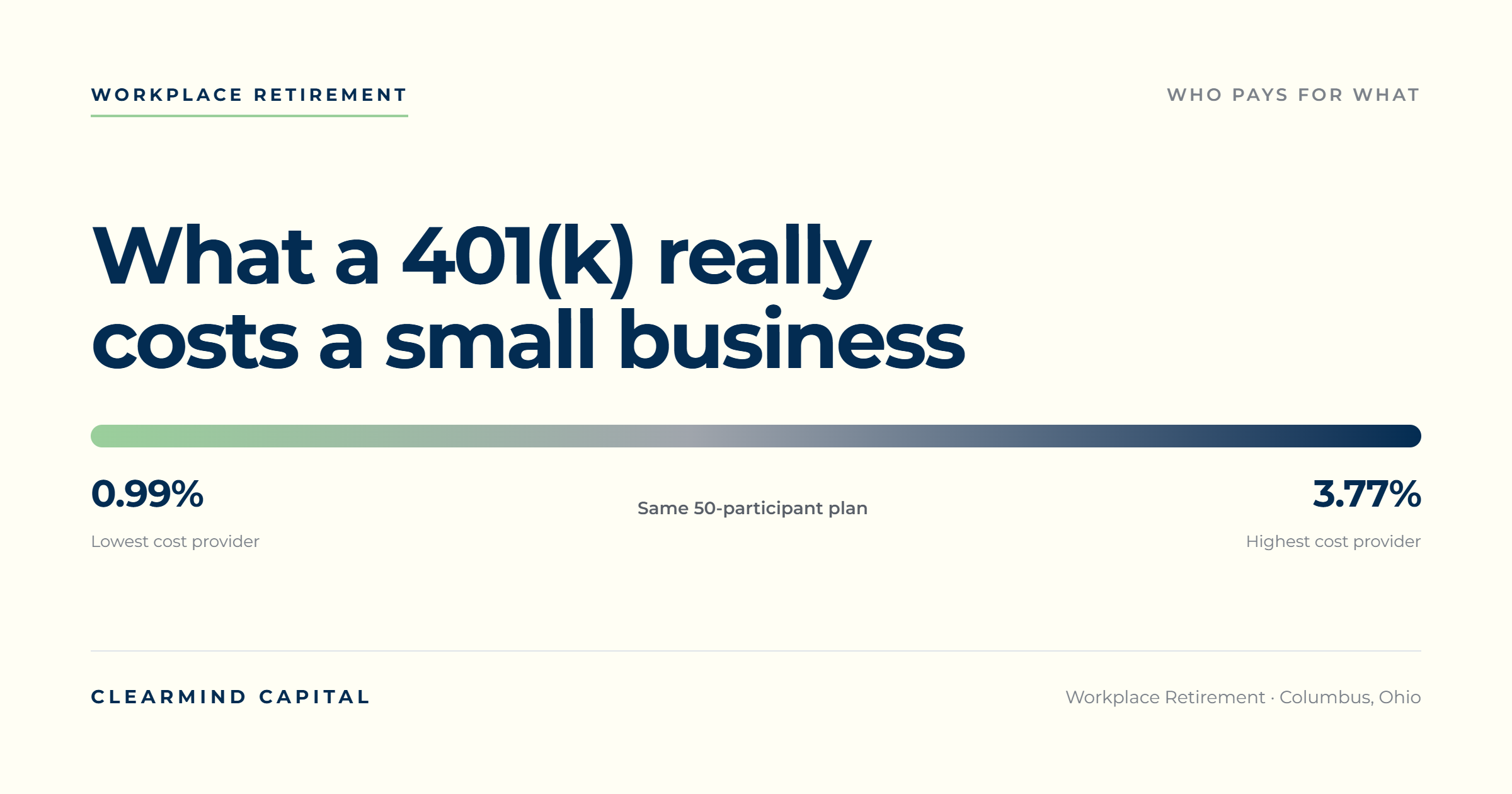
The recordkeeper handles most of the paperwork. That last item is a separate job, and it is where a plan advisor comes in. ++[What a 401(k) Really Costs a Small Business]++
When the answer is no, or not yet
Sometimes it is, and pretending otherwise would be silly.
If cash flow is genuinely tight and you cannot commit to a required employee contribution, a SIMPLE IRA is cheaper and simpler to run. The contribution limits are lower, but it gets people saving and you can graduate to a 401(k) later.
If you have no employees other than yourself and maybe a spouse, a solo 401(k) gives you the same high contribution ceiling with almost no administration and no testing.
The only answer that reliably costs you something is the one where the decision slides another year because nobody sat down and did the arithmetic. That part takes an afternoon. If you want somebody to run it against your actual payroll and employee list, that is what the conversation is for.
Common questions
How much does it cost a small business to start a 401(k)?
Setup typically runs $500 to $3,000 and ongoing administration $1,750 to $5,000 a year for a small plan, though some providers have eliminated setup fees. For a business with 50 or fewer employees starting its first plan, SECURE 2.0 tax credits can cover 100% of qualified startup costs up to $5,000 a year for three years.
What is the 401(k) contribution limit for 2026?
$24,500 for employee contributions. Workers 50 and older can add $8,000, for $32,500. Those turning 60 through 63 during the year can add $11,250 instead, for $35,750. The combined employer and employee ceiling per person is $72,000.
Does a small business have to match employee 401(k) contributions?
No. A match is optional. A safe harbor design, though, requires a set employer contribution in exchange for skipping annual nondiscrimination testing, which is often what lets owners contribute the maximum to their own accounts.
Is a SIMPLE IRA better than a 401(k) for a small business?
A SIMPLE IRA is cheaper and easier to administer, which suits businesses with tight cash flow or very small headcount. A 401(k) allows far higher contributions, more flexible plan design, and access to the SECURE 2.0 startup credits. Many businesses start with a SIMPLE and convert later.
What is the SECURE 2.0 small business tax credit?
Three credits for employers starting a new retirement plan: up to $5,000 a year for three years covering startup costs, $500 a year for three years for adding automatic enrollment, and up to $1,000 per employee earning $100,000 or less for employer contributions. All are claimed on IRS Form 8881 and are nonrefundable.
Sources
- IRS Notice 2025-67, the official notice setting 2026 retirement plan limits, and IRS news release IR-2025-111.
- IRS Instructions for Form 8881 (revised December 2025), the current version governing 2026 filings.
- SECURE 2.0 Act of 2022, sections 102, 111, and 603.
The information presented in this article is for informational purposes and should not be intended as tax, accounting or legal advice, nor is it an offer or solicitation to buy or sell, or as an endorsement of any company, security, fund, or other offering. Please consult your legal, tax, or accounting professional regarding your specific situation. Investments involve risk and have the potential for complete loss. It should not be assumed that any recommendations made will necessarily be profitable.
The opinions expressed in any commentary posted on this site are solely those of the individual author and do not necessarily reflect the views or opinions of ClearMind Capital, LLC. These opinions are based on information available at the time of posting and are subject to change without notice. ClearMind Capital, LLC, does not commit to updating any posted positions or commentary to reflect subsequent developments. While the information and reasoning used to form these opinions are believed to be from reliable sources, ClearMind Capital, LLC, does not verify this information, and no guarantee is provided regarding its accuracy, completeness, or validity. ClearMind Capital, LLC, disclaims any and all liability for actions taken or not taken based on the content of this site. No warranty, express or implied, is given in connection with the content provided.
Certified Financial Planner Board of Standards Center for Financial Planning, Inc. owns and licenses the certification marks CFP®, CERTIFIED FINANCIAL PLANNER®, and CFP® (with plaque design) in the United States to Certified Financial Planner Board of Standards, Inc., which authorizes individuals who successfully complete the organization’s initial and ongoing certification requirements to use the certification marks.