
Start researching financial advisors and you will hit these three words within about four minutes. They sound close enough that people file them in the same drawer.
They describe three different businesses. The fastest way to tell them apart is to stop reading the labels and ask who writes the check.
The short answer
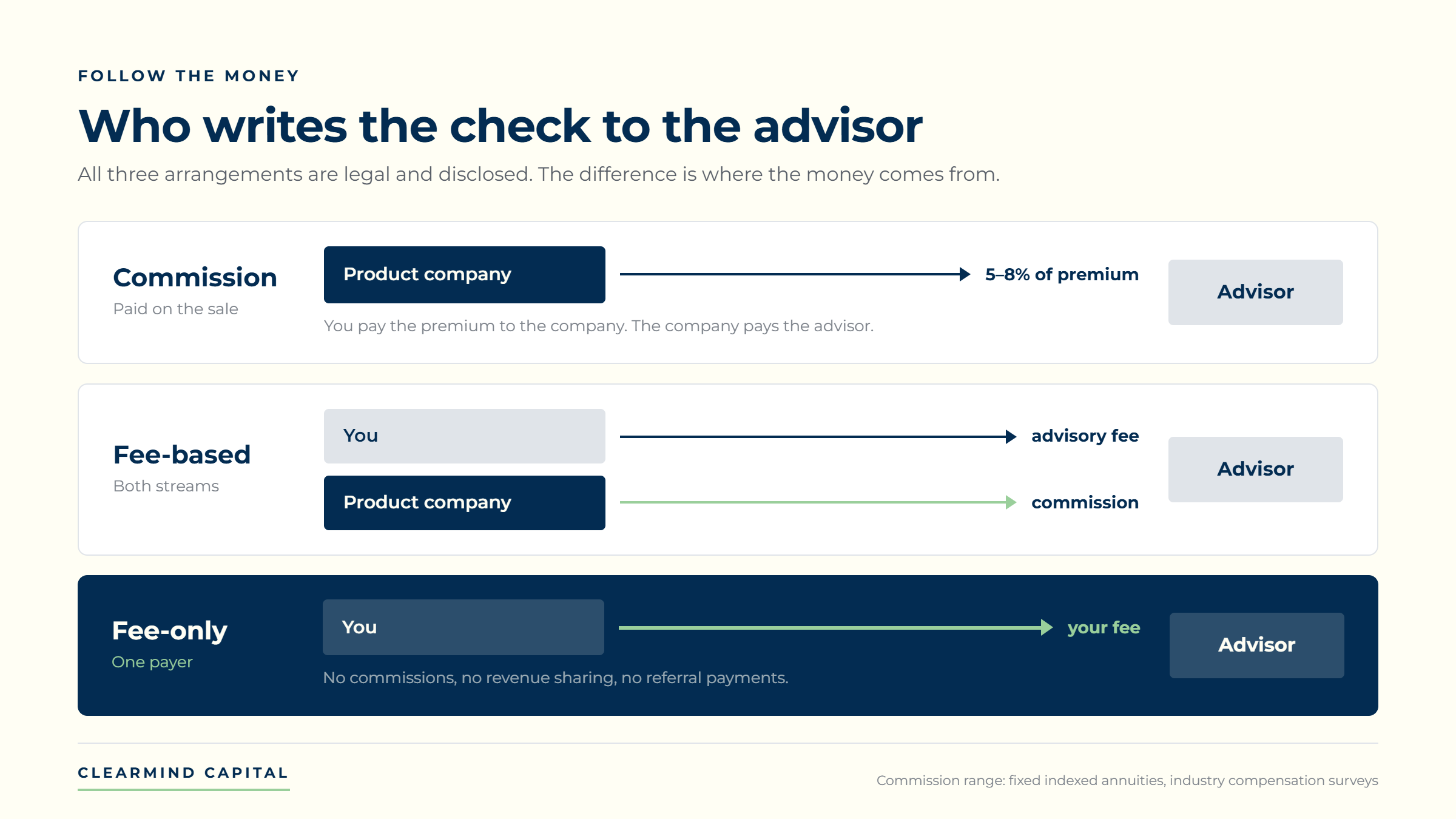
Commission: the product company pays the advisor when you buy something. Fee-based: you pay a fee and the advisor can also earn commissions on certain products. Fee-only: you are the only one paying.
All three are legal, disclosed, and appropriate for someone. The point is knowing which one you are in before you take the advice.
Commission
The advisor is paid by the company whose product you buy. Insurance policies, annuities, and certain mutual fund share classes all carry compensation for whoever placed them.
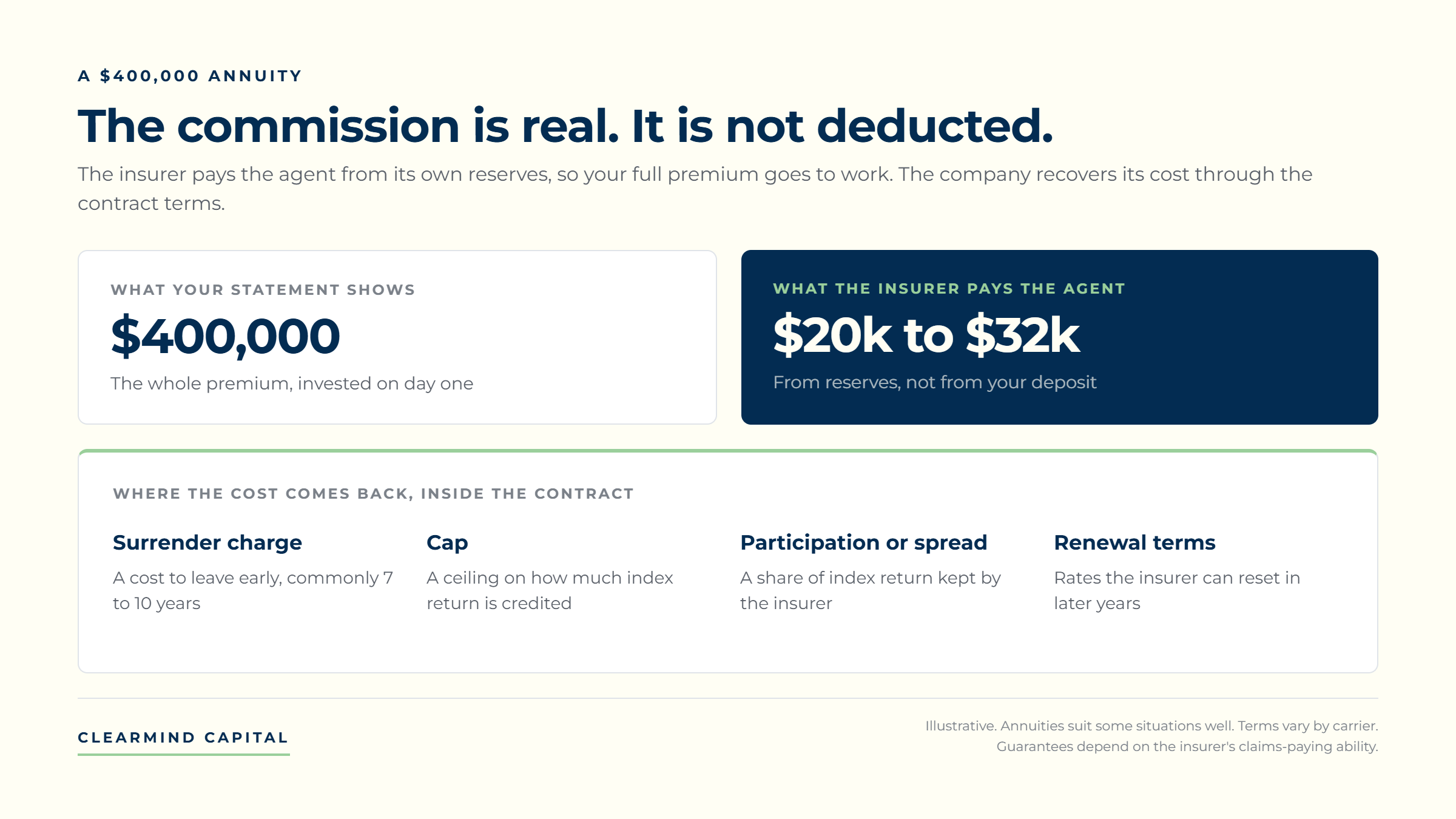
A mutual fund with a 5% front-end load takes five cents of every dollar before the rest gets invested. Commissions on fixed indexed annuities commonly run 5% to 8% of the premium, so on a $400,000 contract the agent's compensation lands somewhere around $20,000 to $32,000.
Now the mechanic that almost everyone gets wrong, including plenty of people in the industry. That commission is not subtracted from your $400,000. The insurance company pays the agent out of its own reserves, and your statement shows the full amount going to work on day one.
So where does it come from? The insurer recovers its cost through the design of the contract: a surrender charge if you leave early, usually running seven to ten years; a cap on how much of the index return gets credited to you; a participation rate or a spread that shaves the upside; and renewal terms the insurer can reset later. None of that appears as a line item. It appears in the return.
That is not a scandal, it is how insurance products are built. Somebody has to be licensed to place a policy, and insurance solves real problems that a portfolio cannot: a term policy for a family with young kids, disability coverage for a surgeon, guaranteed income for someone who genuinely cannot stomach market risk. The commission model exists because those products need distribution.
What you want is to know when you are in a product conversation. That is all.
Fee-based
You pay a fee, usually a percentage of the portfolio, and the advisor can also earn commissions on certain products. This is the dominant arrangement at the large national firms, which means it is what a lot of people already have without having thought about it.
The fee side of the relationship generally behaves like an advisory relationship. The commission side carries the incentives of the commission model. Both streams are disclosed in the firm's Form ADV, so nothing is hidden in any legal sense.
The advantage is real: one person can handle the portfolio and also place the life insurance, instead of you managing two relationships and hoping they talk to each other. The tradeoff is that you carry an ongoing small job, which is noticing when a recommendation happens to come with a commission attached and asking about it. A good fee-based advisor will tell you before you ask.
Fee-only
Client fees are the whole story. A percentage of assets, a flat annual amount, an hourly rate, or a subscription. No commissions, no revenue sharing, no referral payments.
A fee-only advisor can still recommend an annuity when an annuity fits, and will send you to an insurance broker to buy it while earning nothing on the transaction. Some people find that reassuring. Others find it mildly annoying, because now they are dealing with two people.
And fee-only is not conflict-free either. An advisor paid on assets under management earns more when your money stays in the portfolio, which puts a thumb on the scale against paying off a mortgage, buying a rental, or leaving a 401(k) in a cheap employer plan. Different pull, same physics. [Fiduciary and Fee-Only: What They Do Not Solve]
What each one is good at
Rather than ranking them, here is the honest use case for each.
#### Commission works well when
You need a specific insurance product and you know it. Term life, disability, long-term care. The product has to be placed by somebody licensed, the compensation is built into the pricing either way, and paying a separate advisory fee on top of it would cost you more.
Fee-based works well when You want one relationship covering both the portfolio and the insurance, and you would rather have a single point of contact than the theoretically cleaner structure. Plenty of people value that and are right to.
Fee-only works well when The work is mostly planning and portfolio decisions, and you would rather have no product economics in the room at all. It costs you some convenience and buys you a simpler set of incentives to keep track of.
The same $400,000, three conversations
Say you left a job with $400,000 in an old 401(k). Same money, same person, three different offices.
Office one. The recommendation is a fixed indexed annuity. Principal protection, upside linked to an index, guaranteed income available later. All of that is accurate. The contract also carries a surrender schedule, a cap on the index credit, and compensation to the agent in the range described above. If you want guaranteed income and will not need the principal, this can genuinely be the right call. If there is any chance you need liquidity in year four, the surrender schedule becomes your problem and the commission is long since paid.
Office two. A managed portfolio at 1%, so $4,000 a year, plus an annuity for a slice of the balance to cover income later. That may be exactly right. It may also be a nudge toward the piece that pays twice. Both compensation streams are disclosed, so the question is which parts of the recommendation carry a commission and how much. Ask, and a good advisor will tell you.
Office three. Before anything gets recommended, the conversation is about when you need this money, what your other accounts look like, and what your tax picture does over the next five years. The answer might be a diversified portfolio. It might be an annuity bought through a broker who earns the commission while the advisor earns nothing on it. It might be leaving the money in the old plan, which is sometimes correct and never profitable for anybody. [What Happens to Your 401(k) When You Leave a Job]
Three reasonable people could each pick a different office and none of them would be foolish. What separates a good outcome from a bad one is whether the question got asked before the paperwork came out.
The question that sorts it in about eight seconds
"Does anyone besides me pay you in connection with the advice you give me?"
A fee-only advisor says no. A fee-based advisor describes the product lines that pay them. A commission-based professional explains who pays them and roughly how much.
Every one of those is a fine answer. The only bad answer is a vague one, and you will know it when you hear it.
For the record, ours is no. Ask us the follow-up about where our own advice costs us money, though, because that one is more revealing than the first.
Common questions
What does fee-only mean for a financial advisor?
The advisor's entire compensation comes from clients, through a percentage of assets, a flat fee, an hourly rate, or a subscription. They receive no commissions, revenue sharing, or referral payments from product companies.
How much commission does an advisor make on an annuity?
Fixed indexed annuity commissions typically run 5% to 8% of the premium, paid by the insurance company rather than deducted from your deposit. The insurer recovers that cost through surrender charges, caps on index crediting, participation rates or spreads, and renewal rate adjustments.
Is fee-only better than fee-based?
Neither is universally better. Fee-only removes product commissions from the relationship. Fee-based allows one advisor to handle both investments and insurance, which some people prefer. Both structures carry conflicts of interest and both are disclosed in Form ADV. The right fit depends on what you need done.
Do I pay an annuity commission out of my investment?
No, not as a direct deduction. The insurance company pays the agent from its own reserves and your full premium goes into the contract. The cost shows up indirectly in the contract's terms, particularly the surrender charge period and the limits on how much index return gets credited.
How do I find out how my financial advisor is paid?
Ask directly, then confirm it in the firm's Form ADV Part 2A at adviserinfo.sec.gov. Item 5 covers fees and compensation, Item 10 covers outside affiliations such as insurance licensing, and Item 14 covers third-party compensation arrangements.
Sources
- Industry annuity compensation surveys and Annuity.org: fixed indexed annuity commissions of approximately 5% to 8% of premium, paid by the issuing insurer.
- NAIC Suitability in Annuity Transactions Model Regulation, 2020 revision: definitions of cash and non-cash compensation.
- Investment Company Institute, Trends in the Expenses and Fees of Funds, 2025, published March 2026: load share classes and expense ratios.
- SEC Investment Adviser Public Disclosure, adviserinfo.sec.gov: Form ADV Part 2A disclosures.
The information presented in this article is for informational purposes and should not be intended as tax, accounting or legal advice, nor is it an offer or solicitation to buy or sell, or as an endorsement of any company, security, fund, or other offering. Please consult your legal, tax, or accounting professional regarding your specific situation. Investments involve risk and have the potential for complete loss. It should not be assumed that any recommendations made will necessarily be profitable.
The opinions expressed in any commentary posted on this site are solely those of the individual author and do not necessarily reflect the views or opinions of ClearMind Capital, LLC. These opinions are based on information available at the time of posting and are subject to change without notice. ClearMind Capital, LLC, does not commit to updating any posted positions or commentary to reflect subsequent developments. While the information and reasoning used to form these opinions are believed to be from reliable sources, ClearMind Capital, LLC, does not verify this information, and no guarantee is provided regarding its accuracy, completeness, or validity. ClearMind Capital, LLC, disclaims any and all liability for actions taken or not taken based on the content of this site. No warranty, express or implied, is given in connection with the content provided.
Certified Financial Planner Board of Standards Center for Financial Planning, Inc. owns and licenses the certification marks CFP®, CERTIFIED FINANCIAL PLANNER®, and CFP® (with plaque design) in the United States to Certified Financial Planner Board of Standards, Inc., which authorizes individuals who successfully complete the organization’s initial and ongoing certification requirements to use the certification marks.