

Type "financial advisor near me" into Google and you get a map full of pins with almost nothing to tell them apart. Behind those identical-looking pins sit advisors who work in very different ways. Here's what sets the Columbus options apart, and how to cut a list of twenty down to the two or three worth contacting.
What shows up when you search
Central Ohio has a deep bench of financial advisors, which is good but also can add to confusion. One search pulls all three types back at once, stacked on the same map with nothing to separate them.
Independent RIAs are typically smaller, locally owned firms registered with the SEC or the state, held to a fiduciary duty across the relationship, and often, though not always, fee-only. We’re one of these firms.
The local wealth management branch of a national bank or brokerage have branch offices all over the metro. The same advisor, in the same office, can work with you in two different ways, and it can be a little confusing. When they manage your money for an ongoing fee, they're held to a fiduciary standard (like RIAs). When they sell you a product (like a mutual fund or variable annuity) and earn a commission on it, a weaker rule applies. The product just has to be a reasonable fit at the time of the recommendation. Nobody is required to flag which mode they're in. It’s almost like a real estate agent who sometimes represents the buyer and sometimes the seller. You'd want to know which one before you took their advice on a price.
Insurance-based practices are great at protection and longevity planning. Term life, disability, guaranteed income, long-term care... those tools matter. And for certain retirement, estate, and tax situations they're the right call.
With that said, just be careful. Their income comes from commissions on what they sell and larger policies pay larger commissions. All this means is maybe consider either a second opinion or ask the right questions until you have a good understanding.
Some may prefer one over the other. They all have their seat at the table.
How to tell the difference between Financial Advisors
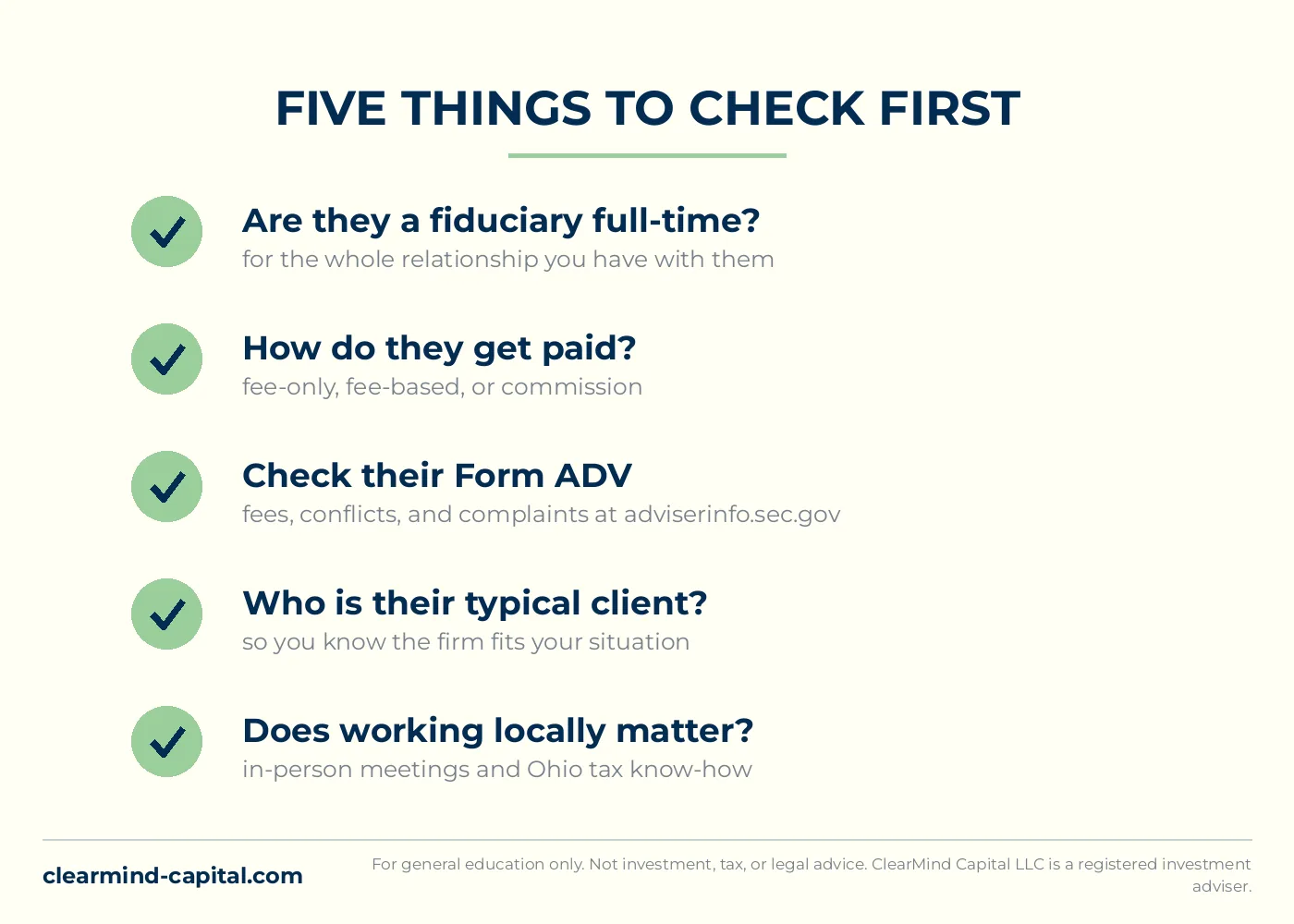
Are they a fiduciary, and is it full-time?
An RIA owes you a fiduciary duty for the whole relationship. A broker working under a rule called Regulation Best Interest owes you something that sounds similar but is narrower, tied to the moment they make a recommendation. Some people are registered as both and move between the two, which is legal and common, and good for you to know. Read: What Does Fiduciary and Fee-Only Mean?
How do they get paid?
Fee-only, fee-based, and commission each carry their own built-in incentives. None of them makes an advisor good or bad on its own, but you want to know which one you're sitting across from. Fee-Only, Fee-Based, or Commission: How to Follow the Money
Look them up at adviserinfo.sec.gov.
Every RIA files a document called Form ADV there, listing fees, conflicts of interest, and any run-ins with regulators. It takes about ten minutes and works for any firm on your list. Brokers have their own version at FINRA's BrokerCheck.
Ask who they usually work with.
A firm that specializes in pre-retirees drawing down a portfolio is solving a different problem than one focused on physicians managing equity compensation, or a firm that mostly works with tech employees.
Decide whether local matters to you
Nowadays, this is certainly a preference call. Plenty of people work happily with an advisor across the country via virtual calls. Others want to sit across an actual table, know the office is a ten-minute drive away, and work with someone who understands the local business and tax landscape, including things like Columbus's own city income tax system or Ohio-specific rules that a national call-center advisor may not think to mention.
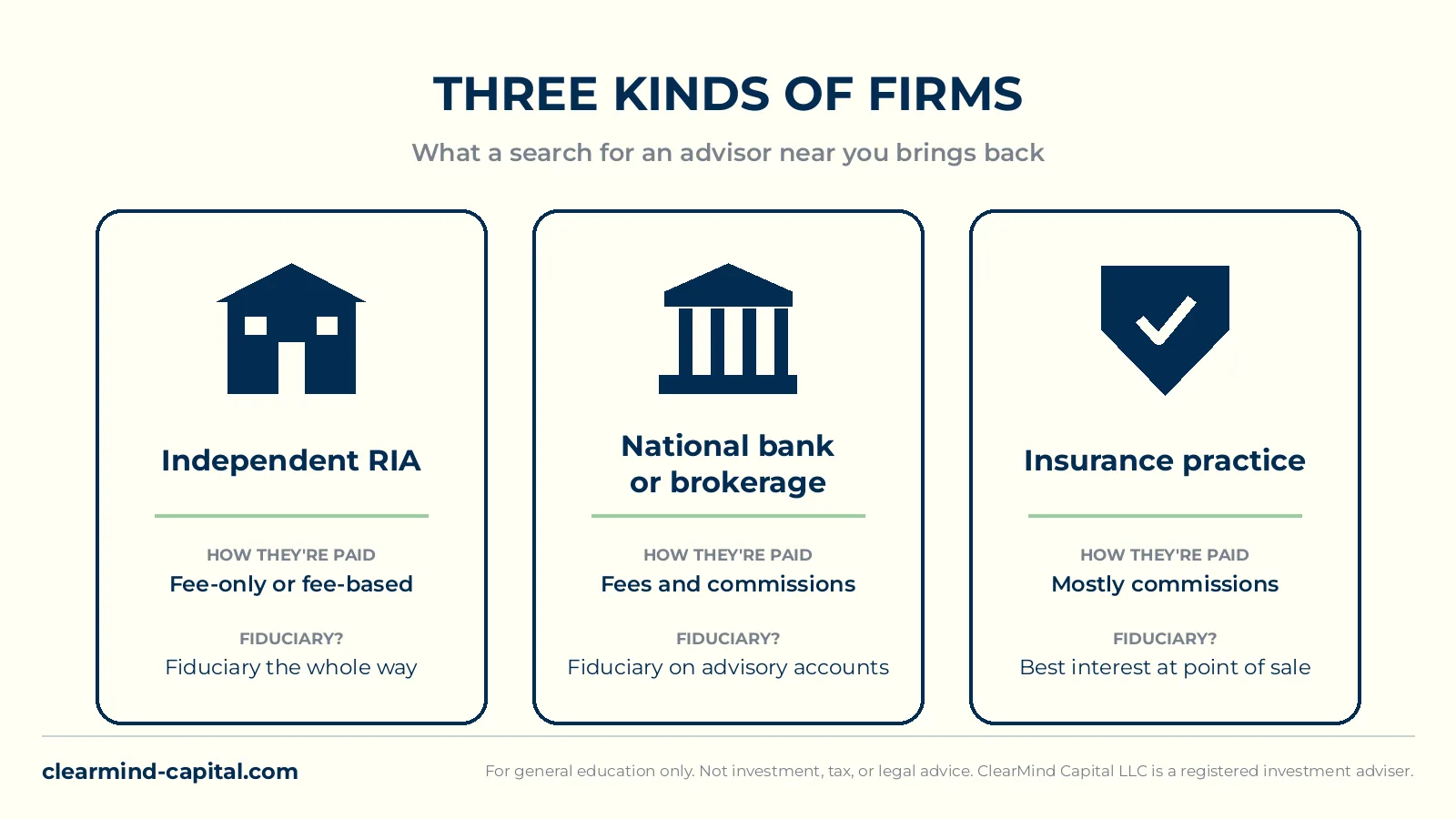
| Type of firm | How they're paid | Fiduciary? | Often best fit for |
|---|---|---|---|
| Independent RIA | Fee-only or fee-based, you pay for advice | Yes, for the whole relationship | People who want ongoing planning and simplified pricing |
| National bank or brokerage branch | Mix of advisory fees and commissions | On advisory accounts, yes; on brokerage accounts, Reg BI | People who want one big-brand shop for everything |
| Insurance-based practice | Mostly product commissions | Best-interest or suitability at the point of sale | People who need a specific insurance product |
What a good first conversation sounds like
A good first meeting, whatever kind of firm it's with, has them asking more questions than you do. What you're working toward, what you've already got in place, what worries you about money, and what you think you might have missed. If a product or a specific recommendation shows up before those questions do, it's usually… a sign.
Read: How Much Does a Financial Advisor Cost in Columbus, Ohio? (2026 Fee Breakdown)
Common questions
What's the difference between a financial advisor and a fiduciary?
"Financial advisor" is a general title with no single legal standard behind it. "Fiduciary" is a specific legal duty to act in the client's interest, owed by registered investment advisers for the full relationship. Brokers work under a narrower, transaction-level standard called Regulation Best Interest.
Should I use a local Columbus advisor or work with someone remote?
Either can work well. Local matters more if in-person meetings, regional knowledge, or Ohio-specific tax and municipal details are important to you. It's a preference question more than a quality question, and plenty of people are happy doing it either way.
How do I verify a financial advisor is legitimate?
Search the firm or the individual at adviserinfo.sec.gov, the SEC's Investment Adviser Public Disclosure database. Read Form ADV Part 2A for the fee structure and conflicts of interest, and check the individual's record for regulatory actions or complaints. FINRA's BrokerCheck covers brokers specifically.
What should I bring to a first meeting with a financial advisor?
Nothing is strictly required for an intro conversation. If it moves into real planning, recent tax returns, account statements, and a rough sense of what you're trying to accomplish will make the conversation far more useful than starting from a blank page.
Do financial advisors near me all charge the same?
No. Fees vary by pay model and by what's included. Some charge a percentage of the assets they manage, some charge a flat or hourly fee, and some are paid through product commissions. The number by itself doesn't tell you what you're getting, so ask what the fee covers beyond investment management.

 Written byNick George & Shane DuckworthClearMind Capital · Private WealthView bio →
- SEC Investment Adviser Public Disclosure (adviserinfo.sec.gov): Form ADV Part 2A structure and content, including fees, conflicts of interest, and disciplinary history.
- Investment Advisers Act of 1940 and the SEC's 2019 Commission Interpretation Regarding Standard of Conduct for Investment Advisers: the fiduciary duty owed by registered investment advisers across the advisory relationship.
- SEC Regulation Best Interest, Rule 15l-1 under the Securities Exchange Act of 1934: the broker-dealer standard of conduct at the time of a recommendation.
- FINRA BrokerCheck (brokercheck.finra.org): broker registration, employment, and disciplinary history.
The information presented in this article is for informational purposes and should not be intended as tax, accounting or legal advice, nor is it an offer or solicitation to buy or sell, or as an endorsement of any company, security, fund, or other offering. Please consult your legal, tax, or accounting professional regarding your specific situation. Investments involve risk and have the potential for complete loss. It should not be assumed that any recommendations made will necessarily be profitable.
The opinions expressed in any commentary posted on this site are solely those of the individual author and do not necessarily reflect the views or opinions of ClearMind Capital, LLC. These opinions are based on information available at the time of posting and are subject to change without notice. ClearMind Capital, LLC, does not commit to updating any posted positions or commentary to reflect subsequent developments. While the information and reasoning used to form these opinions are believed to be from reliable sources, ClearMind Capital, LLC, does not verify this information, and no guarantee is provided regarding its accuracy, completeness, or validity. ClearMind Capital, LLC, disclaims any and all liability for actions taken or not taken based on the content of this site. No warranty, express or implied, is given in connection with the content provided.
Certified Financial Planner Board of Standards Center for Financial Planning, Inc. owns and licenses the certification marks CFP®, CERTIFIED FINANCIAL PLANNER®, and CFP® (with plaque design) in the United States to Certified Financial Planner Board of Standards, Inc., which authorizes individuals who successfully complete the organization’s initial and ongoing certification requirements to use the certification marks.