

If you opened an Ohio 529 for your child, you may be leaving a second $4,000 deduction sitting on the table. Often it belongs to the grandparents.
How the deduction works
CollegeAdvantage is Ohio's state-sponsored 529 education savings plan. When you put money into it, you get a specific state tax break: up to $4,000 per child, every year, comes straight off your Ohio taxable income. This is completely separate from your federal taxes, since 529 contributions are never deductible on a federal return, no matter what state you live in.
A couple of details usually trip people up here. First, a married couple counts as a single giver on their taxes. If you and your spouse file a joint return and both put money toward the same child, your household cap is still $4,000 for that child, not $8,000. But that limit multiplies with each child you have. If you have three kids, you can deduct up to $4,000 for each of them, which means a $12,000 total deduction for your household.
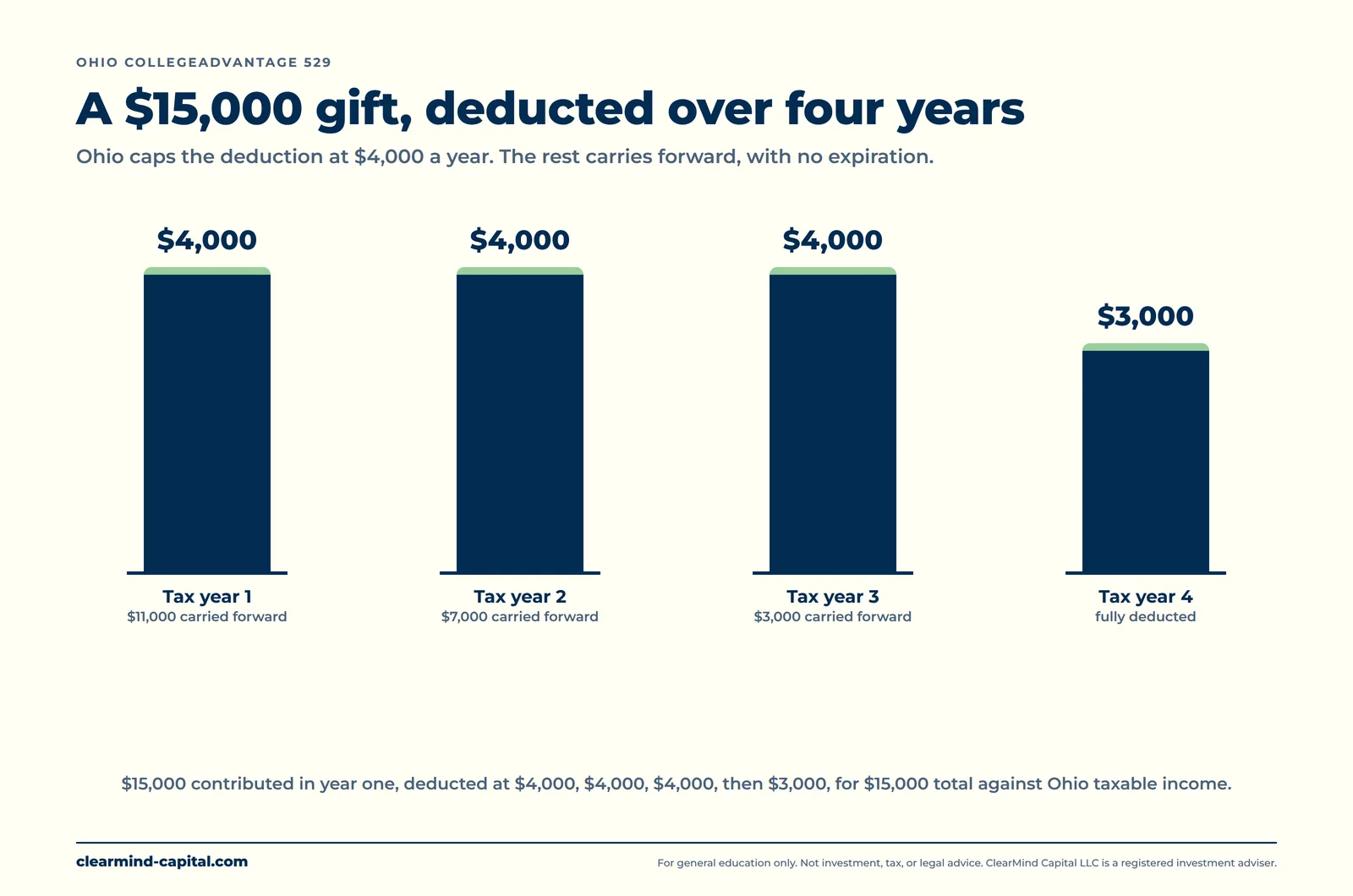
It is also not a use-it-or-lose-it deal. If you drop $15,000 into a newborn's plan all at once, you deduct $4,000 this year. The state then lets you save the remaining $11,000 to use on future tax returns, letting you chip away at it by claiming $4,000 a year until it runs out. There is no expiration date on those saved dollars. This is a huge perk for a grandparent writing one big check, or a parent who wants to front-load the savings early on instead of contributing a little bit at a time.
Who can claim it
Any Ohio taxpayer who puts money into an Ohio 529 CollegeAdvantage account can claim the deduction on their own Ohio return, whether they actually own the account or are even the child's parent. This rule gets missed constantly.
Grandparents are often in a great spot to use this because as we all know... grandparents love spoiling their grandchildren. If a grandparent gives money to a grandchild's account, either by opening one themselves or by contributing to an account the parents already set up, they get their own $4,000 deduction on their state taxes. The exact same thing applies to an aunt, an uncle, or literally anyone else who decides to chip in
Essentially, a single child can trigger this tax break multiple times for the family. The only requirement is that each person or married couple giving the money must file their own separate Ohio tax return and make their own contribution.
Now that we know how the deduction works, we can all agree it isn't the primary reason to open one of these accounts. The real prize is the tax-free growth on your money over the next 10 or 18 years.
What the money can be used for
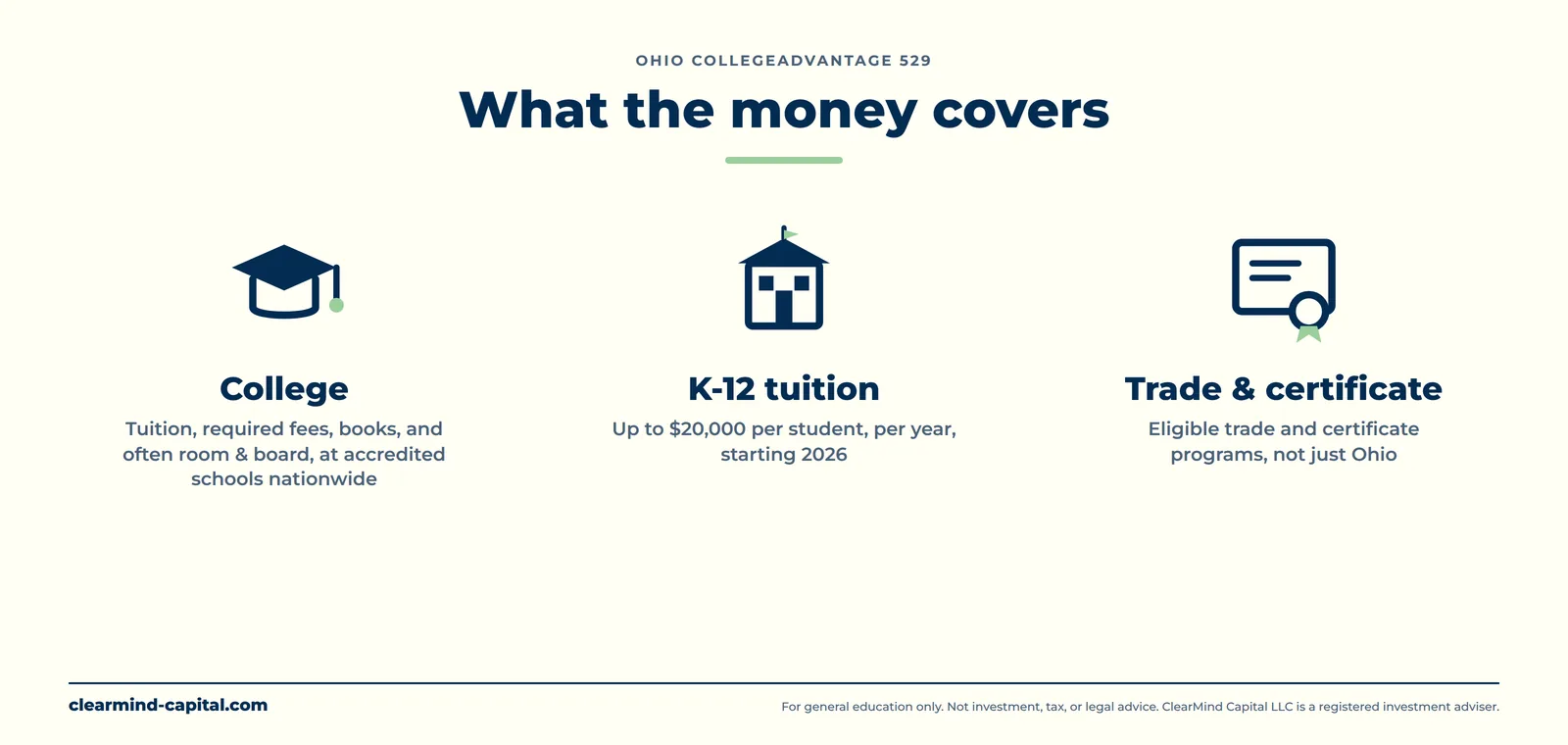
Ohio CollegeAdvantage 529 money covers higher education costs at accredited colleges, universities, and trade or certificate programs nationwide, not just Ohio schools. Tuition, required fees, books, and in many cases room and board come out completely tax-free at both the federal and state level.
It also works for K-12. Starting in 2026, federal rules let you use up to $20,000 per student, every year for K-12, which doubles the old $10,000 cap. The list of eligible K-12 costs now reaches way past tuition to things like books, school materials, tutoring, testing fees, and educational therapies for students with disabilities. Ohio treats these K-12 withdrawals as tax-free too, though it is always worth double-checking your own situation before assuming a K-12 withdrawal lands exactly like a college one on your state return.
Unused money is not stuck either. You can switch the account to another eligible family member with zero penalty. If savings are set aside for one child who lands a full ride or skips college, you can easily move that money to a sibling, a cousin, or even keep it in the account and eventually transfer it to their future children.
Plus, under the SECURE 2.0 Act, you can now roll unused 529 money into a Roth IRA for your child, up to a $35,000 lifetime limit. The account just needs to be open for at least 15 years, and the transfer has to follow normal yearly Roth IRA contribution limits.
What if the Ohio 529 isn't used for school?
This is the question everyone asks, and the answer is friendlier than you might think.
Say you pull money out and spend it on a car, not tuition... well your own contributions come back out tax-free and penalty-free, always. Only the earnings, the growth on top, get taxed, plus a 10% federal penalty on that growth. This image can be helpful.
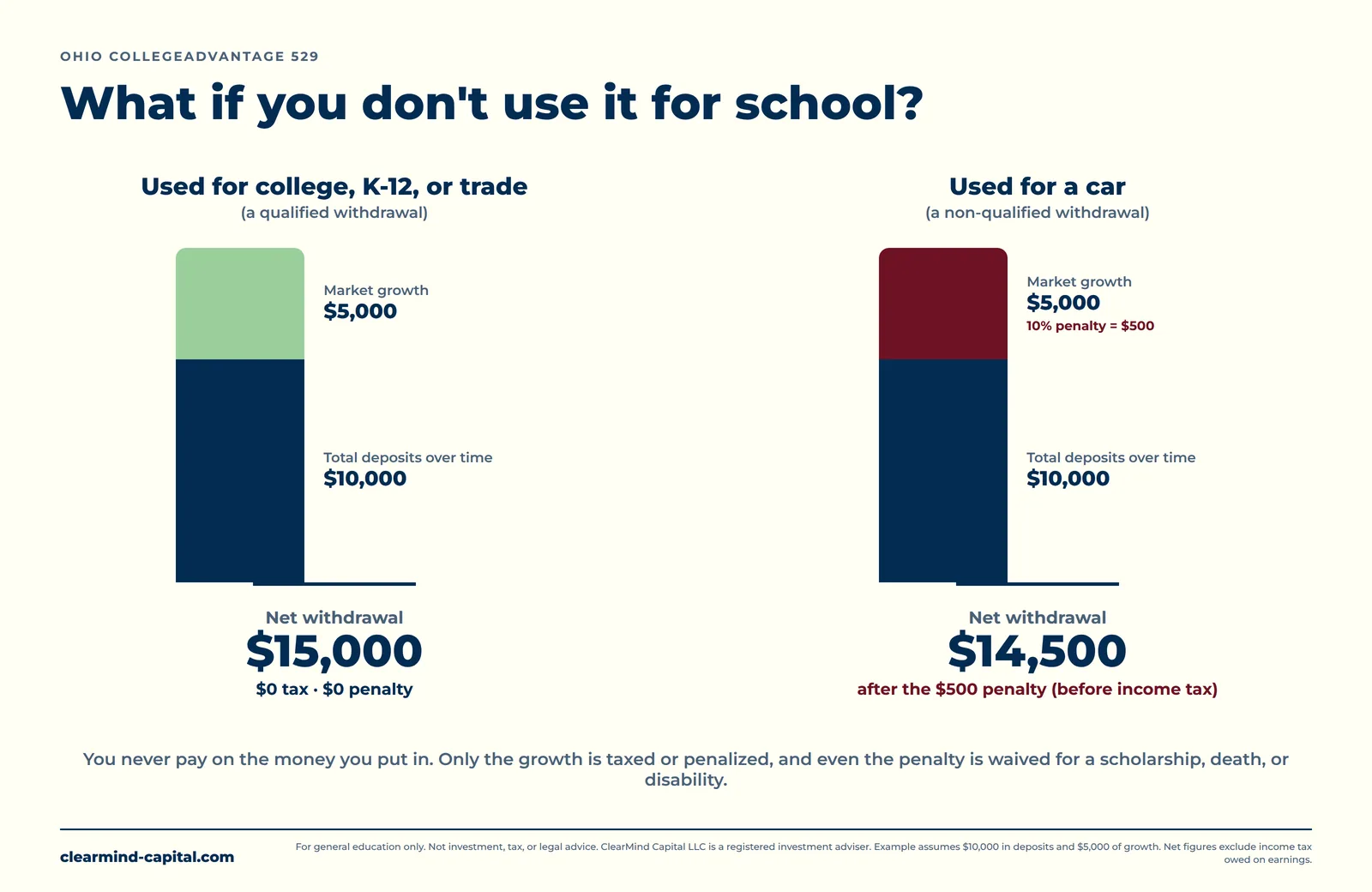
So if you take out $15,000 from an account where you originally put in $10,000, you only owe that 10% penalty on the $5,000 of growth. That is $500, plus normal income tax on those earnings. You do not pay a penalty on the entire $15,000.
On top of that, the federal penalty gets completely waived in a few situations, like if your child wins a scholarship, since you can pull out cash up to the exact amount of the award without a penalty (taxes still apply though... because of course). When you combine those waivers with options like passing the account to another relative or rolling up to $35,000 into your child's Roth IRA, a 529 becomes far less of a trap than people fear.
The specific Ohio rule to remember here is that if you previously took a state tax deduction for that money, Ohio will require you to add those original contributions back onto your state tax return as income for the year you pull the money out for non-school purposes. I know I know... tough one to remember but now you know.
Where this fits into a bigger plan
For many families, the main question tends to be how much to put in these accounts versus retirement and everything else fighting for your dollars.
Every family handles this balance differently. Some people choose to prioritize their own retirement accounts first to secure employer matching funds, knowing you can borrow for college but you can't borrow for retirement. Others choose to prioritize college savings because keeping their kids out of student debt is their primary objective.
Ultimately, finding the right amount to put away depends on your timeline, how much of the future bill you actually want to cover, and how you plan to handle the rest. No rule says a family has to fund 100% of college through a 529 plan anyway. Plenty of solid strategies purposefully target just a specific slice of the cost, leaving room for current income, scholarships, financial aid, or having the student pitch in down the road. It can be helpful to brainstorm this conversation with a professional who can break it down more simply. So you can make the best decision for your family.
How to open a Ohio 529 CollegeAdvantage Account
This takes about 10 minutes online at collegeadvantage.com.
- Have your info and the child's ready. Your Social Security number, plus the child's name, birth date, and Social Security number. You need to be 18 or older, a U.S. citizen or resident, with a U.S. address.
- Choose how to invest the money. The easiest route is choosing a ready-made "set-it-and-forget-it" mix based on your child's age. The plan automatically handles the investments for you, taking bigger growth risks while your child is young and steadily moving the money into safer options as college approaches. If you prefer a do-it-yourself approach, you can manually build your own mix from a menu of individual funds, or ask us for some help.
- Fund it. Just $25 gets you started. You can link your bank account for a quick one-time deposit or set up a recurring contribution (recommended).
- Claim the deduction at tax time. Keep your contribution records and enter them on your state tax return to lower your Ohio taxable income by up to $4,000 per child, with any extra savings holding over for future years.
Common questions
Is it CollegeAdvantage or BlackRock?
Both, sort of... it's a little confusing.
The Ohio 529 CollegeAdvantage comes in two versions. The Direct Plan is the do-it-yourself one you open yourself online. The Advisor Plan, run by BlackRock, is the same CollegeAdvantage program, but you can only open it through a financial advisor, and advisor compensation is built into its pricing.
How much can I deduct for CollegeAdvantage 529 account contributions on my Ohio taxes?
You can write off up to $4,000 per child, every year, straight from your Ohio taxable income, regardless of your tax filing status. If you put in more than $4,000 for a child in a single year, the state lets you save those extra dollars to claim on future tax returns with no expiration date.
Can grandparents deduct 529 contributions in Ohio?
Yes. Any Ohio taxpayer who puts money into a CollegeAdvantage account can claim up to a $4,000 deduction per child on their own state return. This is entirely separate from, and on top of, whatever the parents are separately writing off for that same child.
Is the $4,000 limit per account or per child?
The limit is per child. If you open multiple accounts for the same child, or if several people put money into one account, your personal household deduction cannot go over $4,000 for that child in a single year. However, each separate person or married couple giving the money gets their own unique $4,000 limit per child.
What happens to unused Ohio 529 CollegeAdvantage funds?
You can switch the account to another eligible relative with zero tax consequences. Federal rules also let you roll unused money into a Roth IRA for your child, up to a $35,000 lifetime limit, as long as the account has been open for at least 15 years and you follow annual Roth IRA contribution rules.
Is there a penalty if I don't use the money for school?
You only pay a penalty on the growth, never on the cash you originally put in. The earnings are taxed as regular income plus a 10% federal penalty. However, that 10% penalty is waived completely if your child wins a scholarship, or in the case of death or disability. You can also avoid penalties entirely by passing the account to another relative or moving up to $35,000 into a Roth IRA. Just keep in mind that Ohio will require you to add your original deductions back onto your state tax return as income for the year you withdraw the money.
Can CollegeAdvantage be used outside Ohio?
Yes. The money works at accredited colleges, universities, and eligible trade or certificate programs nationwide. While the upfront tax write-off only benefits Ohio taxpayers, the student can go to school anywhere in the country.
How do I open an Ohio 529 plan?
You can open the Ohio 529 CollegeAdvantage Direct Plan online at collegeadvantage.com in about 10 minutes. You just need a U.S. address, your Social Security number, and the child's Social Security number. It takes just $25 to start, at which point you can link a bank account and pick a ready-made investment option.

 Written byNick George & Shane DuckworthClearMind Capital · Private WealthView bio →
- Ohio CollegeAdvantage (collegeadvantage.com): $4,000 per-beneficiary deduction with unlimited carryforward, K-12 and qualified-expense guidance, the Direct and BlackRock Advisor plan structure, and the $25 minimum to open a Direct Plan account, 2026.
- Ohio Department of Taxation (tax.ohio.gov): Ohio individual income tax rates and the treatment of 529 contribution deductions.
- One Big Beautiful Bill Act (2025): increase of the annual 529 K-12 limit to $20,000 and expansion of qualified K-12 expenses, effective 2026.
- Internal Revenue Code Section 529 and the SECURE 2.0 Act of 2022, Section 126: 529-to-Roth IRA rollover, including the $35,000 lifetime limit and 15-year account requirement.
- Ohio CollegeAdvantage (collegeadvantage.com) and Internal Revenue Code Section 529(c)(6): non-qualified withdrawals, where the earnings portion is subject to federal income tax and a 10% federal penalty, and the scholarship, death, and disability exceptions to the penalty.
The information presented in this article is for informational purposes and should not be intended as tax, accounting or legal advice, nor is it an offer or solicitation to buy or sell, or as an endorsement of any company, security, fund, or other offering. Please consult your legal, tax, or accounting professional regarding your specific situation. Investments involve risk and have the potential for complete loss. It should not be assumed that any recommendations made will necessarily be profitable.
The opinions expressed in any commentary posted on this site are solely those of the individual author and do not necessarily reflect the views or opinions of ClearMind Capital, LLC. These opinions are based on information available at the time of posting and are subject to change without notice. ClearMind Capital, LLC, does not commit to updating any posted positions or commentary to reflect subsequent developments. While the information and reasoning used to form these opinions are believed to be from reliable sources, ClearMind Capital, LLC, does not verify this information, and no guarantee is provided regarding its accuracy, completeness, or validity. ClearMind Capital, LLC, disclaims any and all liability for actions taken or not taken based on the content of this site. No warranty, express or implied, is given in connection with the content provided.
Certified Financial Planner Board of Standards Center for Financial Planning, Inc. owns and licenses the certification marks CFP®, CERTIFIED FINANCIAL PLANNER®, and CFP® (with plaque design) in the United States to Certified Financial Planner Board of Standards, Inc., which authorizes individuals who successfully complete the organization’s initial and ongoing certification requirements to use the certification marks.