
Nobody just wakes up and decides to fire their financial advisor.
What actually happens is quieter. A year goes by, then another. Statements arrive. A meeting gets scheduled and rescheduled. Somewhere in there you stop being able to say what the relationship is doing for you, and asking now would feel like an accusation. Nothing is wrong. Nothing is especially right either.
Most advisors are working hard for the people who hired them, and moving accounts is a genuine hassle that nobody should take on for a bad quarter. Treat it as a clarity check instead. Five things worth looking at, what a good version looks like, and an honest read on whether what you found is a conversation or a decision.
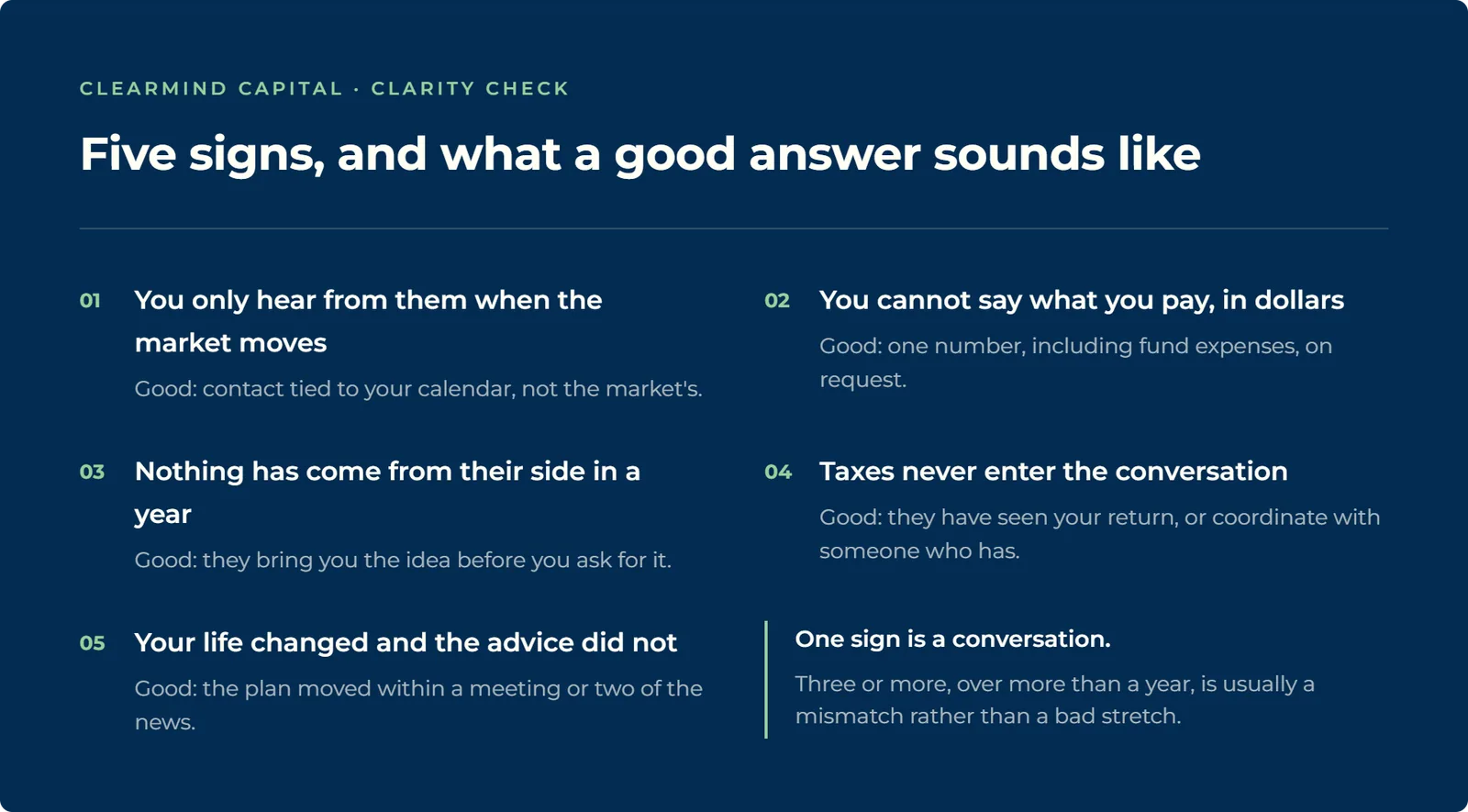
Figure 1. The five-point clarity check for an existing advisor relationship: communication, cost, proactive planning, tax coordination, and whether the advice kept pace with your life.
1. You only hear from them when the market moves
Reactive communication is the most common version of drift. The market drops 10%, an email goes out to everybody with the same three paragraphs about staying the course. That email is fine. It is also not about you.
The thing to look for is contact tied to your calendar rather than the market's. A note in October about whether to make the Roth conversion this year or next. A call when your company announces a vesting change. A check-in before the December deadline for anything that has a December deadline.
There is also the question of who picks up. You hired a person. If every message now routes to a service team and you have not spoken to your advisor in eighteen months, that is worth naming out loud, because sometimes it is a staffing change nobody told you about and sometimes it is a book that grew past what one person can carry.
Worth asking
"What would make you call me between scheduled meetings?"
2. You cannot say what you pay, in dollars
Try it right now, before you look anything up. What did you pay your advisor last year? Not the percentage. The dollars.
Most people cannot answer, and it is not their fault. The advisory fee is deducted from the account and that's what they know. Underneath the fee, the funds carry their own expense ratios that come out of returns and never appear on a statement line. There may be a platform fee. If any part of the relationship runs through commissions, that compensation sits somewhere else again.
None of those layers is automatically a problem. Paying more for real planning work is often the better deal. What matters is that you know the number and know what it buys. If asking for it produces a percentage and a change of subject twice in a row, that is the sign, not the cost itself.
You can check most of it yourself. Every registered investment adviser files a public Form ADV at ++adviserinfo.sec.gov++. Part 2A, Item 5 describes how the firm is paid and whether anyone other than clients pays them. Item 10 lists insurance and brokerage affiliations. That is a ten-minute read, and it is written in plain language by rule.
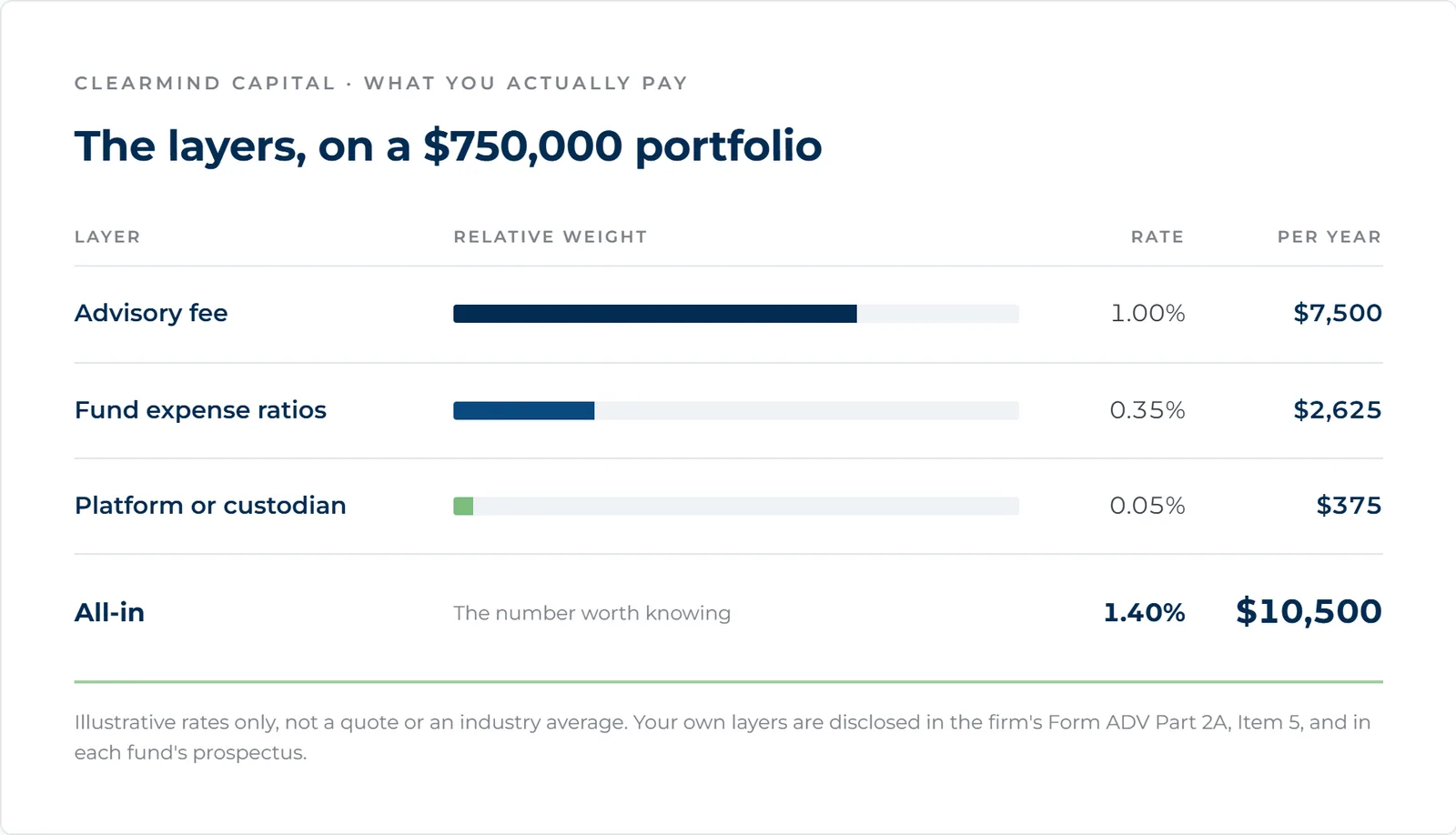
Figure 2. The layers of advisory cost on an illustrative $750,000 portfolio: the advisory fee, the fund expense ratios underneath it, and any platform charge, expressed as one all-in dollar figure.
3. Nothing proactive has come from their side in a year
Think back over the last twelve months and count the ideas that arrived without you asking. Not market commentary. Ideas about your situation.
A beneficiary designation that still names someone from a previous life chapter. An old 401(k) from two jobs ago that nobody has looked at. Cash sitting in a checking account earning nothing while it waits for a decision you have not made. A recommendation to convert less this year because of what it would do to your Medicare premium two years out.
If the count is zero, the relationship may be an investment-management relationship. That is a legitimate service, competently delivered by a lot of good people, but it is priced surprisingly close to comprehensive planning. The question is whether it is what you thought you were buying.
Worth asking
"What does our review meeting look like three years from now?"
If the answer is entirely about performance against a benchmark, you have learned something useful.
4. Taxes never enter the conversation
Most investment decisions are tax decisions wearing a costume. Which account you draw from in retirement is a tax question. Whether to convert to Roth this year is a tax question. When to sell vested shares is a tax question. When to claim Social Security is, largely, a tax question.
Some advisors are hired for the portfolio alone and do that job well, with your CPA handling the rest. That works when the two of them actually speak. It stops working when nobody owns the coordination and both assume the other did.
A simple test: has anyone on your advisory team ever asked to see your tax return? If the answer is no after several years, the tax side of your plan is being handled by whoever files the return in April, which is a look backward at a year that is already closed. Taxes need to be approached proactively, not reactively.
5. Your life changed and the advice did not
You sold the business. You got divorced. Your income doubled. A parent died and left you an inherited IRA with a ten-year clock on it. You decided you want out at 58 instead of 65.
Then look at what happened to the plan afterward. If the allocation, the savings targets, and the meeting agenda are the same as they were before the news, the plan is a document rather than a practice.
This is the sign that matters most, because it is the whole job. Money is a tool for a life you described out loud. When the life changes and the tool does not, the relationship has quietly become account maintenance.
Four things that are not red flags
Fairness matters here, so it is worth naming what does not belong on this list.
- A down year. Diversified portfolios lose money sometimes. An advisor who prevented that would be doing something else for a living.
- Being told no. An advisor who talks you out of something is often the one earning their fee, especially when saying no costs them money.
- Trailing a friend's returns. Different portfolio, different risk, different timeline, and you are hearing about the good year rather than the average one.
- A fee that rose with your balance. That is how a percentage works. Whether the work grew alongside it is the real question.
Raise it before you leave
A surprising number of these gaps close with one honest meeting. Advisors are not mind readers, and plenty of drift comes from a client who never said what they wanted the relationship to be.
The email can be four sentences. Something like: "I would like to spend our next meeting on the relationship rather than the portfolio. I want to understand what I am paying all in, what is included beyond investment management, and how tax planning fits. Can we set aside an hour?"
Then listen to the reaction as much as the answer. Someone secure in their work will welcome that meeting and come prepared. Defensiveness, delay, or a fee explanation you still cannot repeat afterward tells you what a second year would look like.
If it is time, switching is less dramatic than it sounds
People stay in relationships that stopped working because they imagine liquidating everything, triggering a tax bill, and having an uncomfortable phone call. The first two are usually avoidable. The third one you can skip entirely if you want.
Accounts generally move in kind, meaning the holdings transfer as they are rather than being sold, so a taxable account does not have to realize gains just because the advisor changed. Transfers between brokerage firms run through an automated system with a defined timeline, and the new firm handles the paperwork, including notifying the old one. There are details worth checking first, and they are small.
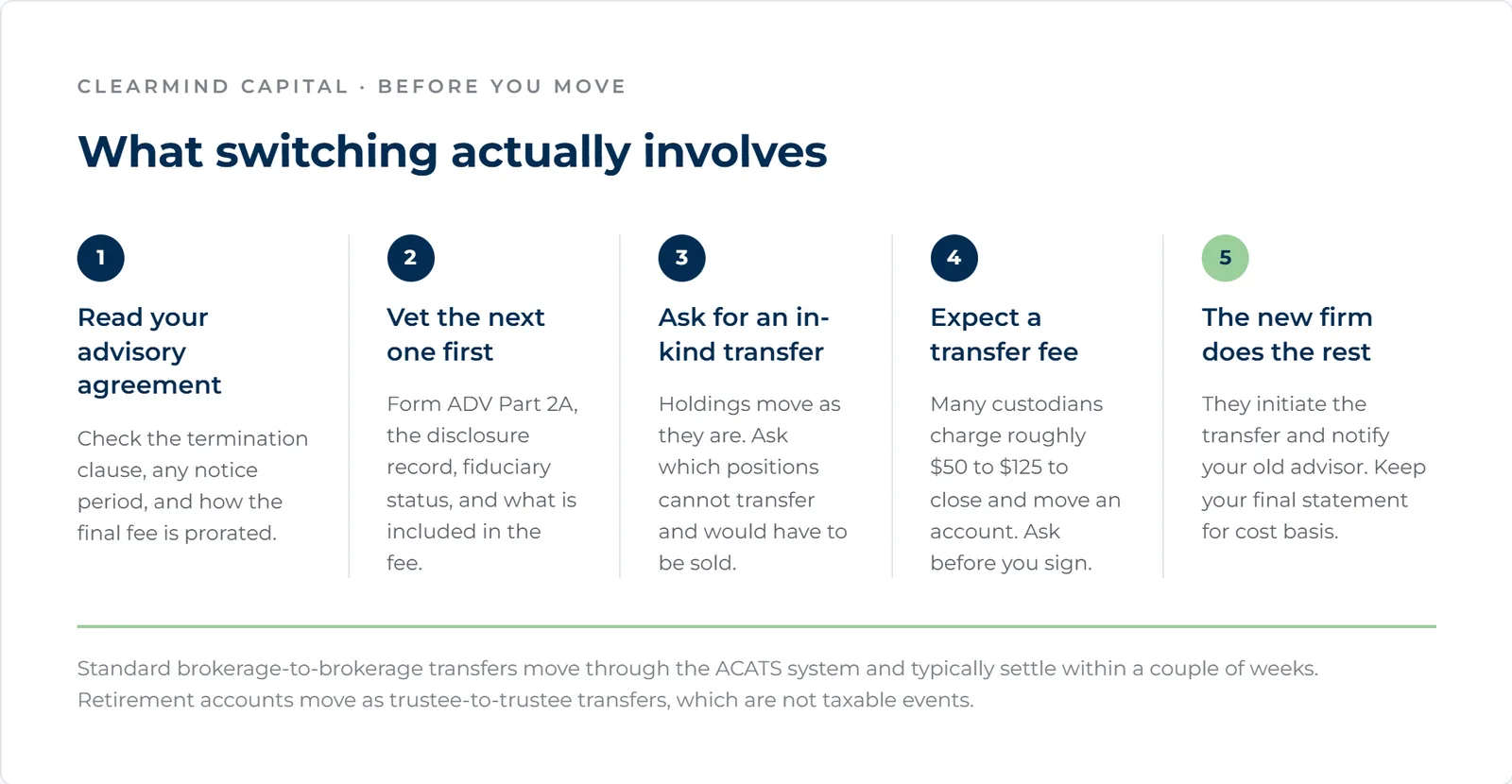
Figure 3. The five practical steps of changing advisors: reviewing your agreement, vetting the next firm, requesting an in-kind transfer, budgeting for account transfer fees, and letting the receiving firm handle the paperwork.
The standard worth holding out for
Fiduciary duty and a fee-only structure set a floor. They are quick to confirm and they matter, and they are the easy part. Two advisors can both be fiduciaries, both be fee-only, and deliver completely different work.
One version manages the accounts competently and reports on them quarterly, forever. Everything promised gets delivered. The other version notices the stale beneficiary designation, asks to see the tax return, gives you the honest answer about the rental property even though the honest answer costs them money, and asks what you want the next ten years to look like before recommending anything.
That second version is what you are actually choosing. If the clarity check turned up more than one gap and the conversation did not close it, you are allowed to go find it.
Common questions
How do I know when to switch financial advisors?
Look for a pattern rather than a single incident: communication only when markets move, a cost you cannot state in dollars, no proactive planning ideas in a year, no tax coordination, and advice that did not change when your life did. One of those is a conversation. Three of them, sustained over more than a year, usually means the relationship is a mismatch.
Does switching advisors trigger taxes?
Usually not. Taxable accounts generally transfer in kind, meaning the holdings move without being sold, and retirement accounts move by trustee-to-trustee transfer, which is not a taxable event. Taxes come up only if positions have to be liquidated because the receiving firm cannot hold them, so ask about that before you start.
How much does it cost to move my accounts?
Many custodians charge an account transfer or termination fee, commonly in the range of $50 to $125 per account. Your advisory agreement may also prorate the final quarterly fee. Both are disclosed, so ask for the total in dollars before you sign anything new.
Do I have to tell my current advisor I am leaving?
No. The receiving firm initiates the transfer and notifies the old one. Many people still prefer to send a short note, and a straightforward one is enough. You do not owe anyone a defense of the decision.
How long does transferring accounts take?
Standard brokerage-to-brokerage transfers run through the automated ACATS system and typically complete within one to two weeks once the paperwork is validated. Accounts holding unusual assets, or retirement plans still with an employer, can take longer.
Want to talk it through?
A relaxed intro with Nick or Shane, whenever suits you. No pitch, and no obligation to change anything.
Keep reading

 Written byNick George & Shane DuckworthClearMind Capital · Private WealthView bio →
- 1. SEC Investment Adviser Public Disclosure, adviserinfo.sec.gov: Form ADV Part 2A structure, including Item 5 (fees and compensation) and Item 10 (other activities and affiliations).
- 2. Investment Advisers Act of 1940 and SEC Commission Interpretation Regarding Standard of Conduct for Investment Advisers, Release IA-5248.
- 3. FINRA Rule 11870, Customer Account Transfer Contracts, governing the Automated Customer Account Transfer Service (ACATS).
- 4. IRS Publication 590-A: trustee-to-trustee transfers of individual retirement arrangements.
- The information presented in this article is for informational purposes and should not be intended as tax, accounting or legal advice, nor is it an offer or solicitation to buy or sell, or as an endorsement of any company, security, fund, or other offering. Please consult your legal, tax, or accounting professional regarding your specific situation. Investments involve risk and have the potential for complete loss. It should not be assumed that any recommendations made will necessarily be profitable.
- The opinions expressed in any commentary posted on this site are solely those of the individual author and do not necessarily reflect the views or opinions of ClearMind Capital, LLC. These opinions are based on information available at the time of posting and are subject to change without notice. ClearMind Capital, LLC, does not commit to updating any posted positions or commentary to reflect subsequent developments. While the information and reasoning used to form these opinions are believed to be from reliable sources, ClearMind Capital, LLC, does not verify this information, and no guarantee is provided regarding its accuracy, completeness, or validity. ClearMind Capital, LLC, disclaims any and all liability for actions taken or not taken based on the content of this site. No warranty, express or implied, is given in connection with the content provided.
- Certified Financial Planner Board of Standards Center for Financial Planning, Inc. owns and licenses the certification marks CFP®, CERTIFIED FINANCIAL PLANNER®, and CFP® (with plaque design) in the United States to Certified Financial Planner Board of Standards, Inc., which authorizes individuals who successfully complete the organization's initial and ongoing certification requirements to use the certification marks.
The information presented in this article is for informational purposes and should not be intended as tax, accounting or legal advice, nor is it an offer or solicitation to buy or sell, or as an endorsement of any company, security, fund, or other offering. Please consult your legal, tax, or accounting professional regarding your specific situation. Investments involve risk and have the potential for complete loss. It should not be assumed that any recommendations made will necessarily be profitable.
The opinions expressed in any commentary posted on this site are solely those of the individual author and do not necessarily reflect the views or opinions of ClearMind Capital, LLC. These opinions are based on information available at the time of posting and are subject to change without notice. ClearMind Capital, LLC, does not commit to updating any posted positions or commentary to reflect subsequent developments. While the information and reasoning used to form these opinions are believed to be from reliable sources, ClearMind Capital, LLC, does not verify this information, and no guarantee is provided regarding its accuracy, completeness, or validity. ClearMind Capital, LLC, disclaims any and all liability for actions taken or not taken based on the content of this site. No warranty, express or implied, is given in connection with the content provided.
Certified Financial Planner Board of Standards Center for Financial Planning, Inc. owns and licenses the certification marks CFP®, CERTIFIED FINANCIAL PLANNER®, and CFP® (with plaque design) in the United States to Certified Financial Planner Board of Standards, Inc., which authorizes individuals who successfully complete the organization’s initial and ongoing certification requirements to use the certification marks.