"So, uh, what do you charge?"
People ask that at the end of a first meeting, half-apologizing, the way you might bring up politics at Thanksgiving. There is nothing rude about it. You would ask a contractor before they touched your kitchen. Ask the advisor.
The reason it feels awkward is that the answer has historically been mushy. Percentages of things, fees inside of products, a brochure with a range in it. So let's try and take the mush out.
The short answer
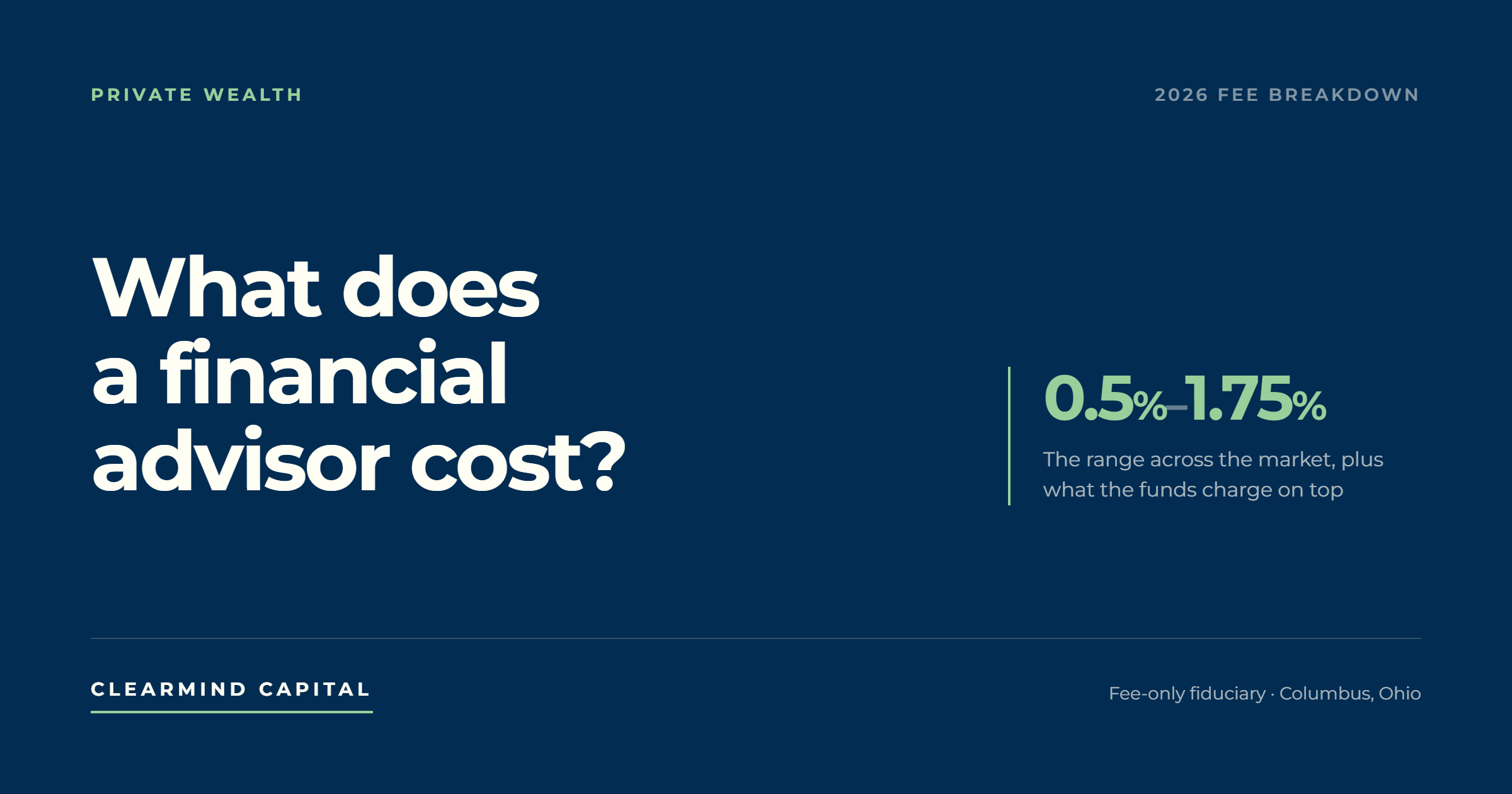
In 2026, ongoing financial advice generally costs somewhere between 0.5% and 1.75% of your portfolio per year, with the middle of the market sitting near 1% on the first million dollars. Hourly advice runs about $300 an hour. Some advisors charge a flat annual amount instead, and some are paid by the companies whose products they sell.
The percentage by itself tells you almost nothing. What it buys is the part worth investigating.
The four ways advisors get paid
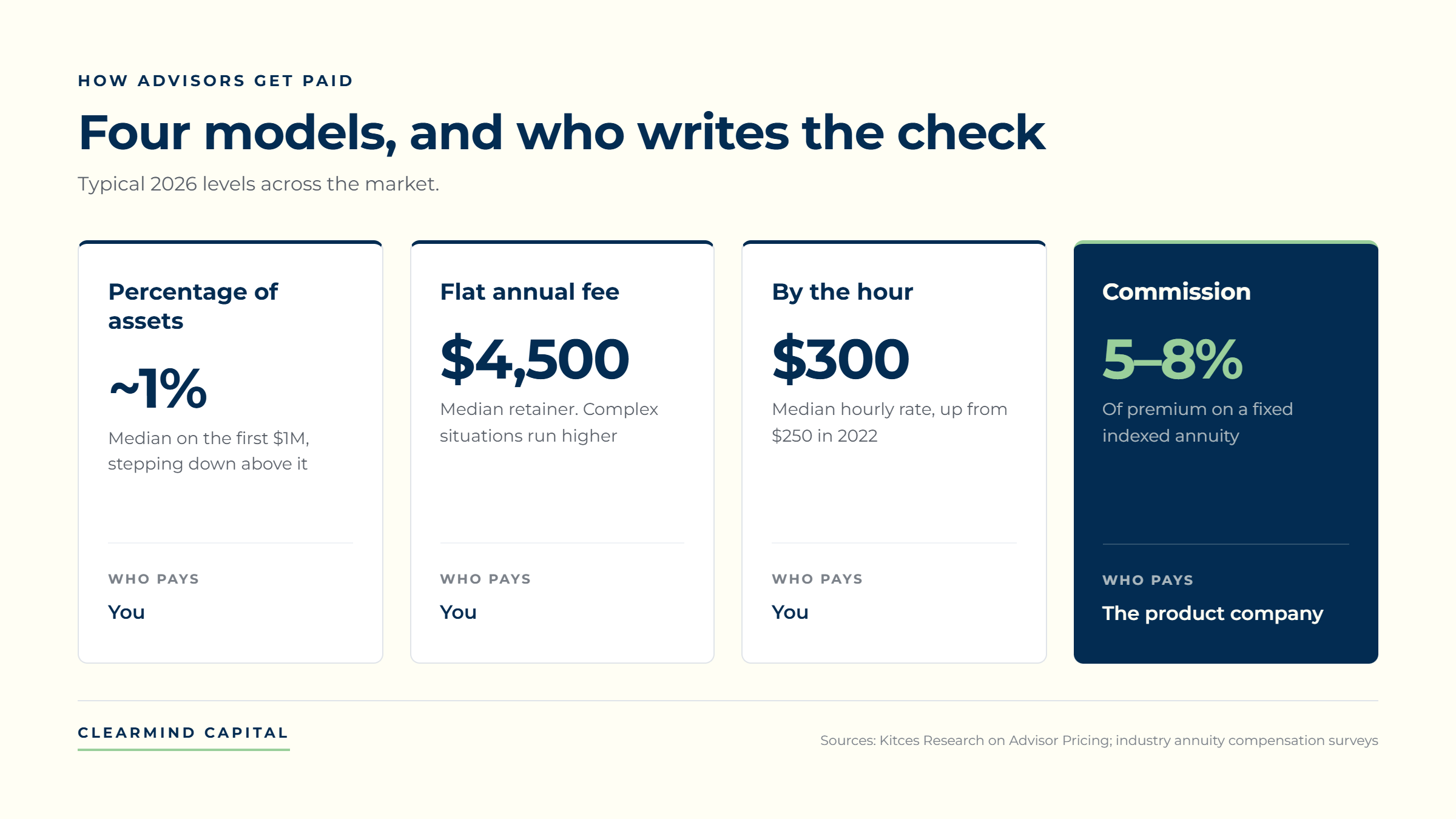
Every arrangement you will run into is one of these four, or a blend of two.
1. A percentage of what they manage
Also called AUM, for assets under management. If you have $600,000 with an advisor charging 1%, you pay $6,000 a year, usually billed quarterly straight from the account so you never write a check.
This is how the large majority of advisors work. Kitces Research finds roughly 92% of advisors use it, with a median near 1% on the first million and lower rates as the balance grows. Schedules are usually tiered, so the first slice of money is charged at one rate and the next slice at a lower one.
The appeal is that you and the advisor are on the same side of the table. Your account grows, their revenue grows. Your account has a rough year, so does theirs. It is one of the few pricing models in professional services where the provider feels the same thing you feel.
2. A flat annual fee
A set dollar amount, priced off how complicated your life is rather than how big your account is. This suits people with high income and not much invested yet, like a physician five years out of residency or an owner whose net worth is mostly the business.
3. By the hour
The median is about $300 an hour. Good for one clean question: should I roll this old 401(k) over, does this pension election make sense, is my plan built right. You get an answer and you leave. Nobody is watching the situation for you afterward, which is the tradeoff.
4. Commission
The advisor is paid by the company whose product you buy, usually an insurance carrier or a fund company. No invoice comes to you. The compensation is built into how the product is priced, which is worth understanding rather than fearing. Insurance is a genuinely useful tool and somebody has to be licensed to place the policy. You just want to know when you are in a sales conversation and when you are in a planning one. ++[Fee-Only vs. Fee-Based vs. Commission]++
Why the percentage tells you so little
Here is where the shopping instinct leads people astray. A lower number looks like a better deal, so 0.65% must beat 1.35%.
Sometimes. Often not.
A 1.35% relationship that includes a tax projection every October, a written withdrawal plan for retirement, coordination with your CPA and your estate attorney, and a human who picks up in a bad market is a different purchase than a 0.65% relationship that produces a quarterly statement and a holiday card. Both are legitimate businesses. They are selling different things at different prices, and the percentage does not distinguish them.
Price is easy to compare. Value takes a few more questions. Most people compare the easy thing and then wonder for years whether they got the other one.
What 1% used to buy, and what it should buy now
For a long stretch, roughly 1% a year bought investment management, full stop. Somebody selected funds, rebalanced when the allocation drifted, and mailed a statement. Tax planning happened in March at your CPA's office with no connection to any of it. Estate documents were somebody else's department entirely.
Then technology took the cost out of the exact part that used to justify the price. Portfolio construction, rebalancing, tax-loss harvesting, performance reporting, opening an account without a fax machine. All of it is close to automatic now, and it costs a fraction of what it did fifteen years ago. Not for everyone, there's plenty of offices out there still using actual paper for signatures. No judgement here. Anyways, ah yes... the questions changes.
The question is now what the fee buys on top of the software.
If the answer is a portfolio and a rebalance, you are paying 2026 prices for a 2010 service. If the answer includes the tax work, the withdrawal sequencing, the insurance read, the estate coordination, and the phone call in March 2020 that talked you out of selling everything, that is a different product at the same price. Ask which one is on the table.
The fee under the fee
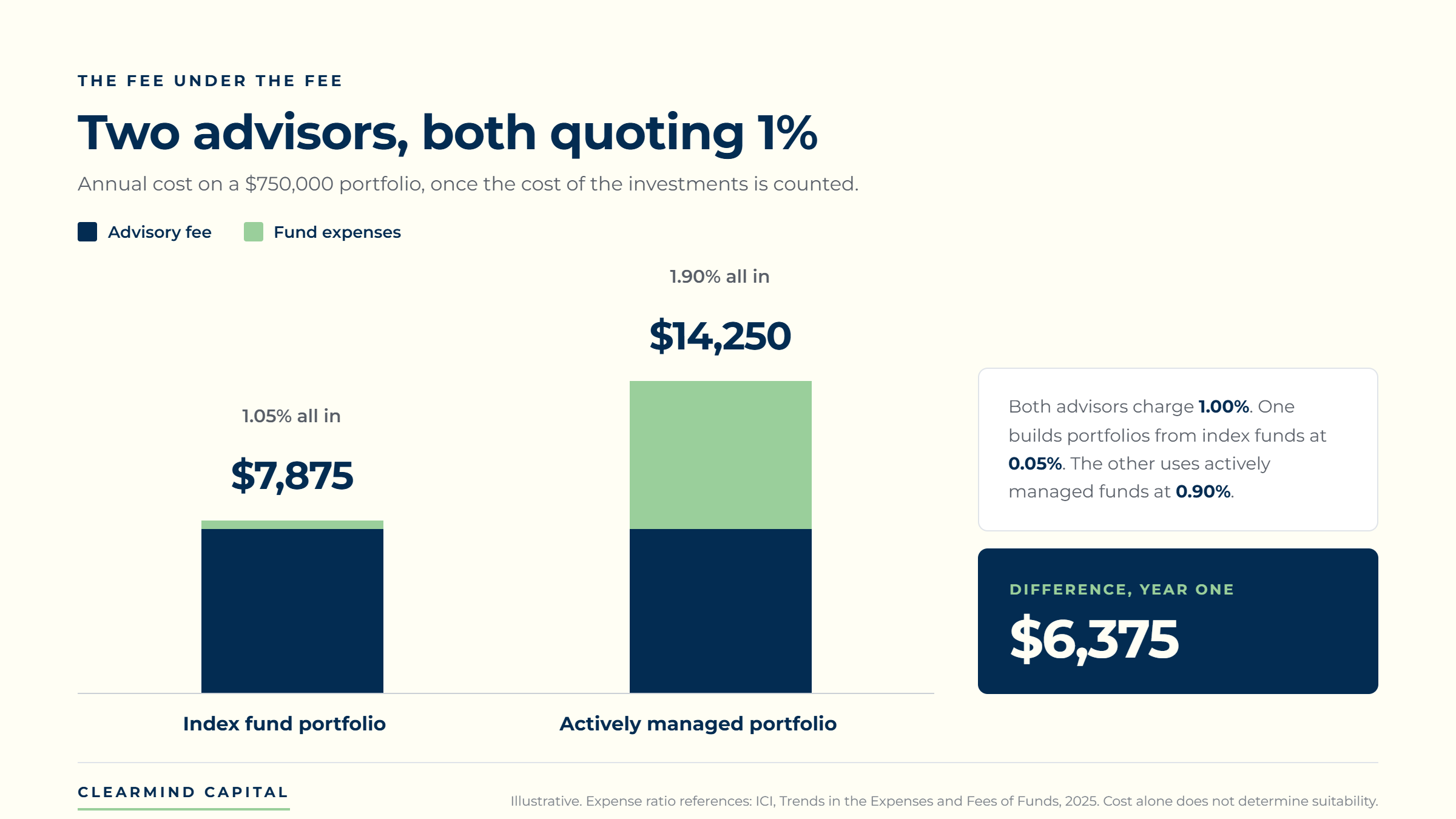
Not to make anything more confusing... but there's another fee that goes under the radar. The advisory fee is one number. The investments inside your portfolio charge a second fee of their own, called the expense ratio, and it comes out of your returns rather than arriving as a bill. Think of the advisory fee as the ticket price and the expense ratio as what they add at checkout.
However, it does not show up on your statement. It's baked into your overall investment value... which is where the hidden part comes in.
#### Rough scale, on a $750,000 portfolio:
| | | | ----------------------------------------- | --------------------------------- | | Broad index funds and ETFs | 0.03% to 0.15% · $225 to $1,125 | | Average across all equity mutual funds | 0.40% · $3,000 | | An actively managed or proprietary lineup | 0.50% to 1.00% · $3,750 to $7,500 |
So two advisors can both quote you "one percent" and one of them costs 1.05% all in while the other costs 1.90%. On $750,000 that gap is about $6,400 in year one, and it repeats every year, on a larger balance each time.
None of which makes an actively managed fund wrong. It makes the question "what is the total" worth asking, in dollars, before you sign. We call this an educated decision.
The thing that outweighs the fee difference
Chase the cheapest fee and you can still end up behind, because the fee is not where the biggest dollars usually live.
Say somebody reads your tax return in October and notices you have a low-income year coming, so a Roth conversion at 12% makes sense before your income jumps back. Or catches that your vested RSUs have been withheld at 22% all year while you are in the 32% bracket, and you are walking into an April surprise. Or moves your bond funds out of the taxable account and into the IRA where they belong.
Any one of those can be worth a few thousand dollars in a single year. The difference between a 0.9% fee and a 1.2% fee on $600,000 is $1,800.
Which raises a question that is worth sitting with for a second:
Has anyone you are currently paying ever asked to see your tax return?
If the answer is no, that is not automatically a scandal. Some advisors are hired for investment management alone and are doing exactly the job they were hired for. But it is worth knowing which job you are buying, because the two are priced surprisingly close together.
What this looks like in Columbus
Columbus pricing tracks the country closely. Independent registered investment advisers here mostly land between 0.75% and 1.25% for portfolios under a million. The wealth management arms of the large national firms, the ones with offices around Dublin, Worthington, and Upper Arlington, often run higher and typically bundle more services into the number. A smaller group of independents uses flat or subscription pricing.
All of those can be the right answer for somebody. What you are choosing between is not really a price. It is a business model, a service set, and a person. [How to Choose a Financial Advisor in Columbus]
Since we are on the subject, here is ours
It would be strange to write all of this and then get vague. Our advisory fee is tiered, and the tiers stack rather than replace each other.
| Assets under management | Annual advisory fee | | ------------------------ | ------------------- | | First $1,000,000 | 1.25% | | $1,000,001 to $2,000,000 | 1.00% | | $2,000,001 to $5,000,000 | 0.75% | | $5,000,001 and above | 0.35% |
We encourage a $120,000 relationship minimum or a $1,200 annual minimum fee. Because the tiers stack, the blended rate falls as the portfolio grows: $1.5 million pays $17,500, a blended 1.17%. Three million pays $30,000, a blended 1.00%. Six million pays $48,500, a blended 0.81%.
We are not the cheapest option in this city and we are not near the top of the range. The fee works the way we think a fee should. Our job is getting you where you're trying to go. When that happens, we can keep doing this, bring on more people, and put money back into what makes the experience worth it — events, resources, and a practice that actually invests in the people inside it. That's the whole point. It's a win-win relationship... how cool is that?
Three questions worth asking whoever you sit down with
"What is my total annual cost in dollars, your fee plus the funds you would use?"
One number, not a range. Somebody who has thought about it can produce this quickly.
"What do I get for that beyond the portfolio itself?"
This is the question that separates two advisors quoting the same percentage.
"Does anyone besides me pay you?"
Every honest answer to this is fine. You just want to have it before you decide, not after.
If you want help running these numbers on your own situation, including what you are paying today, that is a conversation we are happy to have with no expectation attached.
Common questions
Is a 1% financial advisor fee worth it?
It depends entirely on what the 1% covers. For investment management alone, 1% is expensive relative to what technology now costs. For a relationship that includes tax planning, retirement withdrawal strategy, insurance review, and estate coordination, 1% is roughly the market rate for a much larger job. Ask for the scope in writing and judge the price against that.
What is the average financial advisor fee in 2026?
Around 1% of assets per year on the first million dollars, declining at higher balances, according to Kitces Research. The full range across the market runs roughly 0.5% to 1.75%. Hourly advice has a median of about $300, and flat annual retainers have a median near $4,500.
How do financial advisor fees get paid?
Percentage-based fees are usually deducted from the investment account each quarter, so no invoice arrives. Flat and hourly fees are typically billed directly. Commissions are paid by the product company rather than by you, and are built into the pricing of the product.
Do I pay fund expenses on top of the advisory fee?
Yes, in nearly every case. Each fund or ETF in your portfolio charges its own expense ratio, deducted from returns rather than billed. Index funds and ETFs generally run 0.03% to 0.15%. Actively managed funds commonly run 0.50% to 1.00%. Add that to the advisory fee to get your true all-in cost.
How much does a financial advisor cost in Columbus, Ohio?
Columbus tracks national pricing. Independent registered investment advisers here mostly charge 0.75% to 1.75% for portfolios under a million dollars, with the wealth management arms of large national firms often charging more and bundling additional services.
Sources
- Kitces Research on Advisor Pricing: median AUM, hourly, and retainer fee levels.
- Investment Company Institute, Trends in the Expenses and Fees of Funds, 2025, published March 2026: average expense ratios by fund type.
The information presented in this article is for informational purposes and should not be intended as tax, accounting or legal advice, nor is it an offer or solicitation to buy or sell, or as an endorsement of any company, security, fund, or other offering. Please consult your legal, tax, or accounting professional regarding your specific situation. Investments involve risk and have the potential for complete loss. It should not be assumed that any recommendations made will necessarily be profitable.
The opinions expressed in any commentary posted on this site are solely those of the individual author and do not necessarily reflect the views or opinions of ClearMind Capital, LLC. These opinions are based on information available at the time of posting and are subject to change without notice. ClearMind Capital, LLC, does not commit to updating any posted positions or commentary to reflect subsequent developments. While the information and reasoning used to form these opinions are believed to be from reliable sources, ClearMind Capital, LLC, does not verify this information, and no guarantee is provided regarding its accuracy, completeness, or validity. ClearMind Capital, LLC, disclaims any and all liability for actions taken or not taken based on the content of this site. No warranty, express or implied, is given in connection with the content provided.
Certified Financial Planner Board of Standards Center for Financial Planning, Inc. owns and licenses the certification marks CFP®, CERTIFIED FINANCIAL PLANNER®, and CFP® (with plaque design) in the United States to Certified Financial Planner Board of Standards, Inc., which authorizes individuals who successfully complete the organization’s initial and ongoing certification requirements to use the certification marks.