A plan that runs and a plan that works are two different animals.
Contributions go in on time. Statements go out. Nobody complains. From where you sit, the 401(k) is handled, and you have roughly four hundred other things competing for attention.
Meanwhile the plan can be costing your team real money in a way nobody in the building would notice, because the costs come out of investment returns rather than off a paycheck.
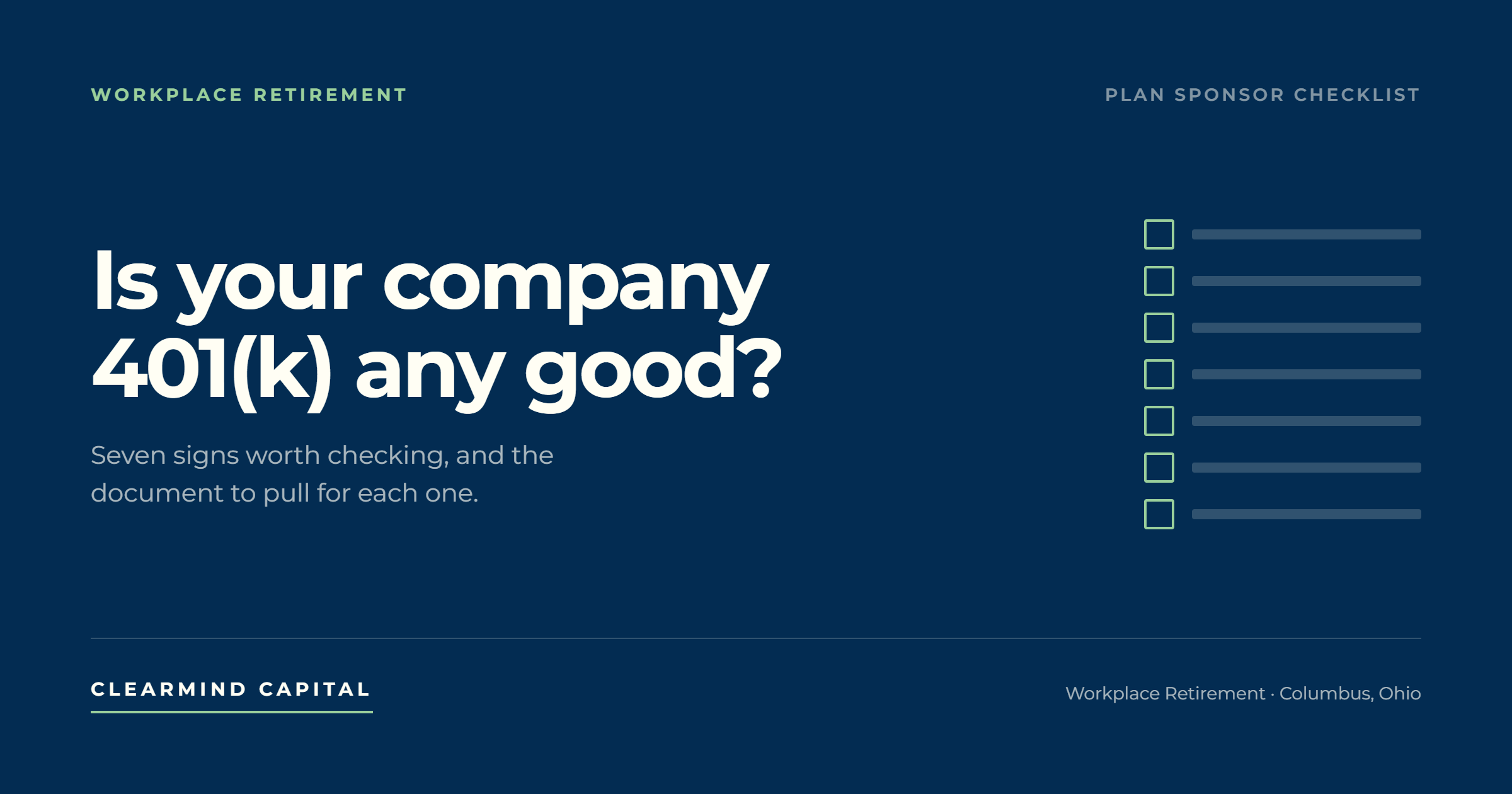
Seven checks. Each one takes minutes, and none of them require hiring anybody.
The short answer
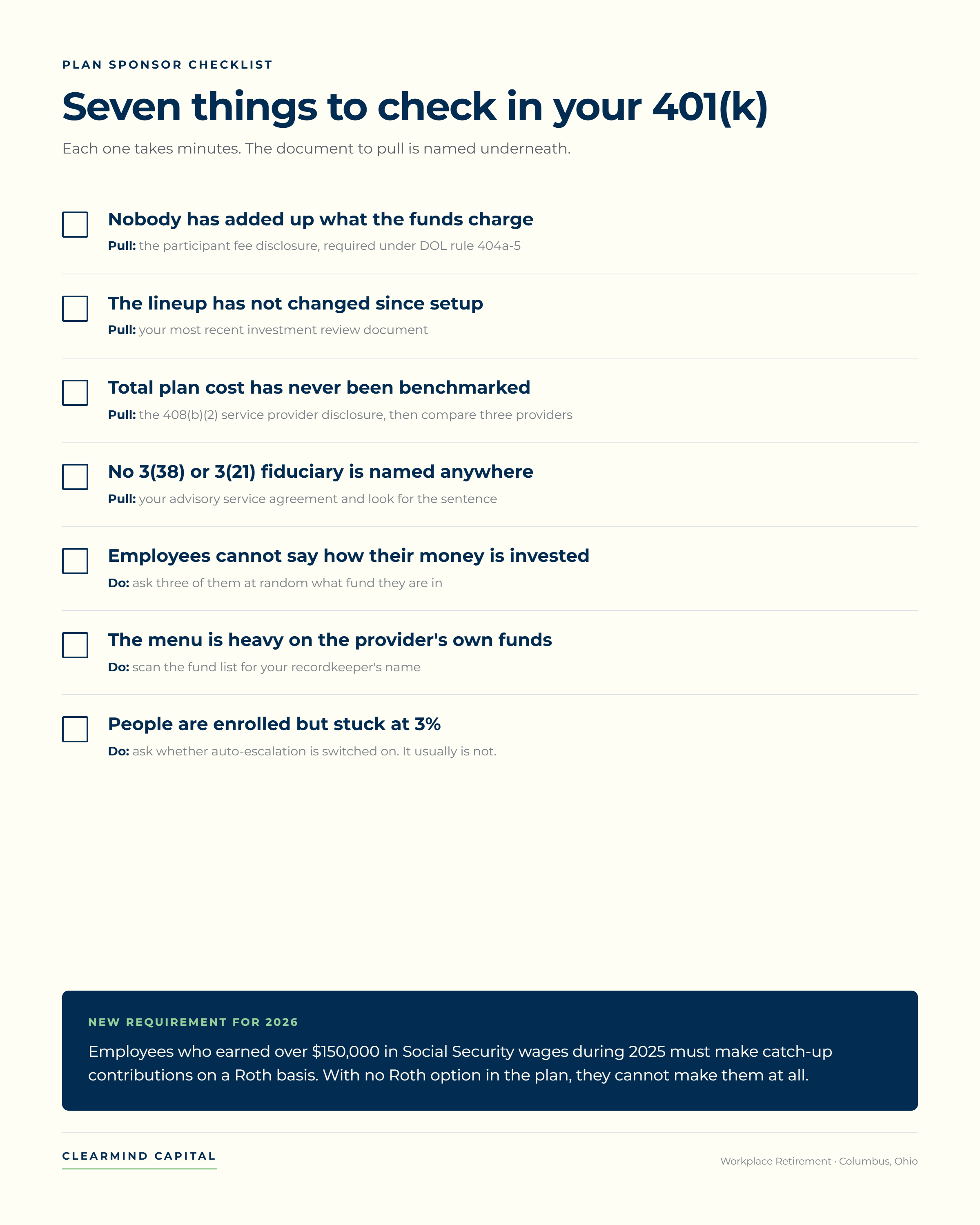
To evaluate a small-business 401(k), check the weighted average expense ratio of the fund menu, whether the lineup has been reviewed since setup, whether total plan cost has been benchmarked, whether a 3(38) or 3(21) fiduciary is named in your service agreement, whether employees know how their money is invested, whether the menu leans on the provider's own funds, and whether auto-escalation is turned on.
1. Nobody has added up what the funds charge
Every fund in the menu has an expense ratio, paid by your employees out of their returns. No invoice, no line on a pay stub, no notification.
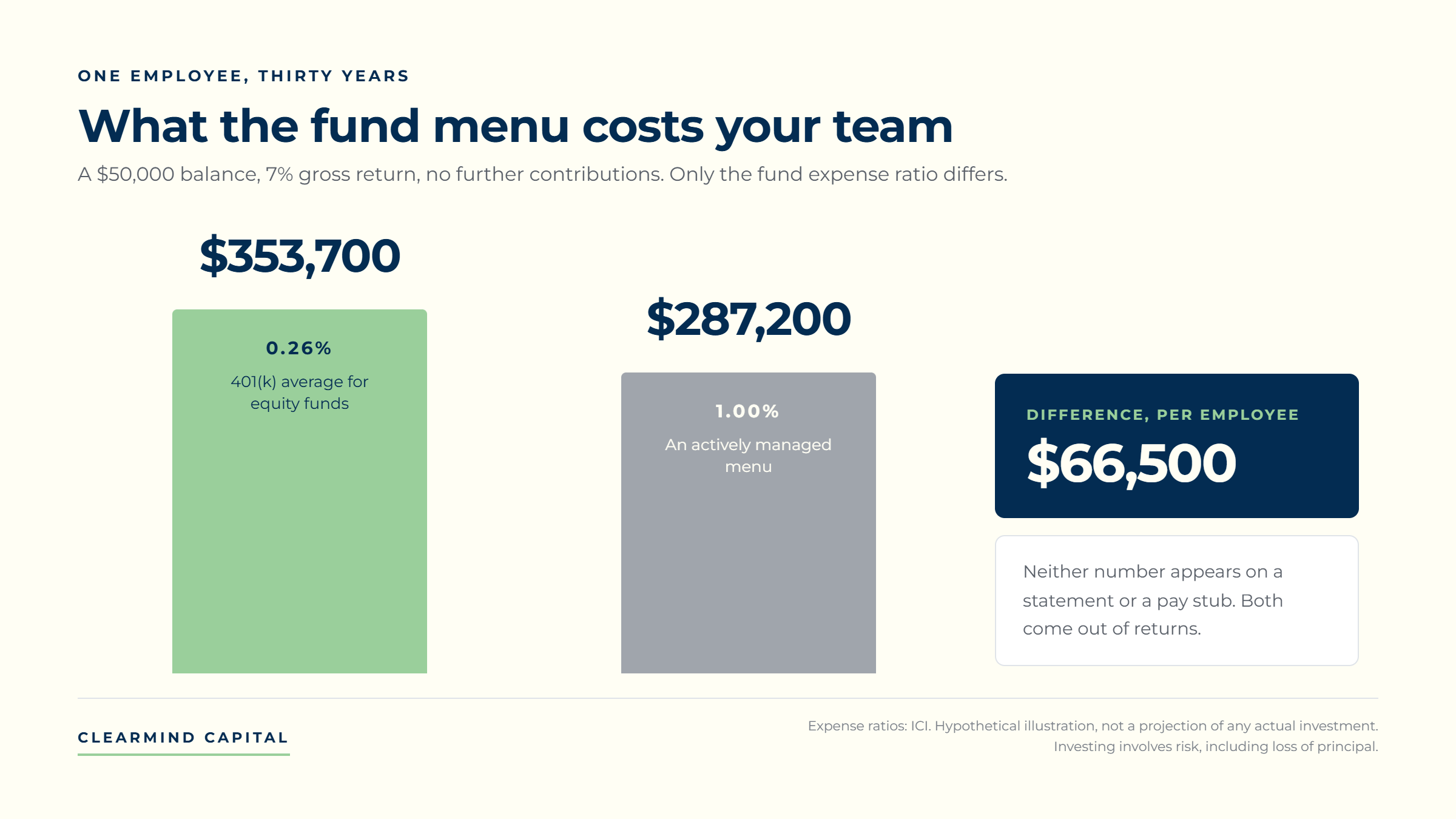
A well-built menu comes in somewhere around 0.05% to 0.25% on a weighted average. For reference, Investment Company Institute data puts the 401(k) average for equity mutual funds at 0.26% and index equity mutual funds at 0.05%. A menu built around actively managed or proprietary funds can average 0.75% to 1.00%.
What to pull: your participant fee disclosure, the document required under DOL rule 404a-5. Your recordkeeper has to provide it. Add up the weighted average and you have your number.
2. The lineup has not changed since the day you set it up
Funds close. Funds merge. Managers leave. A fund drifts from the strategy it was picked for. And once a plan crosses certain asset thresholds, cheaper share classes of the identical fund become available, which nobody moves you into unless somebody is paying attention.
A menu chosen in 2019 and untouched since is not a decision. It is the absence of one.
What to pull: your most recent investment review document. If you cannot find one, that is your finding.
3. The total cost has never been compared to anything
The 401k Averages Book finds that a 50-participant plan with $500,000 in assets can carry total costs anywhere from 0.99% to 3.77% depending on the provider. Same size, same services, a spread of nearly three points a year.
Which means the honest answer to "are our fees reasonable" cannot be arrived at by intuition. "Seems about right" is a feeling, not a benchmark.
What to pull: your 408(b)(2) service provider disclosure, which lays out what every vendor is paid. Then compare against three similar providers. [What a 401(k) Really Costs a Small Business]
4. No independent fiduciary is named on the investments
The person who sold you the plan may have no ongoing role in it at all, and plenty of small plans operate with no plan advisor whatsoever. That is more common than most owners expect.
Under federal law you are a fiduciary on every investment decision the plan makes. A 3(38) investment manager takes discretion over the fund lineup and the responsibility that goes with it. A 3(21) co-fiduciary shares it while you keep the final call.
What to pull: your advisory service agreement. Look for a sentence naming which arrangement you have. If no such sentence exists, you have neither, and you are carrying all of it.
5. Your employees cannot say how their money is invested
Participation rate is the number everybody reports. It stops being the interesting one the day after enrollment.
Somebody who signed up on their first day, landed in whatever the default happened to be, and never opened the portal again might be sitting in a money market or stable value fund. They think they are invested for retirement. They have been losing ground to inflation for six years.
What to do: ask three employees at random what fund their money is in. The quality of the answers tells you whether the education piece is real or ceremonial.
6. The menu is heavy on the provider's own funds
Some recordkeepers and insurance-company platforms build menus around funds they manage themselves. Those funds can carry higher expense ratios and revenue-sharing arrangements, where part of the fund's fee routes back to the provider to cover plan services.
The visible effect is a plan that looks inexpensive on your invoice. The cost moved rather than vanished into participant returns. This is disclosed and legal, and it is most common in the small-plan market.
What to do: scan the fund list for your recordkeeper's name. If it shows up on half the menu, the question worth asking is what process selected those funds.
7. People are enrolled but barely contributing
Auto-enrollment at 3% gets somebody into the plan. It also anchors them there, sometimes for a decade, because 3% starts to feel like the recommended amount rather than the starting line.
Auto-escalation raises deferrals by one percentage point a year up to a cap. It is available on nearly every modern platform; it improves outcomes substantially, and when a plan does not have it turned on, the reason is usually that nobody asked.
What to do: ask your provider whether auto-escalation is enabled. It is often a settings change.
While you have them on the phone, one more for 2026: employees who earned over $150,000 in Social Security wages during 2025 now have to make catch-up contributions on a Roth basis. If your plan has no Roth option, those employees cannot make catch-up contributions at all. Worth confirming before the next payroll run.
If several of these landed, that is normal
None of these mean somebody did something wrong. Most small-business plans get set up during a busy stretch, by a well-meaning owner taking a well-meaning recommendation, and then they run. Years pass. The plan keeps doing exactly what it was configured to do on day one, which is the problem and also completely understandable.
A benchmarking review takes a few weeks, does not interrupt payroll, does not require changing providers, and leaves you with documentation of a prudent process either way. Frequently it also lowers what employees pay, which is the part they will never see and will feel for thirty years.
If you want a second set of eyes on yours, that is an easy conversation to have.
Common questions
How do I know if my company 401(k) is good?
Check the weighted average expense ratio of the fund menu, when the lineup was last reviewed, whether total plan cost has been benchmarked against comparable providers, whether a 3(38) or 3(21) fiduciary is named, and whether auto-escalation is enabled. Your participant fee disclosure and service provider disclosure contain most of the answers.
What is a good expense ratio for a 401(k) plan?
A well-constructed menu typically averages 0.05% to 0.25% weighted across participant assets. Investment Company Institute data shows 401(k) participants paid an average of 0.26% for equity mutual funds and 0.05% for index equity mutual funds.
How often should a 401(k) plan be reviewed?
Investment menus are commonly reviewed at least annually, with a fuller fee benchmarking exercise every two to three years or whenever plan assets or headcount change materially. Documenting each review is as important as performing it.
Can employees sue over high 401(k) fees?
Excessive fee litigation against plan sponsors has been an active area for years, generally centered on whether the sponsor followed a prudent process in selecting and monitoring investments and service providers. Maintaining documented reviews is the practical response. Specific legal questions belong with an ERISA attorney.
What is auto-escalation in a 401(k)?
A plan feature that automatically increases a participant's contribution rate, typically by one percentage point per year up to a set cap, unless they opt out. It counteracts the tendency for people to stay at whatever rate they were enrolled at.
Sources
- Investment Company Institute, The Economics of Providing 401(k) Plans: Services, Fees, and Expenses: average expense ratios incurred by 401(k) participants.
- 401k Averages Book, 26th Edition (Pension Data Source, 2026): total plan cost ranges by plan size.
- ERISA sections 3(21), 3(38), and 404(a); DOL participant fee disclosure rule 29 CFR 2550.404a-5 and service provider disclosure rule 29 CFR 2550.408b-2.
- SECURE 2.0 Act of 2022, section 603: Roth treatment of catch-up contributions for higher earners, effective 2026. Wage threshold confirmed in IRS Notice 2025-67.
- Growth illustration: hypothetical, 7% gross annual return, no additional contributions.
The information presented in this article is for informational purposes and should not be intended as tax, accounting or legal advice, nor is it an offer or solicitation to buy or sell, or as an endorsement of any company, security, fund, or other offering. Please consult your legal, tax, or accounting professional regarding your specific situation. Investments involve risk and have the potential for complete loss. It should not be assumed that any recommendations made will necessarily be profitable.
The opinions expressed in any commentary posted on this site are solely those of the individual author and do not necessarily reflect the views or opinions of ClearMind Capital, LLC. These opinions are based on information available at the time of posting and are subject to change without notice. ClearMind Capital, LLC, does not commit to updating any posted positions or commentary to reflect subsequent developments. While the information and reasoning used to form these opinions are believed to be from reliable sources, ClearMind Capital, LLC, does not verify this information, and no guarantee is provided regarding its accuracy, completeness, or validity. ClearMind Capital, LLC, disclaims any and all liability for actions taken or not taken based on the content of this site. No warranty, express or implied, is given in connection with the content provided.
Certified Financial Planner Board of Standards Center for Financial Planning, Inc. owns and licenses the certification marks CFP®, CERTIFIED FINANCIAL PLANNER®, and CFP® (with plaque design) in the United States to Certified Financial Planner Board of Standards, Inc., which authorizes individuals who successfully complete the organization’s initial and ongoing certification requirements to use the certification marks.