

Two words appear on nearly every financial advisor's website: fiduciary and fee-only. They sit next to each other so often that people read them as one promise, or as a badge meaning "this one is a good guy."
They are worth understanding, because they describe two genuinely different things. They also do less than the marketing implies, which is the more useful thing to know.
The short answer
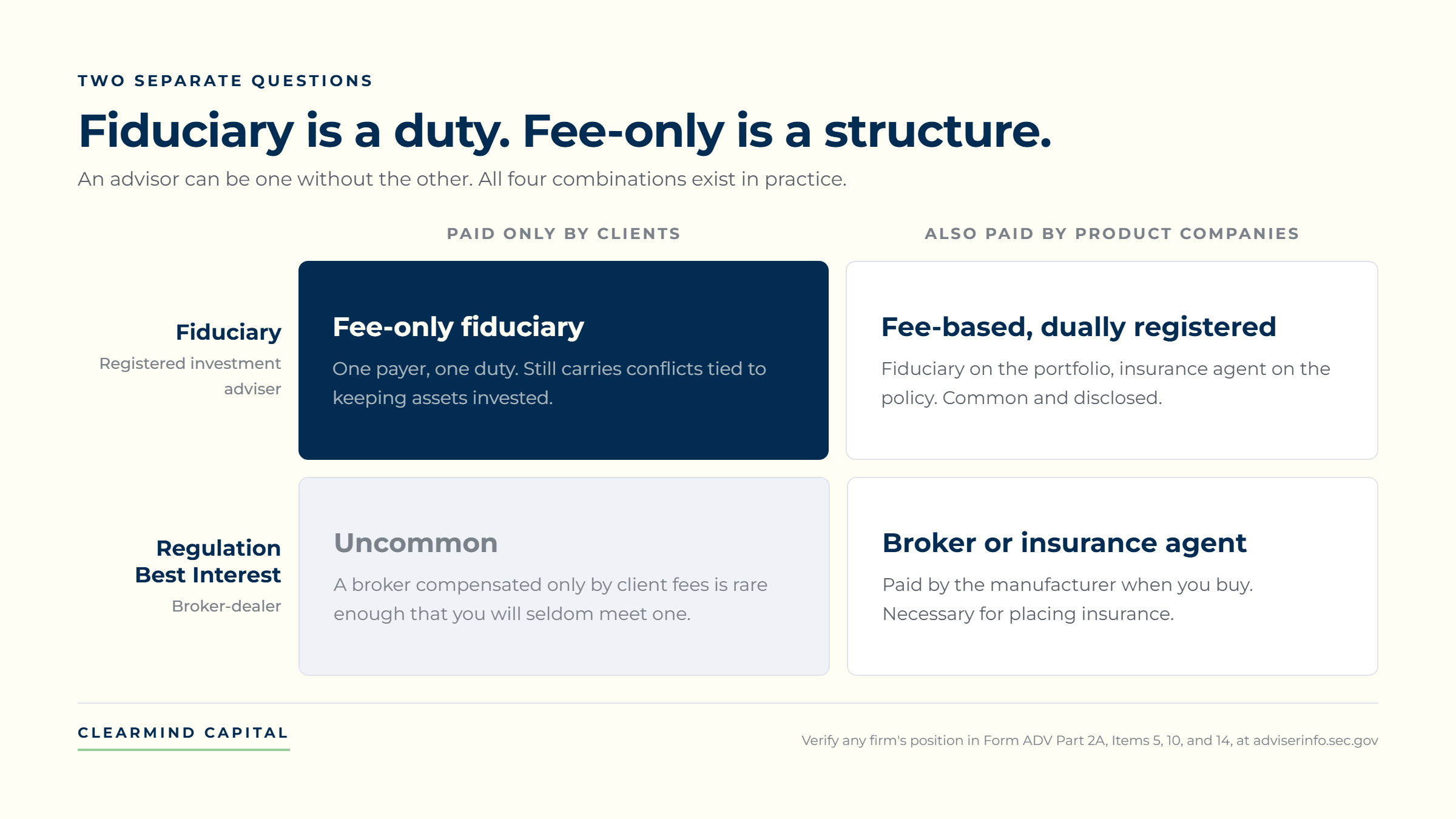
Fiduciary is a legal duty to put your interest ahead of the advisor's own. Fee-only is a business structure where clients are the only source of the advisor's income. An advisor can be one without the other.
Neither removes every conflict of interest, including in the fee-only model. Both are worth confirming, and neither is a substitute for judging the person in front of you.
Fiduciary is a duty
A fiduciary is legally obligated to put your interest ahead of their own. Under the Investment Advisers Act of 1940, that duty covers the whole relationship rather than a single transaction, and it includes an obligation to eliminate conflicts of interest or disclose them clearly.
Registered investment advisers owe you that duty, whether they are registered with the SEC or with a state securities regulator. Brokers work under a different rule, Regulation Best Interest, which requires acting in the retail customer's best interest at the moment a recommendation is made. It applies transaction by transaction rather than continuously.
A wrinkle because of course... an advisor can be dually registered, which means fiduciary through their advisory firm when managing your portfolio and an insurance agent when placing a policy. Same person, same office, sometimes the same meeting. That is legal, extremely common, and disclosed in their filings. It just means "are you a fiduciary" deserves a follow-up: "on everything, or on some of it?" ++[How to Choose a Financial Advisor]++
Fee-only is a structure
Fee-only means every dollar the advisor earns comes from clients. A percentage of assets, a flat annual amount, an hourly rate, or a subscription. No commissions from insurance carriers, no trailing payments from fund companies, no referral fees from anybody.
Fee-based is the term that causes confusion, because it looks like a spelling variant and describes something different: client fees plus commissions on certain products. Both income streams are disclosed in the firm's Form ADV.
What fee-only removes is a specific, well-documented pull. When one recommendation pays the advisor $22,000 and the equally reasonable alternative pays nothing, that gap sits on the scale whether anyone wants it to or not. Removing it structurally is cleaner than asking a person to ignore it.
What it does not do is make anyone neutral.
Every model has a pull. Here is ours.
This is the part that usually gets left out of articles like this one, and leaving it out is what makes them feel like advertising.
We are a fee-only firm paid a percentage of the assets we manage. That structure carries its own conflicts, and they are not small or theoretical.
#### Money sitting in cash
If you have $22,000 in a savings account and we suggest investing it, our fee goes up. A small amount, but it goes up. Someone advising you to hold that cash for a down payment next year earns less by saying so.
Rolling over an old 401(k). Moving it to an IRA we manage adds to what we are paid. Leaving it in a well-run employer plan with cheap institutional funds sometimes serves you better and pays us nothing. Regulators watch this one closely, and they should.
Paying off the mortgage, or buying a rental. Any advice that moves money out of the portfolio reduces the fee. Paying down debt, funding a business, buying property, giving to your kids. All of it costs the advisor something.
We think the percentage model is the right fit for the way we work, because it keeps us in the same boat as you through good markets and bad ones. That does not make the conflicts disappear. It means you should be able to name them, and so should we.
The takeaway is not that one model is clean and the others are dirty. It is that every arrangement pays somebody for something, and a person you can trust will walk you through their own version without getting defensive about it. [Fee-Only vs. Fee-Based vs. Commission]
How to check any of this in ten minutes
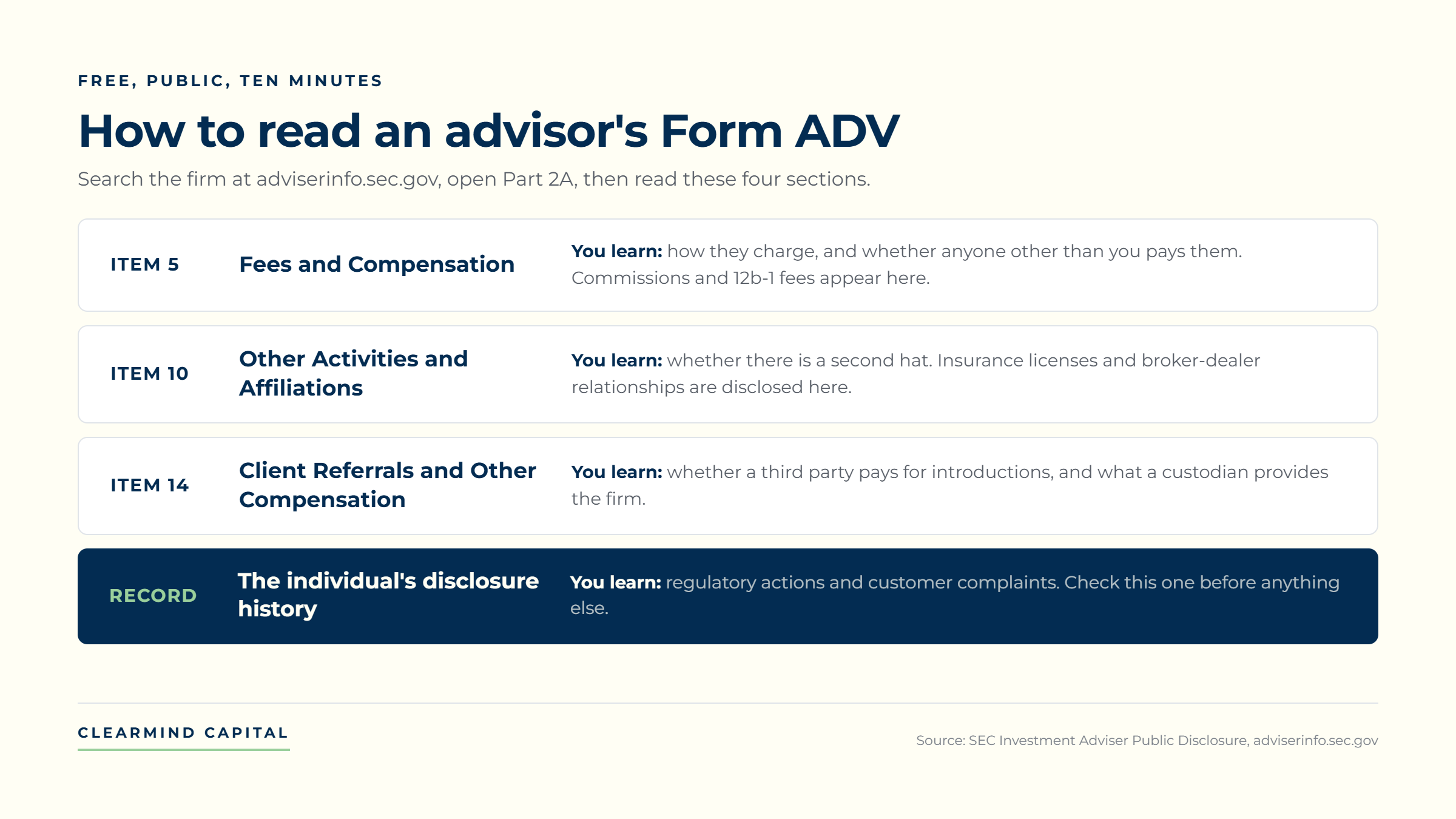
Every registered investment adviser files a public document called Form ADV. Nobody reads them, and they are genuinely useful.
- Search the firm or the person at adviserinfo.sec.gov.
- Open Part 2A, the brochure. It is written in plain language by rule.
- Item 5, Fees and Compensation. How they charge, and whether anyone other than clients pays them.
- Item 10, Other Activities and Affiliations. Insurance licenses and broker-dealer relationships live here.
- Item 14, Client Referrals and Other Compensation. Third-party arrangements.
- Then the disclosure section on the individual's record, for regulatory actions and complaints.
If the brochure describes commissions or compensation from product sponsors, the firm is fee-based rather than fee-only, regardless of what the homepage says. Not a scandal. Just a fact worth having.
Underneath all of it, this is a trust business
Structures and duties set a floor. They are worth confirming, and they are the easy part. The harder question is what standard the person holds themselves to once the paperwork is signed.
There is a version of this work that stays at the surface. Your accounts get managed, the allocation is sensible, statements arrive, a review meeting happens once a year and covers performance. Everything promised is delivered. Nothing is wrong.
And there is a version where somebody notices that your beneficiary designations still name a person from a previous chapter of your life. Where they ask to see the tax return and find something in it. Where they tell you the honest answer about the rental property even though the honest answer costs them money. Where the conversation expands past the accounts and into the actual decisions that build a life, because that is where the leverage is.
Both people can be fiduciaries. Both can be fee-only. The letters on the business card are identical.
So confirm the structure, because it is quick and it matters. Then judge the standard, which takes a meeting or two and is the thing you are really choosing.
Two questions to end on
"Does anyone besides me pay you in connection with advice you give me?"
Establishes the structure. Any clear answer is a good answer.
"Where does your advice cost you money?" Establishes the standard. Somebody who has thought seriously about their own conflicts will have an answer ready, and it will be specific.
Ask us both of them any time. We have answers to both, and the second one is the more interesting conversation.
Common questions
What is a fee-only fiduciary?
An advisor who is legally required to act in your interest and whose only compensation comes from clients rather than from product companies. The two terms describe separate things: fiduciary is a legal duty, fee-only is a compensation structure.
What is the difference between fee-only and fee-based?
Fee-only advisors are paid solely by clients. Fee-based advisors are paid by clients and also earn commissions on certain products such as insurance or annuities. Both disclose their compensation in Form ADV, and the terms are easy to confuse in marketing material.
Do fee-only advisors have conflicts of interest?
Yes. An advisor paid a percentage of assets under management earns more when money stays invested with them, which creates a pull against advice to hold cash, pay off a mortgage, buy real estate, or leave a 401(k) in an employer plan. Fee-only removes product commissions rather than removing all conflicts.
Are all financial advisors fiduciaries?
No. Registered investment advisers owe a fiduciary duty across the relationship. Brokers are held to Regulation Best Interest, which applies at the point of each recommendation. Some professionals are dually registered and act as a fiduciary in part of their work but not all of it.
How do I verify an advisor is a fiduciary?
Look up the firm at adviserinfo.sec.gov and read Form ADV Part 2A. Item 5 shows how the firm is compensated, Item 10 shows insurance and brokerage affiliations, and Item 14 shows third-party compensation. The individual's disclosure record shows regulatory and complaint history.
Sources
- Investment Advisers Act of 1940 and SEC Commission Interpretation Regarding Standard of Conduct for Investment Advisers, Release IA-5248.
- SEC Regulation Best Interest, Rule 15l-1 under the Securities Exchange Act of 1934.
- SEC Investment Adviser Public Disclosure, adviserinfo.sec.gov: Form ADV Part 2A item structure.
The information presented in this article is for informational purposes and should not be intended as tax, accounting or legal advice, nor is it an offer or solicitation to buy or sell, or as an endorsement of any company, security, fund, or other offering. Please consult your legal, tax, or accounting professional regarding your specific situation. Investments involve risk and have the potential for complete loss. It should not be assumed that any recommendations made will necessarily be profitable.
The opinions expressed in any commentary posted on this site are solely those of the individual author and do not necessarily reflect the views or opinions of ClearMind Capital, LLC. These opinions are based on information available at the time of posting and are subject to change without notice. ClearMind Capital, LLC, does not commit to updating any posted positions or commentary to reflect subsequent developments. While the information and reasoning used to form these opinions are believed to be from reliable sources, ClearMind Capital, LLC, does not verify this information, and no guarantee is provided regarding its accuracy, completeness, or validity. ClearMind Capital, LLC, disclaims any and all liability for actions taken or not taken based on the content of this site. No warranty, express or implied, is given in connection with the content provided.
Certified Financial Planner Board of Standards Center for Financial Planning, Inc. owns and licenses the certification marks CFP®, CERTIFIED FINANCIAL PLANNER®, and CFP® (with plaque design) in the United States to Certified Financial Planner Board of Standards, Inc., which authorizes individuals who successfully complete the organization’s initial and ongoing certification requirements to use the certification marks.