You leave a job. The last paycheck clears, the badge goes in a drawer, and somewhere in your inbox is a notice about your 401(k) that you will absolutely deal with later.
Later is where this goes sideways. Doing nothing is a decision, and depending on the balance, your old plan is allowed to make it for you.
The short answer
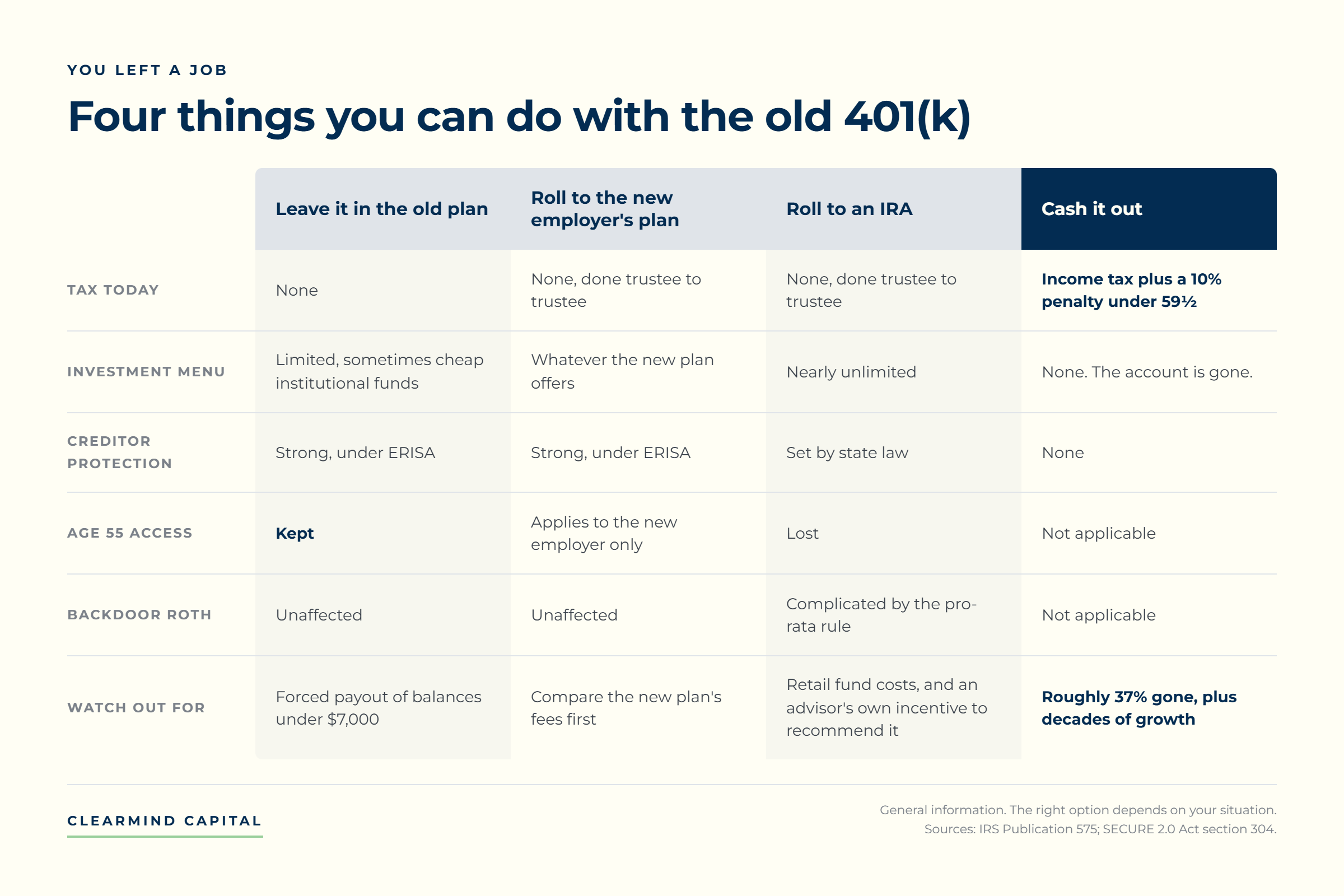
You have four options: leave it in the old plan, roll it into your new employer's plan, roll it into an IRA, or cash it out. The first three avoid taxes entirely if handled as a direct transfer.
Cashing out is the expensive one. For an Ohio resident under 59½ in the 24% federal bracket, roughly 37% of the balance goes to taxes and penalty, before counting decades of lost growth.
Option 1: Leave it where it is
Underrated, and frequently the right call for a year or two while you get your footing.
A large employer's plan buys institutional share classes that you cannot access as an individual, so the funds inside can genuinely cost less than what you would pay in an IRA. Money in a workplace plan also carries strong federal creditor protection under ERISA. And if you separated from that employer during or after the year you turned 55, that plan lets you take withdrawals without the 10% early distribution penalty, an exception you give up the moment you roll it to an IRA.
The downsides are a limited fund menu, whatever administrative fee the plan charges former employees, and one more login to keep track of. Plans can also push out small balances, which is covered further down.
Option 2: Roll it into your new employer's plan
Everything lands in one place, the ERISA creditor protection carries over, and you keep the door open for backdoor Roth contributions later, since money sitting in a workplace plan is excluded from the pro-rata calculation that complicates them.
One more wrinkle worth knowing: if you plan to work past 73, assets in your current employer's plan are generally exempt from required minimum distributions while you are still working there.
Check the new plan's menu and its fees before you move anything. Sometimes the old plan is better.
Option 3: Roll it into an IRA
The widest investment selection, and the cleanest place to run Roth conversion strategy because you control the timing rather than a plan document.
The honest tradeoffs: retail fund share classes can cost more than institutional ones, IRA creditor protection is set by state law rather than federal ERISA, a large pre-tax IRA balance complicates backdoor Roth contributions through the pro-rata rule, and you permanently lose the age 55 exception described above.
Also worth saying plainly, since it applies to us: advisors who charge a percentage of assets under management have a financial reason to prefer this option. Regulators watch rollover recommendations closely for exactly that reason. Ask anyone recommending a rollover what they earn if you do it and what you give up, and expect a straight answer. [Fiduciary and Fee-Only: What They Do Not Solve]
Option 4: Cash it out
This is the mistake. It happens at every balance level, and it happens fastest right after a job change, when cash is tight, and the money feels like it appeared out of nowhere.
What cashing out costs, in real numbers
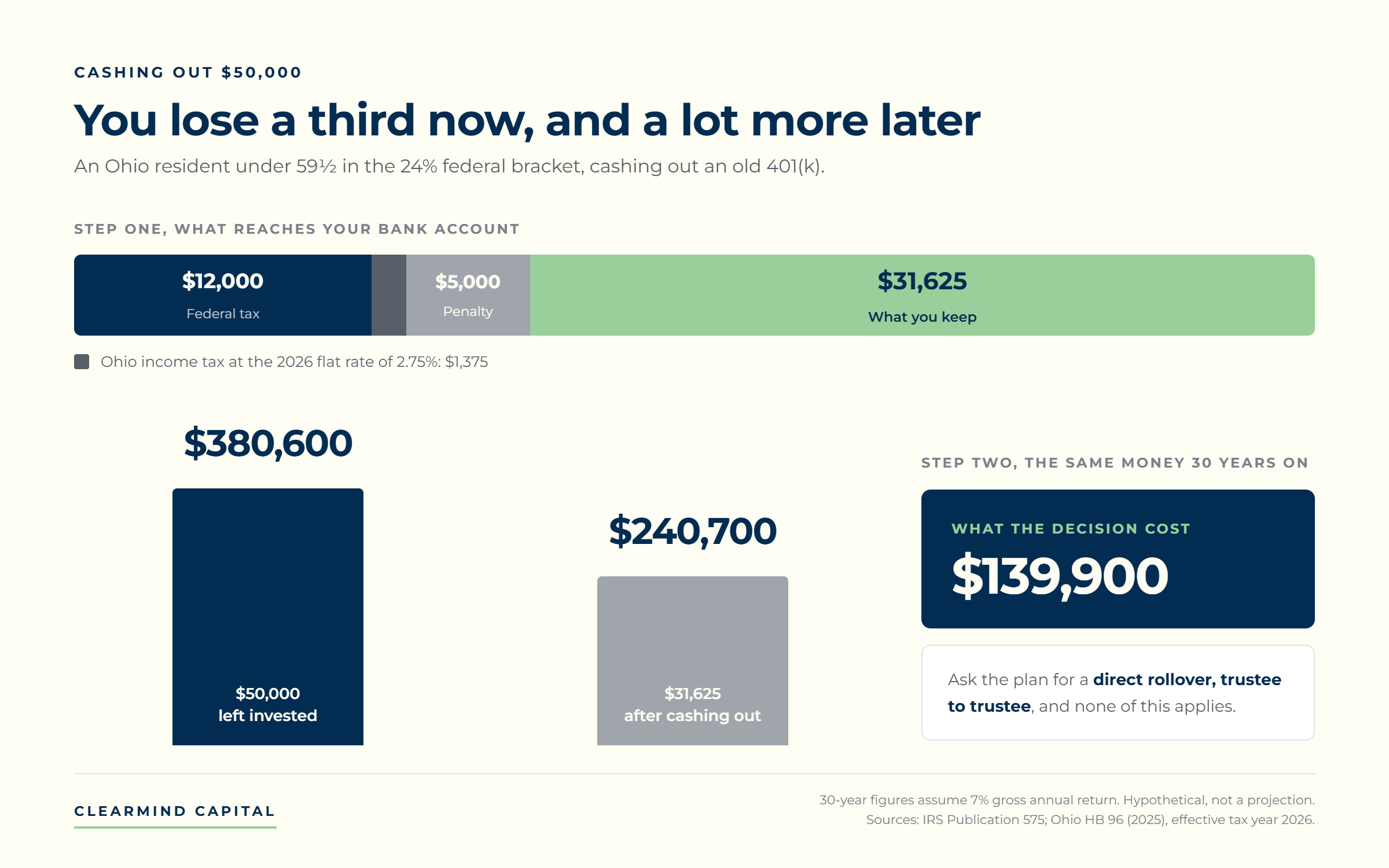
Take a $50,000 balance. Ohio resident, under 59½, in the 24% federal bracket.
#### Federal income tax at 24%
$12,000
Ohio income tax at the 2026 flat rate of 2.75%
$1,375
Early distribution penalty of 10%
$5,000
What you keep
$31,625
Roughly 37% gone. And that $50,000 gets added to your income for the year, which can push part of it into a higher bracket and reduce credits and deductions that phase out with income, so the real number is often worse than the arithmetic above.
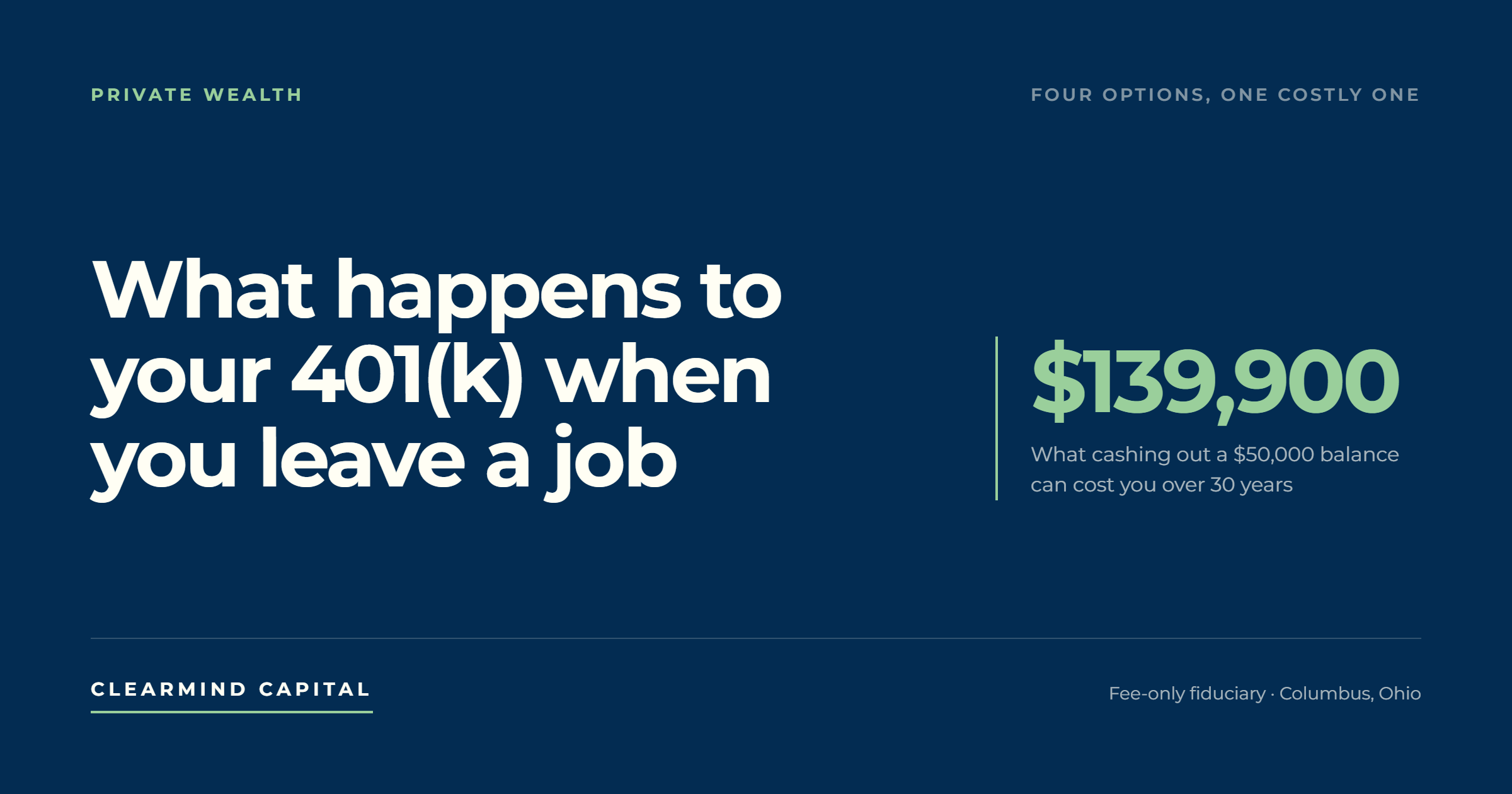
The higher cost is the one nobody writes on the form. That $50,000 left alone for 30 years at a 7% return becomes about $380,600. The $31,625 you kept becomes about $240,700. Solving a short-term cash problem cost roughly $140,000 of future money.
#### The withholding trap
When a plan pays a distribution to you rather than to another retirement account, 20% federal withholding is mandatory. So on that $50,000, the plan sends $10,000 to the IRS and about $40,000 to you.
If you meant to roll it over, you now have 60 days to deposit the full $50,000 into an IRA, including the $10,000 you never received, which you have to cover from other savings until you file and get it back. Miss the window and the whole thing becomes a taxable distribution.
The way around all of it: ask for a direct rollover, trustee to trustee, so the check is never made out to you. Use those exact words on the phone and the entire problem disappears.
If you do nothing, the plan may act for you
Plans are allowed to clear out small balances belonging to former employees, and the thresholds surprise people.
- Under $1,000. The plan can mail you a check, which becomes a taxable distribution with a penalty attached unless you roll it within 60 days.
- $1,000 to $7,000. The plan can move it into an IRA it chooses, without asking you. These default IRAs are typically parked in cash-equivalent investments and carry their own fees, so a balance can sit there for a decade earning close to nothing.
- Above $7,000. The plan generally cannot force you out. It stays put until you decide.
There is now a federal Retirement Savings Lost and Found database, launched by the Department of Labor, to help people track down old accounts. Useful, and also a sign of how routine losing one has become.
Three things people miss
An outstanding 401(k) loan
Leave the job with a loan balance and it generally becomes due. Unpaid, it is treated as a distribution: taxed, and penalized if you are under 59½. You do get until the tax filing deadline for that year, including extensions, to make up the amount as a rollover contribution. Plenty of people have no idea the clock started.
Company stock inside the plan
If a meaningful chunk of your balance is employer stock with a low cost basis, a provision called net unrealized appreciation can let you pay ordinary income tax on the original cost only, then long-term capital gains rates on the growth when you sell. Rolling that stock into an IRA gives up the option permanently. Worth a conversation before anything moves.
Mixed money types
Plans often hold pre-tax, Roth, and after-tax dollars in the same account. Each has to land in the right destination. A sloppy rollover can create a taxable event or reset a Roth five-year clock you already had running. Ask the plan for a breakdown by money type before you fill out anything.
So which one
Cashing out is almost always the expensive answer. Among the other three, the right pick depends on the fees in each plan, your age, your creditor exposure, whether you use backdoor Roth contributions, and what your tax picture looks like over the next few years.
That sounds like a lot of variables, and it is genuinely a thirty-minute conversation with a specific answer at the end. Not a project.
If you have an old account sitting somewhere and you are not sure, bring the statement. Sometimes the answer is leave it exactly where it is, which is fine by us. [When Should You Hire a Financial Advisor]
Common questions
What happens to my 401(k) if I quit my job?
Nothing automatically, if the balance is above $7,000. The money stays invested in the old plan until you act. Below $7,000 the plan may move it into an IRA of its choosing, and below $1,000 it may send you a check, which becomes taxable unless rolled over within 60 days.
How much tax do you pay if you cash out a 401(k) early?
You owe ordinary income tax at your marginal rate plus a 10% early distribution penalty if you are under 59½, plus state income tax. For an Ohio resident in the 24% federal bracket, that totals roughly 37% of the balance. The plan must also withhold 20% federally before paying you.
Should I roll my 401(k) into an IRA or leave it?
It depends on the fees and fund quality in each, your age, and your tax plans. An IRA offers wider investment choice and easier Roth conversion timing. An employer plan can offer cheaper institutional share classes, stronger federal creditor protection, and preserves the age 55 penalty exception. Compare both before moving.
How long do I have to roll over a 401(k)?
There is no deadline if the balance stays in the old plan and you later request a direct transfer. If a distribution is paid to you personally, you have 60 days to deposit the full amount, including the 20% withheld, into another retirement account.
What is a direct rollover?
A transfer sent straight from your old plan to the receiving retirement account, without the check being made payable to you. It avoids the mandatory 20% withholding and the 60-day deadline entirely. Ask for a "direct rollover, trustee to trustee."
Sources
- IRS Publication 575 and Topic No. 558: early distribution penalty, age 55 separation from service exception, and rollover rules.
- Internal Revenue Code section 3405(c): mandatory 20% withholding on eligible rollover distributions paid to the participant.
- SECURE 2.0 Act of 2022, section 304 (automatic rollover threshold increased to $7,000) and section 523 (Retirement Savings Lost and Found).
- Internal Revenue Code section 402(e)(4): net unrealized appreciation on employer securities.
- Ohio House Bill 96 (2025): flat 2.75% state income tax rate, effective tax year 2026.
- Growth illustration: hypothetical, 7% gross annual return, no additional contributions, future taxes not modeled.
The information presented in this article is for informational purposes and should not be intended as tax, accounting or legal advice, nor is it an offer or solicitation to buy or sell, or as an endorsement of any company, security, fund, or other offering. Please consult your legal, tax, or accounting professional regarding your specific situation. Investments involve risk and have the potential for complete loss. It should not be assumed that any recommendations made will necessarily be profitable.
The opinions expressed in any commentary posted on this site are solely those of the individual author and do not necessarily reflect the views or opinions of ClearMind Capital, LLC. These opinions are based on information available at the time of posting and are subject to change without notice. ClearMind Capital, LLC, does not commit to updating any posted positions or commentary to reflect subsequent developments. While the information and reasoning used to form these opinions are believed to be from reliable sources, ClearMind Capital, LLC, does not verify this information, and no guarantee is provided regarding its accuracy, completeness, or validity. ClearMind Capital, LLC, disclaims any and all liability for actions taken or not taken based on the content of this site. No warranty, express or implied, is given in connection with the content provided.
Certified Financial Planner Board of Standards Center for Financial Planning, Inc. owns and licenses the certification marks CFP®, CERTIFIED FINANCIAL PLANNER®, and CFP® (with plaque design) in the United States to Certified Financial Planner Board of Standards, Inc., which authorizes individuals who successfully complete the organization’s initial and ongoing certification requirements to use the certification marks.