
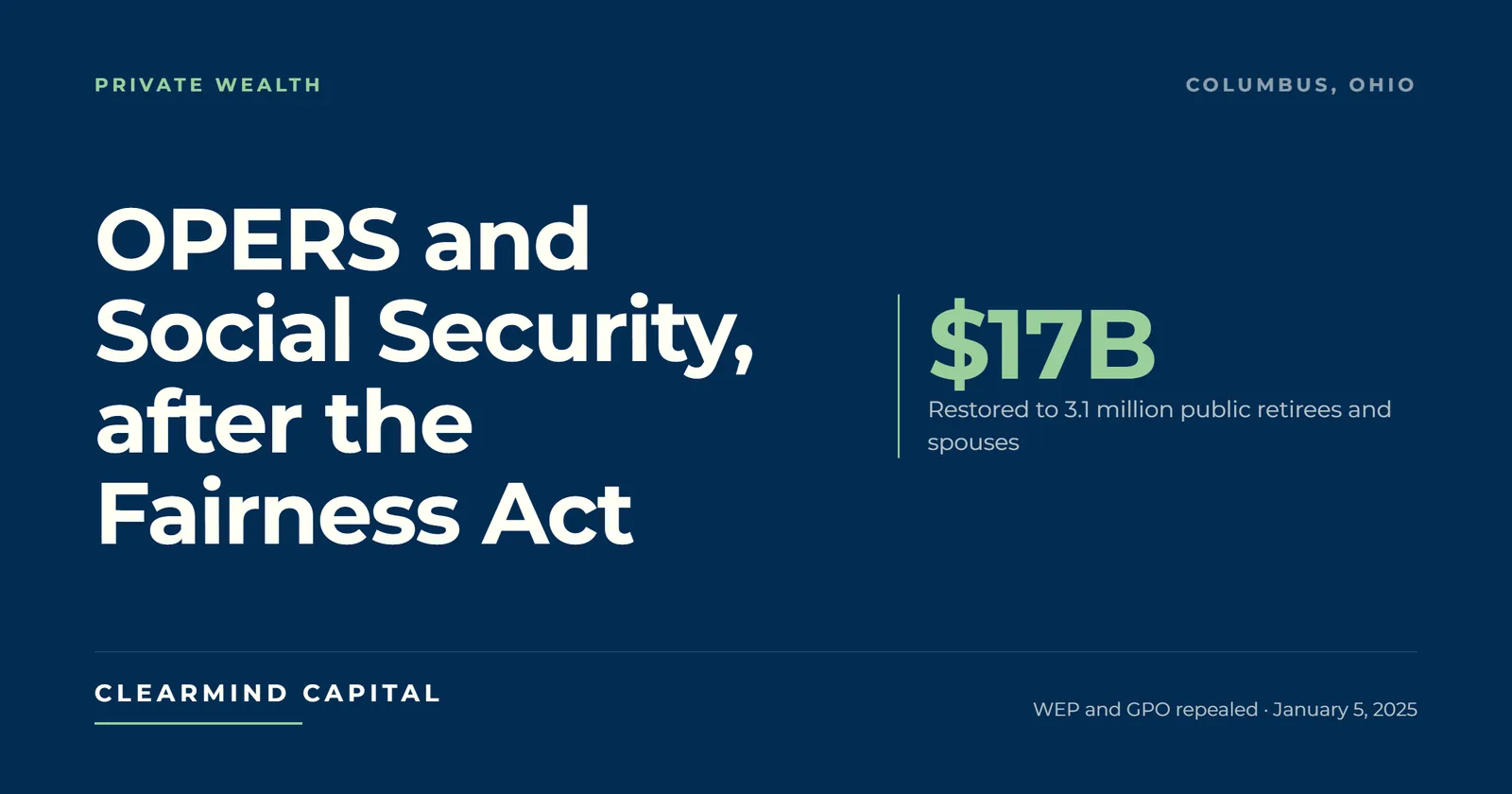
Columbus is a state capital, a county seat, and home to one of the largest public university systems in the country, so the odds that you or someone in your household is a member of the Ohio Public Employees Retirement System (OPERS) are higher here than almost anywhere else in Ohio. For decades, that came with a catch nobody explained well at the time you signed up. If you are a public employee, read this. We're going to try to explain this as simply as we can, so hang in there. Alright, here we go.
This Story Will Help
Picture a woman named Linda. She spent 22 years working for a state agency here in Columbus, an OPERS job. Before that, she spent 12 years at a private company, paying into Social Security like everyone else there did.
When Linda retired, she was owed two separate things. An OPERS pension, built from her 22 years of state work. And a Social Security benefit, built from her 12 years in the private sector.
Now… Social Security's formula is deliberately generous to short careers. It's built to help someone who worked a genuinely low-paying, thin career, by replacing a bigger percentage of their income than it replaces for someone with a long, high-earning career. It's how the program helps people who didn't earn much over a lifetime. Which really… is what the system was designed for originally.
The problem is, the formula only sees what it sees. It looked at Linda's 12-year Social Security record and treated it like her entire career, because that's all Social Security has any visibility into. Her other 22 years, the OPERS years, never touched Social Security's books at all. So the formula calculated her benefit as if she'd been a low lifetime earner, and paid her the generous rate meant for exactly that kind of career.
But Linda wasn't a low lifetime earner. She worked 34 years straight, just for two different retirement systems. And now she had OPERS pension income coming from the years Social Security couldn't see.
So Congress created the Windfall Elimination Provision (WEP) - if you also have a pension from work that never paid into Social Security, should your Social Security check still get calculated as if you were poor your whole life? Congress said no, that's a windfall, and WEP reduced the Social Security portion of Linda's income to correct for it.
Now picture Linda's husband, Tom. Tom worked a full, ordinary career, and paid into Social Security every single year of it. He never touched a pension system like OPERS.
Under normal Social Security rules, a spouse who worked less, or didn't work at all, can claim a benefit based on their spouse's record instead of their own. That's the spousal benefit, and it exists specifically to protect a spouse who doesn't have much retirement income of their own.
If Linda had no OPERS pension, she'd be exactly the person that benefit is meant for, and she'd collect a healthy check off Tom's record. But she does have a pension. If you already have your own solid pension income, should you still get the same spousal protection meant for someone with nothing? Congress said no again and created the Government Pension Offset (GPO), and GPO cut Linda's spousal benefit, generally by two-thirds of whatever her OPERS pension paid her. For a lot of households, two-thirds of the pension was more than the entire spousal benefit, which wiped it out completely.
This is what the Social Security Fairness Act Just Repealed
Because in practice, the WEP & GPO was causing more problems than solutions.
WEP used a flat formula that didn't know the actual size of someone's pension. Two people with wildly different pension amounts could see the exact same cut to their Social Security check. It was basically guessing. And well… GPO was worse in this respect. Cutting two-thirds of the pension amount often erased the entire spousal or survivor benefit outright, for households that weren't exactly living large on a modest OPERS pension to begin with.
Teachers, firefighters, police officers, and public employees like Linda, the exact group these systems were built to serve, spent decades arguing that the math had overcorrected. Finally… some change.
With that said, not everyone agreed repealing WEP and GPO was the right call. Critics point out that it reopens the exact scenario these rules were designed to prevent, someone collecting a full pension plus a full, unreduced Social Security benefit, something a person who spent their whole career paying into Social Security and nothing else can't do. It also adds real cost to a program that's already facing long-term funding pressure. Both things can be true. The rules were arguably too blunt, and the repeal arguably brings back the imbalance they were meant to fix. This debate will continue, I’m sure.
What changed for Linda, and maybe for you
For Linda, WEP & GPO are now gone. Her own Social Security benefit is no longer reduced for having an OPERS pension. And if her spousal benefit off Tom's record is higher than her own, she gets bumped up to that higher amount instead, the same way it's always worked for anyone eligible for both. She's now collecting her full OPERS pension plus whichever Social Security number is bigger, her own or the spousal one, both finally calculated without a cut.
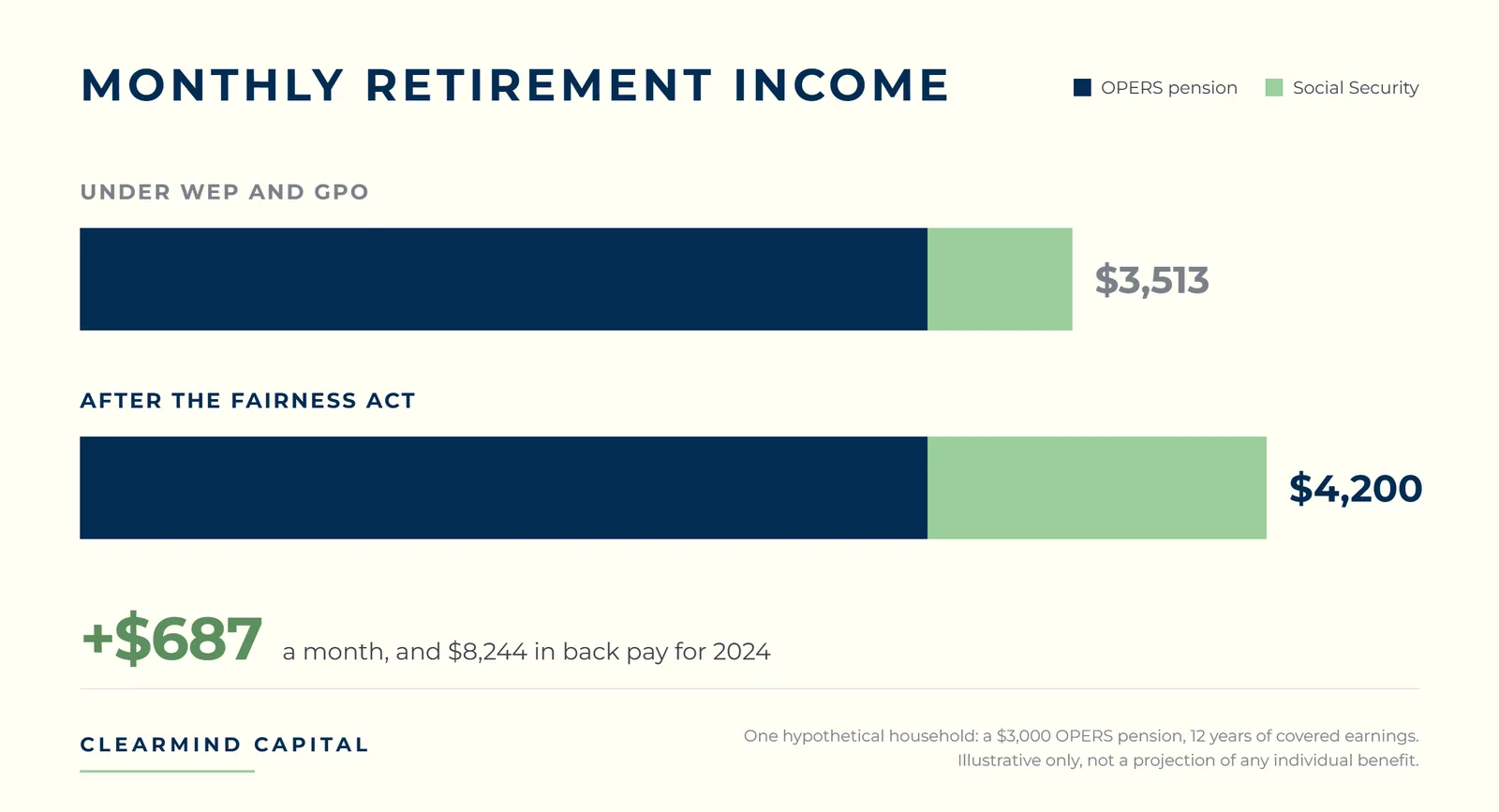
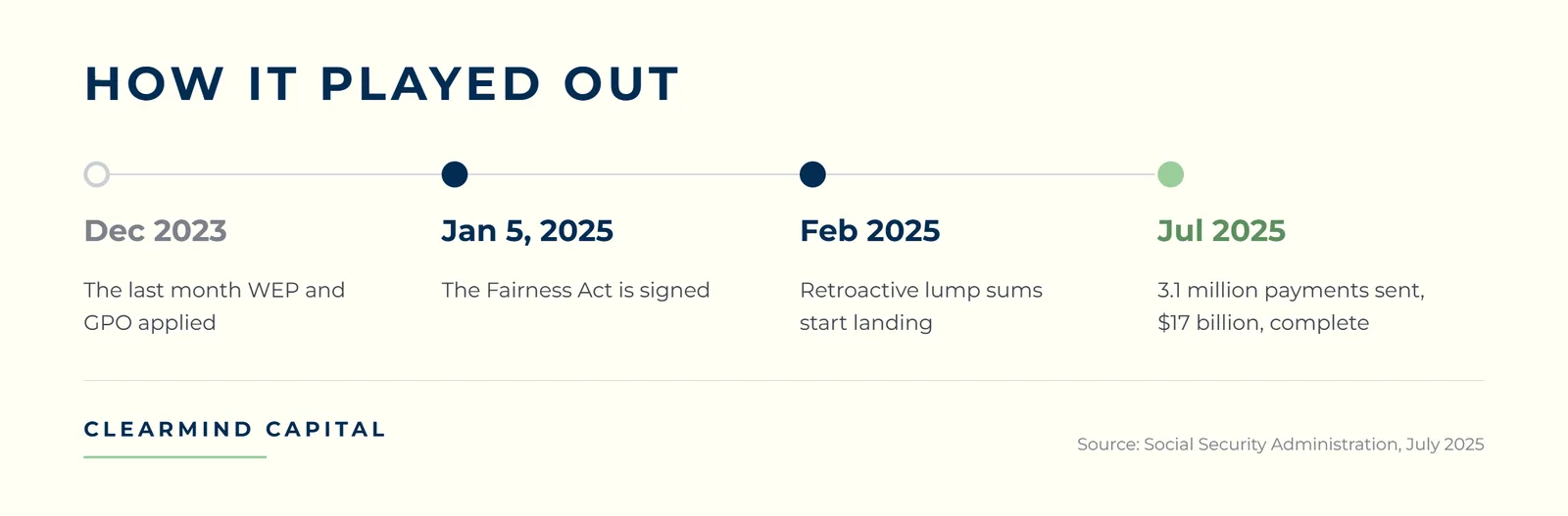
Because of The Social Security Fairness Act, The Social Security Administration owed back payments to everyone who'd already had their 2024 benefit reduced, and most of those retroactive lump sums went out during 2025. Going forward, monthly checks for affected OPERS members and their spouses are calculated without either rule in the formula at all.
If you assumed years ago that your number would always come in reduced, that assumption is now out of date.
Who This Covers
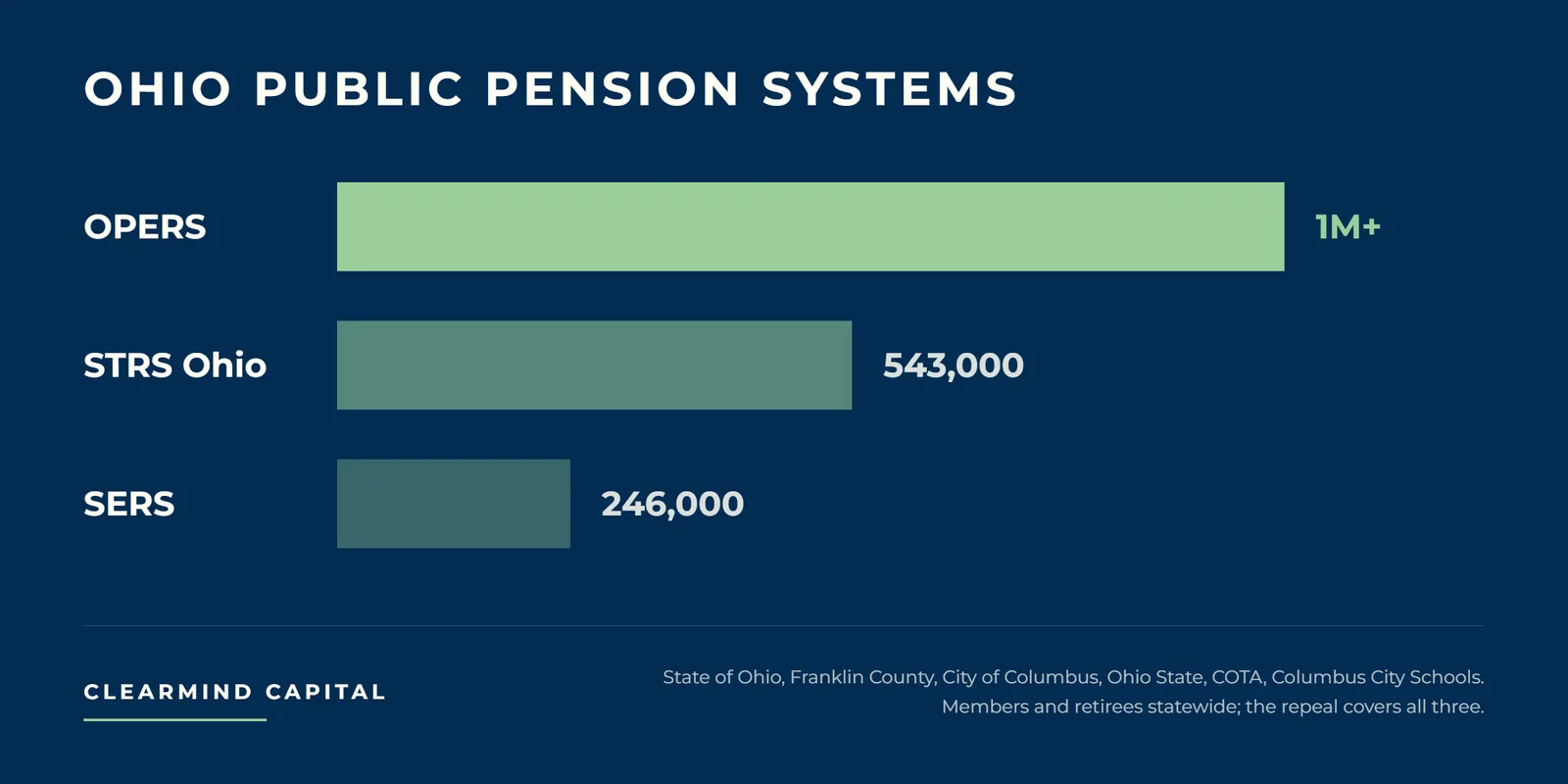
OPERS covers most state and local government employees in Ohio. Classroom teachers fall under the State Teachers Retirement System (STRS) instead, and non-teaching school employees, like bus drivers, custodians, and cafeteria staff, fall under the School Employees Retirement System (SERS). Everything above applies the same way to STRS and SERS members and their spouses, not just OPERS.
All three systems share the same basic setup Linda has: contributions go into the pension instead of into Social Security, which is exactly why WEP and GPO applied to all of them.
What this means if...
You're still working toward retirement
If you are contributing to OPERS, consider recalibrating your retirement plan with your advisor.
You have OPERS service and also worked private-sector jobs, like Linda
If you have 40 quarters of Social Security-covered earnings somewhere in your history, even from a job decades ago, you likely qualify for a Social Security retirement benefit on your own record, and it's no longer reduced. It's worth requesting an updated estimate directly from Social Security.
Your spouse worked a full career and you're the OPERS member, like Linda and Tom
Your spousal or survivor benefit off their record is no longer cut for having a pension. If you were told years ago you wouldn't qualify for much of anything here, that answer may no longer be correct.
You're deciding when to claim Social Security
The claiming-age math changes when the benefit itself is bigger than you planned for. A benefit that gets a real boost from delaying to 70 is a different decision than one that was mostly wiped out by GPO anyway.
You're weighing whether to take the OPERS pension as a lump sum, an annuity, or some blend
Some OPERS plan types offer choices here, and a larger, un-reduced Social Security benefit changes how much income floor you already have covered, which affects how much risk makes sense in the rest of the decision.
Common Questions
Does the Social Security Fairness Act affect all OPERS members?
Only OPERS members who also qualify for a Social Security benefit, either on their own earnings record from other work or as a spouse or survivor. If you have no Social Security-covered earnings history and no spouse with one, WEP and GPO never applied to you and the repeal doesn't change your situation.
When did the WEP and GPO repeal take effect?
The Social Security Fairness Act was signed into law on January 5, 2025. The repeal is retroactive to benefits payable for months starting January 2024, and most retroactive lump-sum payments were issued during 2025.
How do I know if I was affected by WEP or GPO?
If your Social Security statement or benefit letter ever referenced a reduction for a "non-covered pension," or if you were told a spousal or survivor benefit would be reduced or eliminated because of a pension like OPERS, STRS, or a similar public pension, you were likely affected. Request a current estimate directly from the Social Security Administration to see today's number.
Do OPERS members pay into Social Security?
No. OPERS-covered wages are not subject to Social Security payroll tax. Contributions instead go directly into the OPERS pension system. This is the underlying reason WEP and GPO applied to OPERS members in the first place, and it hasn't changed. What changed is how Social Security treats other, separately covered earnings and spousal benefits.
Is Ohio Deferred Compensation the same as OPERS?
No. OPERS is the pension system itself. Ohio Deferred Compensation is a separate, optional 457(b) savings plan available to most Ohio public employees, similar in function to a 401(k), and it's meant to supplement the OPERS pension rather than replace it.
 Written byNick GeorgeCFP®, ChFC®, CLU®, IWA™FounderView bio →
- Social Security Administration, "Social Security Fairness Act: Windfall Elimination Provision (WEP) and Government Pension Offset (GPO) update," ssa.gov, last updated July 21, 2025.
- Ohio Public Employees Retirement System, "WEP, GPO repealed," PERSpective, Jan. 9, 2025.
- Social Security Fairness Act (H.R. 82), signed into law January 5, 2025.
The information presented in this article is for informational purposes and should not be intended as tax, accounting or legal advice, nor is it an offer or solicitation to buy or sell, or as an endorsement of any company, security, fund, or other offering. Please consult your legal, tax, or accounting professional regarding your specific situation. Investments involve risk and have the potential for complete loss. It should not be assumed that any recommendations made will necessarily be profitable.
The opinions expressed in any commentary posted on this site are solely those of the individual author and do not necessarily reflect the views or opinions of ClearMind Capital, LLC. These opinions are based on information available at the time of posting and are subject to change without notice. ClearMind Capital, LLC, does not commit to updating any posted positions or commentary to reflect subsequent developments. While the information and reasoning used to form these opinions are believed to be from reliable sources, ClearMind Capital, LLC, does not verify this information, and no guarantee is provided regarding its accuracy, completeness, or validity. ClearMind Capital, LLC, disclaims any and all liability for actions taken or not taken based on the content of this site. No warranty, express or implied, is given in connection with the content provided.
Certified Financial Planner Board of Standards Center for Financial Planning, Inc. owns and licenses the certification marks CFP®, CERTIFIED FINANCIAL PLANNER®, and CFP® (with plaque design) in the United States to Certified Financial Planner Board of Standards, Inc., which authorizes individuals who successfully complete the organization’s initial and ongoing certification requirements to use the certification marks.


