Transcript
Words with this mark have a quick definition. Tap one to read it without leaving the article.
Here's a scenario I see quite often. I'll sit down with someone in their mid-50s or early 60s, and they've done everything right. When we run their plan, the numbers work easily. In fact, they work so well that the person could probably stop working right now. And then they tell me they're planning to retire in 10 years, or at age 67. When I ask why 10 years, or why 67, the answer is usually something like, I don't know, that just seems like the right number, or that's what a lot of other people do.
This is so common it's almost unfortunate, because people retire earlier than they think. There are multiple reasons for that. Health, for example, tends to be the number one reason someone retires earlier than planned. But that's not really the message here. The message is something I've learned after having many of these conversations. Most of the time, the reason people stay in their chair longer than they need to comes down to fear. Fear of running out, fear of getting it wrong, fear of change. And most of them never had anyone they trust sit down and walk them through what's actually possible. They think they have to figure it all out on their own.
It's the WebMD effect. You feel something weird in your body, you Google the symptoms, and an hour later you're 80% sure you have some rare disease, and you walk around for six months thinking you might be dying. We try to self-diagnose, when the whole time a 15-minute conversation with an actual doctor would have told you what was going on. Retirement is very similar. People run calculations in their head, compare themselves to their dad who retired at 65 with a pension, scroll through articles late at night, and worry quietly to their spouse. And the whole time, they just never sat down with someone who could show them the picture.
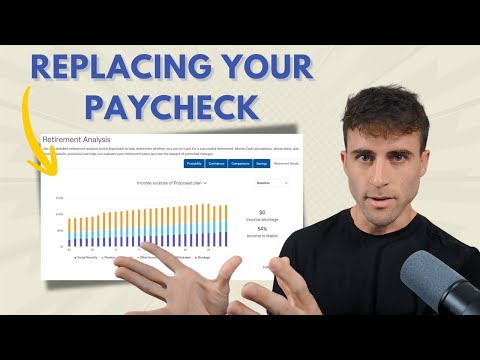
So let me walk through what tends to come into focus when they finally have this conversation. These are all good to know, especially if you're considering retirement or you're around this age. The first thing is where retirement income actually comes from. When I say retirement income, just think withdrawals. You're going to need to start withdrawing money from places to replace your paycheck. A lot of people picture one or two accounts doing all the work, their Glossary of Financial Clarity401(k)A retirement account through your job where money leaves your paycheck before you ever see it. If your employer matches, that match is about the closest thing to free money you'll get offered at work. It comes in traditional (tax later) and Roth (tax now) flavors.General education only. Not tax or investment advice. Read the full story and Glossary of Financial ClaritySocial SecuritySocial Security is the federal program that sends monthly checks to retirees, along with some disabled workers and survivors. You pay into it through payroll taxes your whole working life, and what you eventually collect depends on your earnings history and the age you start claiming. For most retirees it's the one paycheck that lasts as long as they do.General education only. Not tax or investment advice. Read the full story, and then they try to push that into a calculator and have the calculator tell them when they can retire. But those withdrawals usually come from more sources than one or two accounts, and they all behave differently.
You have the pre-tax bucket: Glossary of Financial ClarityTraditional IRAThe mirror image of a Roth: take the tax break now, let it grow untouched, and settle up with the IRS when you pull the money out in retirement. So you're betting your tax rate will be lower later than it is today. Handy in your peak earning years, when that upfront break is worth the most.General education only. Not tax or investment advice. See the full glossary, pre-tax 401(k), money you put away before paying taxes, so you'll pay taxes when you take it out. Then the tax-free bucket: Glossary of Financial ClarityRoth IRANamed after Senator William Roth, who pushed it into law in 1997. The design is clever on both ends: you pay the tax now instead of later, so the government collects its revenue up front, and in exchange your money grows and comes out completely tax-free in retirement. You put in dollars you've already been taxed on, let them grow for years, and qualified withdrawals down the road owe nothing. You're basically betting your tax rate later will be higher than it is today, which is why it tends to shine early in a career or in a low-income year.General education only. Not tax or investment advice. Read the full story, Glossary of Financial ClarityRoth 401(k)The Roth version of your workplace 401(k). Your contributions come out of your paycheck after tax, so there's no break today, but the money grows tax-free and qualified withdrawals in retirement owe nothing. There's also no income cap to use it, so high earners who are shut out of a Roth IRA can still go Roth here, as long as the plan offers it.General education only. Not tax or investment advice. Read the full story, where you already paid taxes and the money grows the rest of the way without being taxed again. And then maybe a taxable bucket, like a brokerage account or savings, money you can access whenever you want, with few restrictions. Sitting on top of those buckets is Social Security, or maybe a government plan substitute, plus whatever else you've been building. Maybe a pension. Maybe rental income. Maybe a spouse still working a few more years, or part-time income.
Most people already know they have some of these pieces, but what they've never had is a playbook that ties them together. You could have all the right players on a team and still not have a strategy that wins games. A real plan tells you which bucket to pull from first, how that withdrawal affects your tax bill, what we're assuming for market returns and why, what happens if the market drops in year three, and what your health care costs might look like along the way. Once someone sees that playbook, you can almost see them soften up, because the retirement number that scared them last week starts to look a lot different. That's my favorite part of this job.
The next thing people get stuck on is health insurance. People will make an entire retirement decision just off of health insurance. They look at retiring before 65 and say, no way, the cost is going to be too much, and they don't even give it a chance. 65, when Medicare starts, is the minimum age I'll retire. But every time I go through what this would actually look like, they're surprised. Private health insurance in America is priced based on your income. Simply put, the less income you report in a given year, the less you pay for coverage. So if you're at a high-paying job that doesn't offer health insurance and you have to buy it on the private marketplace, that probably looks expensive, and it probably is. But once you're retired and you don't have a paycheck coming in, you've got way more control over your income than you used to.
One wrinkle worth knowing: the enhanced subsidies that ran from 2021 through 2025 expired at the end of last year, so we're back to the old, pre-COVID rules. And there's a hard cliff at the top of the eligibility range. One dollar of income over the line and that health care help disappears entirely, which is exactly why planning is so important. We do not go a dollar over.
The other thing I see is people picturing retirement as binary. Either you're working a full career, or you've stopped completely, no in between. But there's a whole middle setting people miss. You can leave the stressful career, the one that's eating at you and maybe causing other issues in your life, and pick up something low-stakes that covers just a slice of your expenses. Teach a class, consult a few hours a week. The math gets friendlier when you stop thinking about work as something you fully turn off. Some of my favorite client stories are people who downshifted three or four years before they would have called themselves retired, and almost every one of them tells me they have zero regrets. Even if they could retire on paper, retiring fully is a big change. They just wanted more control over their day-to-day.
And then there's the part that has nothing to do with numbers, spreadsheets, or projections at all. There's a book called Die With Zero by Bill Perkins. The premise is that money, time, and health are three separate resources, and a lot of us end up stockpiling the money one years past the point where we still have the other two. The big trips, the years where helping your kids matters because they still need you, those years are mostly behind us at 75. If you're sitting on a plan that already works and you're still grinding because you're scared, you might be trading your best years for a number you just don't need to hit.
I'm not telling anyone to go reckless or burn through their savings tomorrow. The whole reason I do this job is to help people build something sustainable. All I want to put on the table is this: if the plan works and the only thing keeping you in your chair is fear, that's a planning problem worth solving.
So here's where I'll leave it. If you're on the fence about retirement and you're not sure what your plan can support, that's the conversation I want to have with you. Maybe the answer is you need to keep working for a while, but at least you'll know and feel confident about it. And sometimes the answer is you've been able to retire for two years and nobody told you yet. I'd rather you find out either way.
Still wondering where you stand? Here is how we help you know if you are ready to retire.
Common questions
Why do people work longer than they need to?
Usually fear rather than math. Fear of running out, of getting it wrong, of the change itself. Most have never had someone walk them through what their own numbers actually support, so they self-diagnose from articles and comparisons to a parent who retired with a pension. Meanwhile health is the leading reason people end up retiring earlier than they planned anyway.
Where does retirement income actually come from?
More places than most people picture. There's the pre-tax bucket of traditional IRAs and pre-tax 401(k)s, taxed on the way out. The tax-free bucket of Roth accounts, already taxed. And a taxable bucket like a brokerage or savings account, accessible any time. Social Security sits on top, sometimes alongside a pension, rental income, or a spouse still working. The plan is knowing which one to draw from first and what that does to the tax bill.
Can I retire before 65 if I need health insurance?
It's worth running the numbers before ruling it out. Marketplace coverage is priced on reported income, and once the paycheck stops you generally have far more control over what that income looks like than you did while working. Plenty of people set 65 as a hard floor purely on an assumption about cost.
What is the health insurance subsidy cliff?
A hard cutoff at the top of the marketplace subsidy eligibility range. One dollar of income above the line and the assistance disappears entirely rather than phasing out. The enhanced subsidies that ran from 2021 through 2025 have expired, which puts that cliff back in play, so income planning around the threshold matters. Check current-year figures before relying on any specific number.
Do I have to retire all at once?
No, and the middle setting gets overlooked. Leaving a stressful career and picking up something low-stakes that covers a slice of expenses, like teaching a class or consulting a few hours a week, changes the math considerably. It also cushions what is otherwise a very abrupt change.
 Hosted byNick GeorgeCFP®, ChFC®, CLU®, IWA™FounderView bio →
The information presented in this article is for informational purposes and should not be intended as tax, accounting or legal advice, nor is it an offer or solicitation to buy or sell, or as an endorsement of any company, security, fund, or other offering. Please consult your legal, tax, or accounting professional regarding your specific situation. Investments involve risk and have the potential for complete loss. It should not be assumed that any recommendations made will necessarily be profitable.
The opinions expressed in any commentary posted on this site are solely those of the individual author and do not necessarily reflect the views or opinions of ClearMind Capital, LLC. These opinions are based on information available at the time of posting and are subject to change without notice. ClearMind Capital, LLC, does not commit to updating any posted positions or commentary to reflect subsequent developments. While the information and reasoning used to form these opinions are believed to be from reliable sources, ClearMind Capital, LLC, does not verify this information, and no guarantee is provided regarding its accuracy, completeness, or validity. ClearMind Capital, LLC, disclaims any and all liability for actions taken or not taken based on the content of this site. No warranty, express or implied, is given in connection with the content provided.
Certified Financial Planner Board of Standards Center for Financial Planning, Inc. owns and licenses the certification marks CFP®, CERTIFIED FINANCIAL PLANNER®, and CFP® (with plaque design) in the United States to Certified Financial Planner Board of Standards, Inc., which authorizes individuals who successfully complete the organization’s initial and ongoing certification requirements to use the certification marks.