
Words with this mark have a quick definition. Tap one to read it without leaving the article.
Is it worth it for a shop my size?
Curtis asked that in June and again in September. Curtis is made up, though the arithmetic below is what we run on a first call. He is 52, he owns a machine shop in Westerville with eleven people on payroll besides him, and he priced a plan two years ago. He got a setup fee, an annual administration quote, added a match on top of both in his head, landed north of $10,000 and let it sit.
More than half of small firms believe a retirement plan would cost over $10,000 a year, and close to 30% put it above $20,000, in survey work the Pew Charitable Trusts compiled in 2024.
Then his lead machinist asked when the shop was going to have one.
For a business with 50 or fewer employees, the company's own Glossary of Financial Clarity401(k)A retirement account through your job where money leaves your paycheck before you ever see it. If your employer matches, that match is about the closest thing to free money you'll get offered at work. It comes in traditional (tax later) and Roth (tax now) flavors.General education only. Not tax or investment advice. Read the full story bill usually runs a few thousand dollars a year, and a federal credit covers 100% of it for three years, capped at $250 for each eligible employee who is not highly compensated. The bigger number sits on the other side of the ledger. An owner who is 50 or older can defer $32,500 of their own pay into a 401(k) in 2026, against $8,600 in an IRA, and company contributions are deductible on top of that. What is left to decide is the match or profit sharing, which is a design choice rather than a fixed price.
The bill the shop gets
There are two charges and Curtis can get both quoted before he signs anything. Setup is billed once and covers the plan document and the payroll connection. Administration comes every year, normally a base fee plus a charge for each person in the plan. What a 401(k) Really Costs a Small Business takes that bill apart line by line.
Curtis lands at $1,500 to build the plan and about $3,000 to run it the first year, with ten of his eleven people eligible to join. So $4,500, against the five figures he had been carrying around.
The credit covers most of the first year
A business with 50 or fewer employees can claim 100% of what the plan costs to set up and administer, for the first year and the two after it. The cap is $250 for every eligible employee who is not highly compensated, with a floor of $500 and a ceiling of $5,000.
Ten of Curtis's people count, so his cap is $2,500 and his first year nets out around $2,000. 401(k) Tax Credits for a Small Business walks through all three credits and the traps in them.
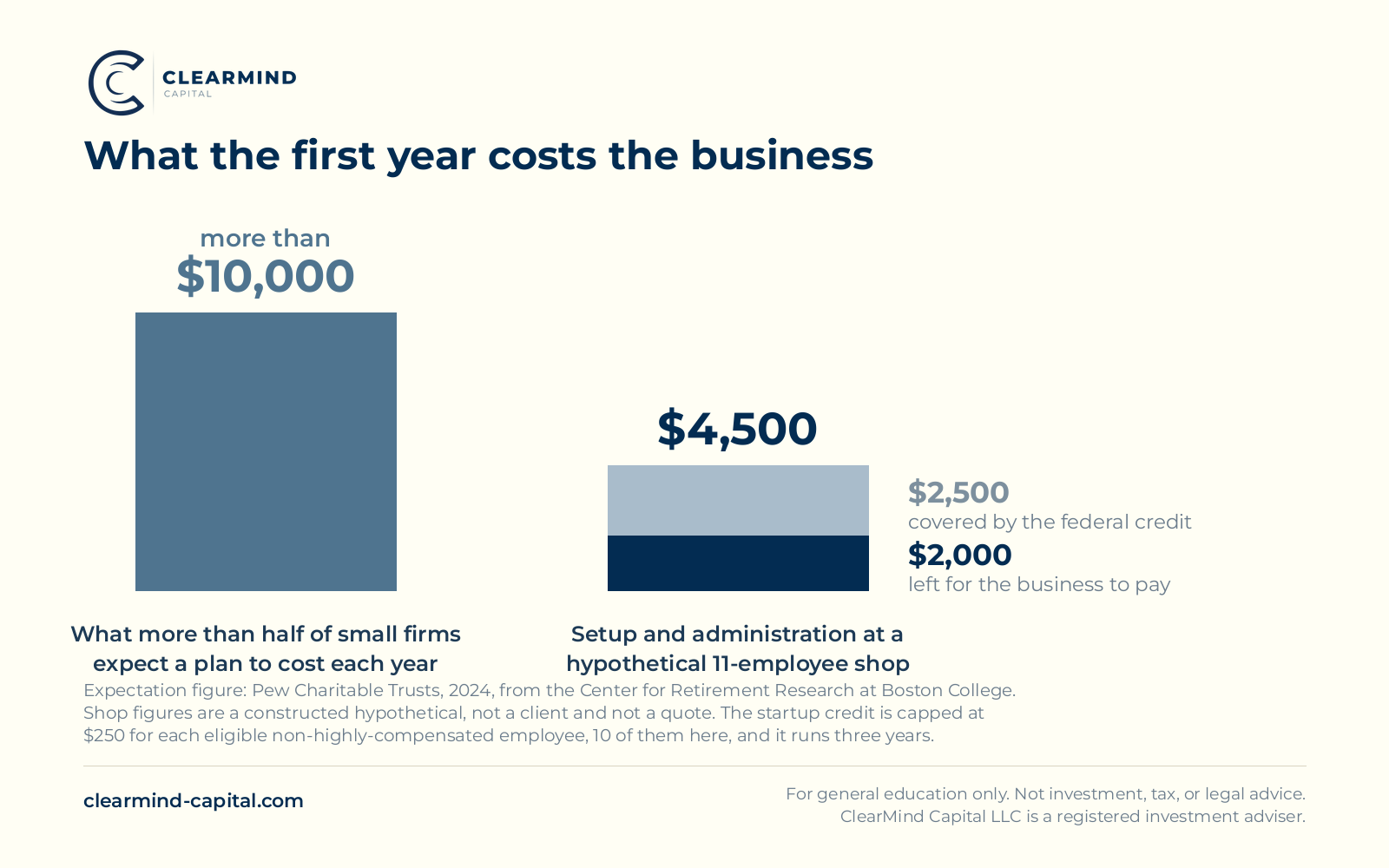
The credit runs three years and then stops. From the fourth year on his shop carries roughly $3,000 of administration a year, which is the recurring cost of having a plan before he puts a dollar in for anybody.
What Curtis gets for it
He is 52, which is the part of this that moves the most money. In 2026 he can defer $24,500 of his own pay, plus $8,000 more because he is over 50, so $32,500 into his own account. Without a plan at the shop, his option is an IRA at $7,500 plus a $1,100 catch-up.
That is $32,500 against $8,600. For an owner at Curtis's age the gap tends to settle the question on its own, whatever the administration runs.
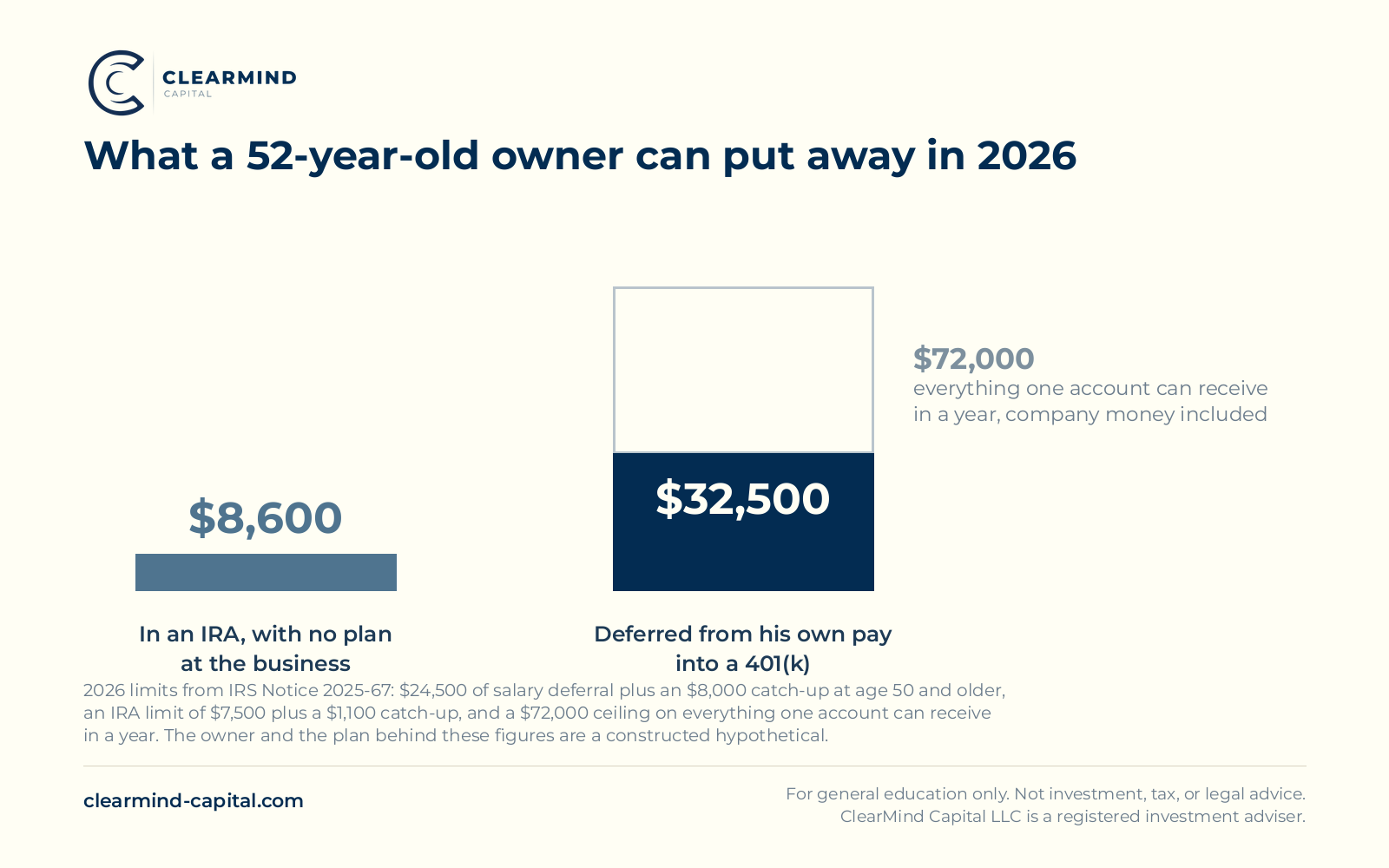
Company contributions are deductible to the business, and some of what the shop puts in lands in Curtis's own account rather than leaving the building. The contribution is still money going out the door, at a lower net cost than the gross figure suggests.
The match is a decision, not a price
Nobody can quote this one in advance, because it follows a design Curtis has not picked yet.
A safe harbor match at 4% of pay would run about $25,000 a year across his crew if every one of them deferred enough to earn all of it. Fewer of them will, at least at first. Profit sharing can be zero in a year when zero is right, and a plan can run with no company money at all, which trades the contribution for annual testing that limits what Curtis himself can defer.
A second credit pays up to $1,000 per employee for what the business contributes, at 100% for the first two years before it steps down. On ten employees that is up to $10,000 a year while it lasts.
What his crew gets
Of the small firms Pew surveyed that already offer a plan, 89% said it helps them hire and keep people. Curtis has one machinist he cannot replace quickly and two apprentices he would like to keep for a decade.
We would also tell him the plan has to work for the people in it, which is where the fund menu and the fees charged against their balances come in. Those are chosen, not inherited, and a plan sold as cheap to the company often costs his crew more. How to Tell if Your 401(k) Fees Are Too High covers how that gets checked.
When the answer is no
Revenue Curtis cannot predict six months out argues for waiting, because a safe harbor contribution is a commitment for the whole plan year once he makes it. A business in that spot sometimes starts with a SIMPLE IRA instead, which costs nothing to administer and asks for a smaller company contribution.
What does not hold up is pricing the 401(k) at $10,000 and stopping there.
Where Curtis starts
With his census. Headcount, pay, ages and how many people he expects to join, because every number above moves with those four things. The design comes next, and the provider after that.
Austin Wolfe and Joe Anderson run Workplace Retirement at ClearMind Capital in Columbus, and set up and administer 401(k) plans for businesses across Ohio and nationwide. Book a call and we will price a design against your own census, or start with the plan assessment if you would rather see the shape of it first.
Common questions
Is a 401(k) worth it for a small business?
Two numbers answer it. What the company pays to run the plan is usually a few thousand dollars a year, covered by a federal credit for the first three years. What the owner can put away in it, at 50 or older, is $32,500 in 2026 against $8,600 in an IRA. The employer contribution sits between those two and is a design choice.
How much does a 401(k) cost a small business per year?
Setup runs from a few hundred dollars to a few thousand once, and administration is a base fee plus a per-person charge every year. Employer contributions are separate and are set by the plan's design. Investment costs come out of participant accounts rather than the company's bank account.
Can a small business start a 401(k) with no match?
Yes. A plan can run with no employer contribution at all. Those plans face annual nondiscrimination testing, which caps what owners and highly paid employees can defer when the rest of the staff defers little. A safe harbor design trades a required contribution for skipping that test.
Is it cheaper to give employees a raise instead of a 401(k)?
They are different kinds of money. A raise is payroll tax to the business and income tax to the employee in the same year, while a 401(k) lets the owner and the staff defer tax on what they put in, and the company contribution carries a credit for up to five years and a deduction after that. Which one fits depends on the business, and it is worth running both past your Glossary of Financial ClarityCPAA CPA, or certified public accountant, is an accountant who has passed a demanding licensing exam and met state experience requirements. Not everyone who does taxes holds the license, and it lets them do things an unlicensed preparer can't, like represent you in front of the IRS and sign off on audited financial statements.General education only. Not tax or investment advice. Read the full story.
Does the owner have to contribute for employees to use the plan themselves?
Not necessarily, though testing usually decides the answer. Without a safe harbor contribution, what owners and highly compensated employees can defer is tied to what everyone else defers, so an owner wanting to use the full limit generally ends up putting money in for the staff.

 Written byAustin Wolfe & Joe AndersonClearMind Capital | Workplace RetirementView bio →
- The Pew Charitable Trusts, Small Employers' Economics of Offering Retirement Savings Plans, July 2024, for the share of small firms expecting a plan to cost over $10,000 and over $20,000 a year, which Pew draws from Anqi Chen, Small Business Retirement Plans, Center for Retirement Research at Boston College, 2023, and for the 89% of surveyed firms offering a plan who said it helps them hire and retain workers, which Pew draws from its own 2017 survey of firms with 5 to 250 employees.
- Internal Revenue Service, Retirement plans startup costs tax credit, for the 100% credit on eligible startup and administration costs at 50 or fewer employees, the cap at the greater of $500 or the lesser of $250 per eligible non-highly-compensated employee or $5,000, the three-year period, and the employer contribution credit of up to $1,000 per employee at 100%, 100%, 75%, 50% and 25%.
- Internal Revenue Code section 45E, for the same limits in the statute, including at subsection (f) the $1,000 per employee contribution credit and its wage ceiling.
- Internal Revenue Service, Notice 2025-67, for every 2026 figure: the section 402(g) elective deferral limit of $24,500, the section 414(v) age-50 catch-up of $8,000, the section 415(c) annual additions limit of $72,000, the section 219(b)(5) IRA limit of $7,500 and its $1,100 catch-up, and the section 414(q)(1)(B) highly compensated employee threshold of $160,000.
- Internal Revenue Service, 401(k) Plan Overview, for nondiscrimination testing, safe harbor designs and the deductibility of employer contributions under Internal Revenue Code section 404.
- Curtis, his headcount, his payroll and every dollar figure attributed to his shop are a constructed hypothetical for illustration, not a client and not a quote.
The information presented in this article is for informational purposes and should not be intended as tax, accounting or legal advice, nor is it an offer or solicitation to buy or sell, or as an endorsement of any company, security, fund, or other offering. Please consult your legal, tax, or accounting professional regarding your specific situation. Investments involve risk and have the potential for complete loss. It should not be assumed that any recommendations made will necessarily be profitable.
The opinions expressed in any commentary posted on this site are solely those of the individual author and do not necessarily reflect the views or opinions of ClearMind Capital, LLC. These opinions are based on information available at the time of posting and are subject to change without notice. ClearMind Capital, LLC, does not commit to updating any posted positions or commentary to reflect subsequent developments. While the information and reasoning used to form these opinions are believed to be from reliable sources, ClearMind Capital, LLC, does not verify this information, and no guarantee is provided regarding its accuracy, completeness, or validity. ClearMind Capital, LLC, disclaims any and all liability for actions taken or not taken based on the content of this site. No warranty, express or implied, is given in connection with the content provided.
Certified Financial Planner Board of Standards Center for Financial Planning, Inc. owns and licenses the certification marks CFP®, CERTIFIED FINANCIAL PLANNER®, and CFP® (with plaque design) in the United States to Certified Financial Planner Board of Standards, Inc., which authorizes individuals who successfully complete the organization’s initial and ongoing certification requirements to use the certification marks.


