
Maya films recipes in her home kitchen. She'd been at it for two years, and she figured… why not? She loved it, and it started to bring in a little extra money. Then a five-ingredient dinner video went viral. Her account took off, and before she knew it, brand deals were coming in. In six months, her bank balance was higher than she'd ever seen.
She did what most of us would do. She caught up on bills, took her family to the beach, and upgraded her camera gear. The rest she left sitting in her checking account, figuring that was the safe move.
Trouble is, none of that money was as free as it looked. Between the taxes nobody warned her about, income that swings from a huge month to a dead one, and the burnout that creeps in from feeding the algorithm every single day, building any kind of system around your money gets hard fast. Maya isn't a real person, but her situation is about as common as it gets in 2026. Creators deal with a set of money problems that nobody really hands you a manual for. So here is ours.
The Day You Became a Business
The moment you take your first dollar from a brand deal, you're a business. Well, the Glossary of Financial ClarityIRSThe IRS, or Internal Revenue Service, is the federal agency that collects taxes and enforces the tax code. It processes returns, sends refunds, and runs audits. Most of what feels like a tax rule in everyday life is the IRS turning the laws Congress writes into forms, deadlines, and instructions.General education only. Not tax or investment advice. Read the full story sees you as one. You don't have to file Glossary of Financial ClarityLLCAn LLC, or limited liability company, is a business structure that puts a legal wall between the company and your personal stuff. If the business gets sued or runs up debt, your house and savings generally aren't on the hook. It's a favorite for freelancers and small business owners because it's lighter to run than a corporation but still gives you that protection.General education only. Not tax or investment advice. Read the full story paperwork or print business cards for that to be true. Once you earn $400 or more in net self-employment income in a year, you owe Glossary of Financial ClaritySelf-employment taxWhen you work for yourself, self-employment tax is the Social Security and Medicare bill you cover on your own. On a regular paycheck your employer pays half of that and you pay the other half. Working for yourself, you're both halves, so you owe the full 15.3% on your net profit. It catches a lot of new freelancers off guard the first year.General education only. Not tax or investment advice. Read the full story and you file a Schedule C with your return.
But in case nobody said it... congratulations! Being a business owner is exciting. The catch is that a whole pile of new jobs came with it.
You Are Not a W-2
You already know this isn't a normal job, and there's no normal paycheck landing every two weeks. That's exactly why a system around your cash flow matters more for you than for almost anyone else. It comes down to two tax bills hiding inside every payment you get.
- Regular income tax. The same tax everyone pays, based on your bracket.
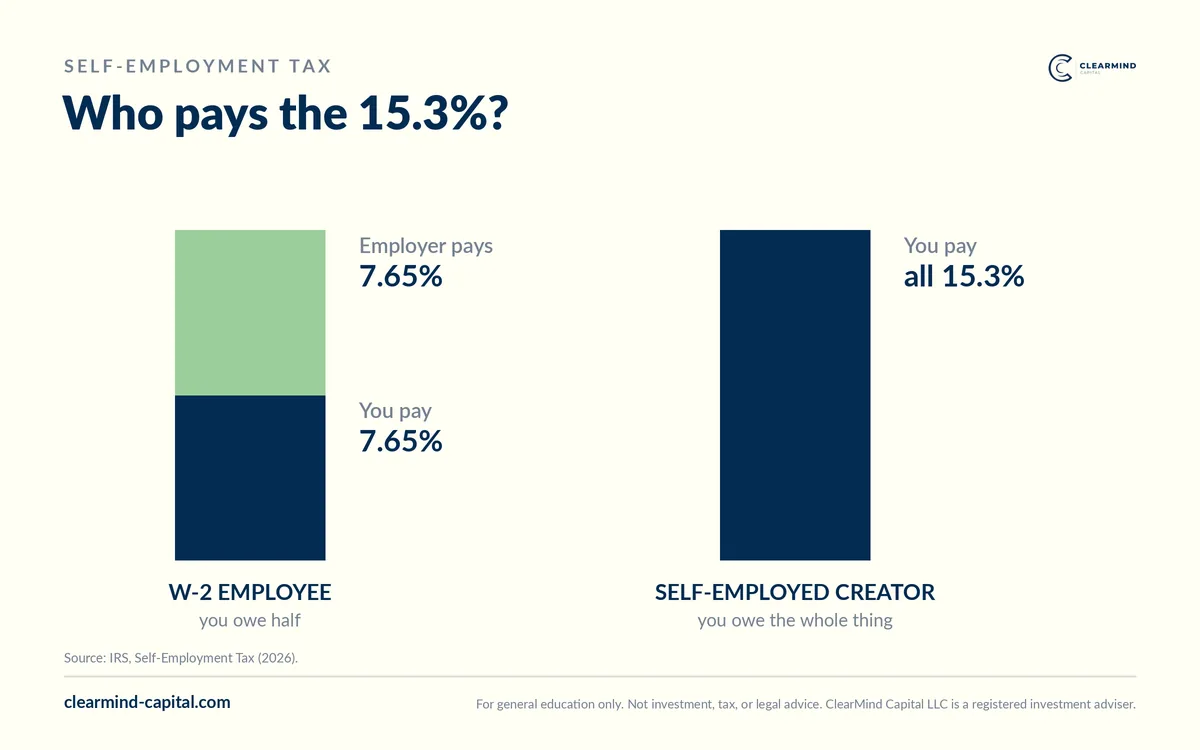
- Self-employment tax. This is 15.3% of your net earnings (12.4% for Social Security and 2.9% for Medicare). A W-2 employee pays half of this and their employer covers the other half. You're both now, so you pay all of it.
There's a little relief built in. You get to deduct the employer half of that self-employment tax when you figure your income tax. And the 12.4% Social Security piece stops once your earnings pass $184,500 in 2026, though the 2.9% Medicare piece keeps going no matter how high you climb.
Okay, I Need To Withhold... What's Next?
There's no rule for exactly how you set the money aside. That part is on you. But the IRS does expect you to pay as you earn, all year long. That's what paying taxes really is, a running tab you settle as you go. Your tax return is really just where you close the books for the year and true up what you owe. That's true for everyone, W-2 or not. The only difference is that nobody's withholding for you, so you pay in four times a year yourself.
Your Glossary of Financial ClarityCPAA CPA, or certified public accountant, is an accountant who has passed a demanding licensing exam and met state experience requirements. Not everyone who does taxes holds the license, and it lets them do things an unlicensed preparer can't, like represent you in front of the IRS and sign off on audited financial statements.General education only. Not tax or investment advice. Read the full story runs the numbers and gives you "estimates," payments sized so you land close enough that the IRS doesn't hit you with an underpayment penalty. You settle the rest when you file. If you expect to owe $1,000 or more for the year, you're on the hook to make these, and they're usually due in April, June, September, and January.
Skip them and you can get hit with a penalty even if you pay the whole thing in April. The way you avoid that is called the safe harbor: pay in at least 90% of this year's tax, or 100% of what you owed last year (110% if you're a higher earner), and you're in the clear. For a creator, last year's number is the easy one to aim at, since it's already locked in and can't move on you. Your CPA tracks and uses all of this to determine your payment schedule... so you don't need to remember all this. Just try not to skip those quarterly payments so you don't end up sending more to the IRS than you need to.
Riding the Income Waves
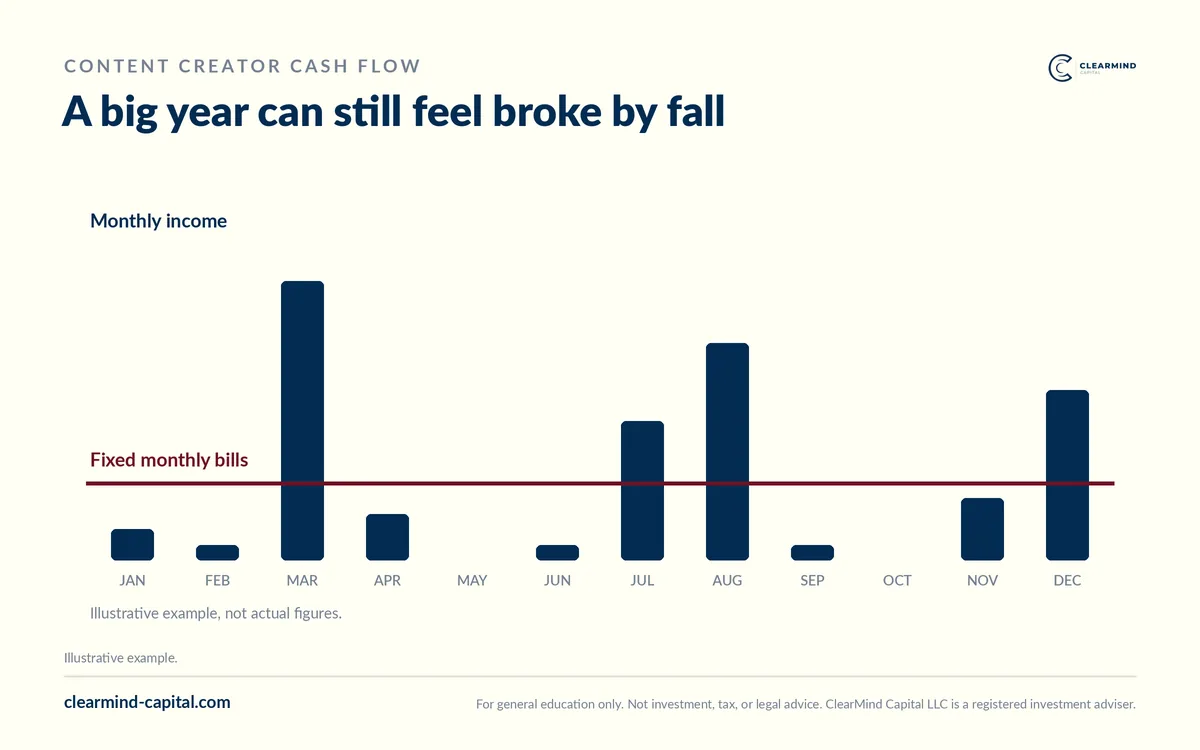
The money comes in waves.... you know this. You also know that your rent payment doesn't ride those waves. It costs the same in a dead month as it does in a huge one, and so does the car payment and the health insurance.
That gap, between income that jumps around and bills that never move, is one of the hardest parts of this whole thing. You can pull in $120,000 and still feel dead broke by October, just because the bulk of it landed back in March and March is long gone.
The Future
Think about someone who owns a couple of franchise locations. They spend years building the thing up so that one day they can hopefully sell it and walk away.
A lot of creators don't have that. When you're the brand, the business is basically you, and there's no clean way to sell yourself to the next owner. Your audience follows you personally, so the value lives in you. That makes it worth a fortune while you're running it and nearly impossible to hand off to anyone else. That's not to say creators never build something sellable. You've got your IP, and maybe a product line down the road. But plenty don't, and for those creators, the business closes its doors the day they stop posting.
And to top it off, the main engine (income) is fragile. A platform can change how it pays overnight, or a brand can kill the campaign that was your biggest check without warning, and there's usually no one to call and nothing you did to cause it.
Put those two things together and you've got the whole point of this section. Your income can dry up, and you may not have a business to sell when it does. So the wealth you build outside the business, while the money is still good, becomes the real asset. That's your exit. Building it while you can is the whole game for a creator, and the best time to start is right now, while the big months are still rolling in.
Funding Your Own Exit
So how do you build it? Well... of course it depends. A person who has kids will have a different future vision than a person without kids. Everyone is so unique in want they want their future to hold.
Let's take a common goal, like retirement, to keep it simple. We prefer a more detailed goal, but we digress.
At a corporate job, retirement mostly happens on autopilot. There's a 401(k), maybe a match, and the money moves over before you can spend it. Nobody sets that up for you as a creator, so... you guessed it... you need to set it up yourself. The good news is the tools built for self-employed people are quite generous. Two examples:
- SEP-IRA. Contribute up to 25% of your net self-employment earnings, up to $72,000 in 2026. Easy to open, almost no upkeep.
- Solo 401(k). Lets you save even more at the same income. You contribute as the employee (up to $24,500 in 2026) and as the employer, up to that same $72,000 combined.
For a creator coming off a strong year, that's a serious chunk of income you can shelter from taxes now while you build the nest egg that becomes your actual retirement. However, these things are complex, and it can be hard to know what is right for you to do. Read: What Does Financial Independence Mean?
Where This Leaves You
There are some incredible benefits of being a business owner, but it does come with more responsibility. It just asks you to do a handful of things an HR department would normally handle for you: set aside your own taxes, smooth out your own paychecks, build your own safety net, and fund your own retirement. Once those systems are up and running, your overall confidence and day-to-day feel should hopefully increase in a positive way.
Remember... the sooner the right systems and team are in place, the more of that hard-earned money (& brain energy) you get to keep.
You're doing great. Keep it up. Read: When To Hire a Financial Advisor
Common Questions
Do I owe taxes if this is just a side thing?
Probably, yeah. If you're doing it to make money and it's bringing money in, the IRS treats it as a business, and $400 or more in net earnings means you owe self-employment tax. A true hobby gets taxed differently and can't write off losses the same way. If you're not sure which side of the line you're on, that's worth a real conversation, because it changes a lot.
How much should I set aside from each payment?
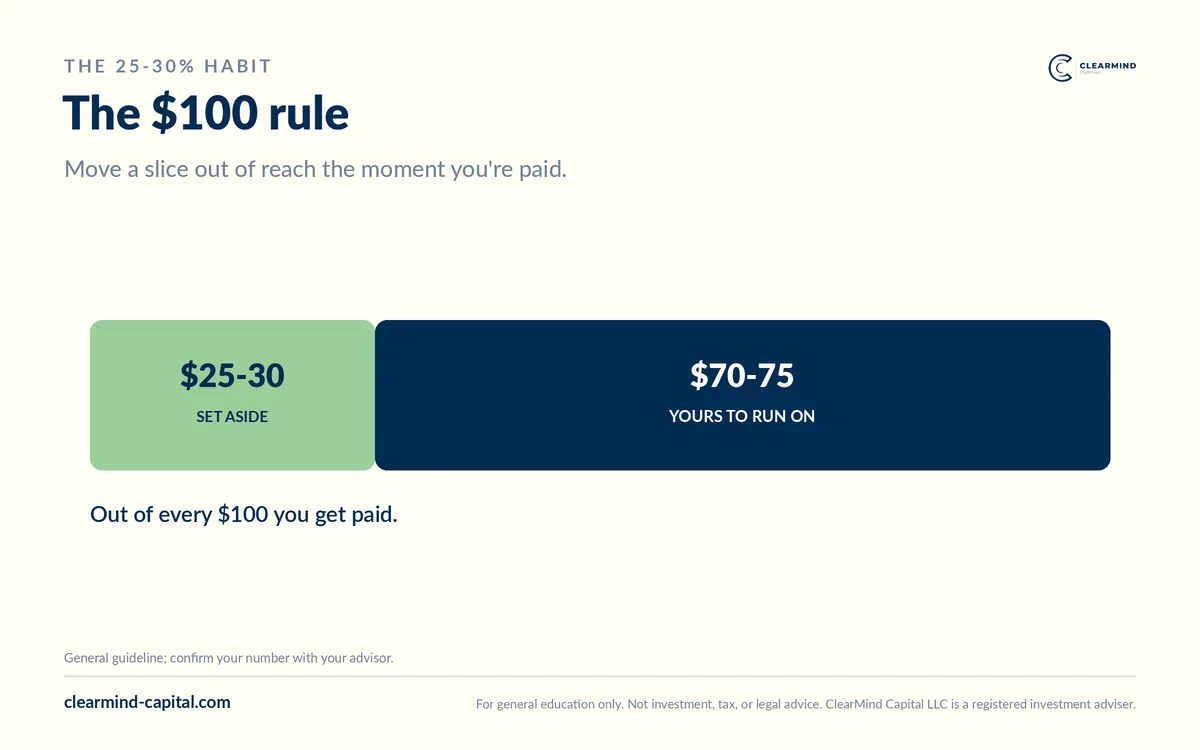
Start with 25% to 30% off the top of every payment, moved somewhere you won't touch it. Your real number depends on your total income, your state, and your deductions, so it's worth pinning down instead of guessing. Guessing low is how you end up like Maya in April.
What are estimated taxes and when are they due?
They're taxes you send the IRS yourself, four times a year, roughly April, June, September, and January, since no employer is doing it for you. If you expect to owe $1,000 or more for the year, you're on the hook to make them.
Should I set up an LLC or an S-corp?
Maybe. An entity can give you some liability protection and, once your income gets high enough, real tax savings. It also costs money and adds paperwork. It's a numbers decision, so make it with an advisor who's looked at your numbers, not off some video you saw.
If I can't really sell my business, how do I build wealth?
This is the big one. You build it outside the business, on purpose, while the income is strong. Retirement accounts, taxable investments, a real cash reserve, maybe real estate down the road. Your personal balance sheet becomes the thing you're really building, and every good month is a chance to add to it.
What retirement account makes sense for a creator?
A SEP-IRA is easy and lets you put away up to 25% of your net earnings (up to $72,000 in 2026). A Solo 401(k) can let you save even more at the same income. Which one fits comes down to how much you want to sock away and how steady your income is.
This is one of the questions families bring us most. See how we plan around it.

 Written byNick George & Shane DuckworthClearMind Capital | Private WealthView bio →
- IRS — Self-employment tax (Social Security and Medicare taxes): 15.3% rate, 12.4% + 2.9% split, employer-half deduction, $400 filing threshold. https://www.irs.gov/businesses/small-businesses-self-employed/self-employment-tax-social-security-and-medicare-taxes
- SSA — Contribution and Benefit Base: 2026 Social Security taxable maximum $184,500. https://www.ssa.gov/oact/cola/cbb.html
- IRS — Estimated taxes: $1,000 threshold, four payment periods, 90%/100% (110% higher income) safe harbor. https://www.irs.gov/businesses/small-businesses-self-employed/estimated-taxes
- IRS — Understanding your Form 1099-K: $20,000 / 200-transaction reporting threshold; income taxable regardless of form. https://www.irs.gov/businesses/understanding-your-form-1099-k
- IRS — COLA increases for dollar limitations (2026): SEP max $72,000; 401(k) elective deferral $24,500; defined contribution limit $72,000. https://www.irs.gov/retirement-plans/cola-increases-for-dollar-limitations-on-benefits-and-contributions
- IRS — 401(k) limit increases to $24,500 for 2026 (IR-2025-111). https://www.irs.gov/newsroom/401k-limit-increases-to-24500-for-2026-ira-limit-increases-to-7500
- IRS — Know the difference between a hobby and a business. https://www.irs.gov/newsroom/know-the-difference-between-a-hobby-and-a-business
The information presented in this article is for informational purposes and should not be intended as tax, accounting or legal advice, nor is it an offer or solicitation to buy or sell, or as an endorsement of any company, security, fund, or other offering. Please consult your legal, tax, or accounting professional regarding your specific situation. Investments involve risk and have the potential for complete loss. It should not be assumed that any recommendations made will necessarily be profitable.
The opinions expressed in any commentary posted on this site are solely those of the individual author and do not necessarily reflect the views or opinions of ClearMind Capital, LLC. These opinions are based on information available at the time of posting and are subject to change without notice. ClearMind Capital, LLC, does not commit to updating any posted positions or commentary to reflect subsequent developments. While the information and reasoning used to form these opinions are believed to be from reliable sources, ClearMind Capital, LLC, does not verify this information, and no guarantee is provided regarding its accuracy, completeness, or validity. ClearMind Capital, LLC, disclaims any and all liability for actions taken or not taken based on the content of this site. No warranty, express or implied, is given in connection with the content provided.
Certified Financial Planner Board of Standards Center for Financial Planning, Inc. owns and licenses the certification marks CFP®, CERTIFIED FINANCIAL PLANNER®, and CFP® (with plaque design) in the United States to Certified Financial Planner Board of Standards, Inc., which authorizes individuals who successfully complete the organization’s initial and ongoing certification requirements to use the certification marks.