Every three years, the county auditor updates the estimated market value of every house in Franklin County. In the last big update (2023), those values went up by a median of 41%.
When you see a jump that high, it is easy to assume your property tax bill is about to go up by 41% too. But Ohio property taxes do not work that way. A law called House Bill 920 (passed in 1976) actually acts as a buffer, preventing your taxes from shooting up at the exact same rate as your home's value.
Ready to dive deeper on such an exciting topic?!
How Your Property Tax Bill Is Calculated
A common misconception is that the county takes your home's total market value and multiplies it by a tax rate... but the good news... it isn't calculated that way.
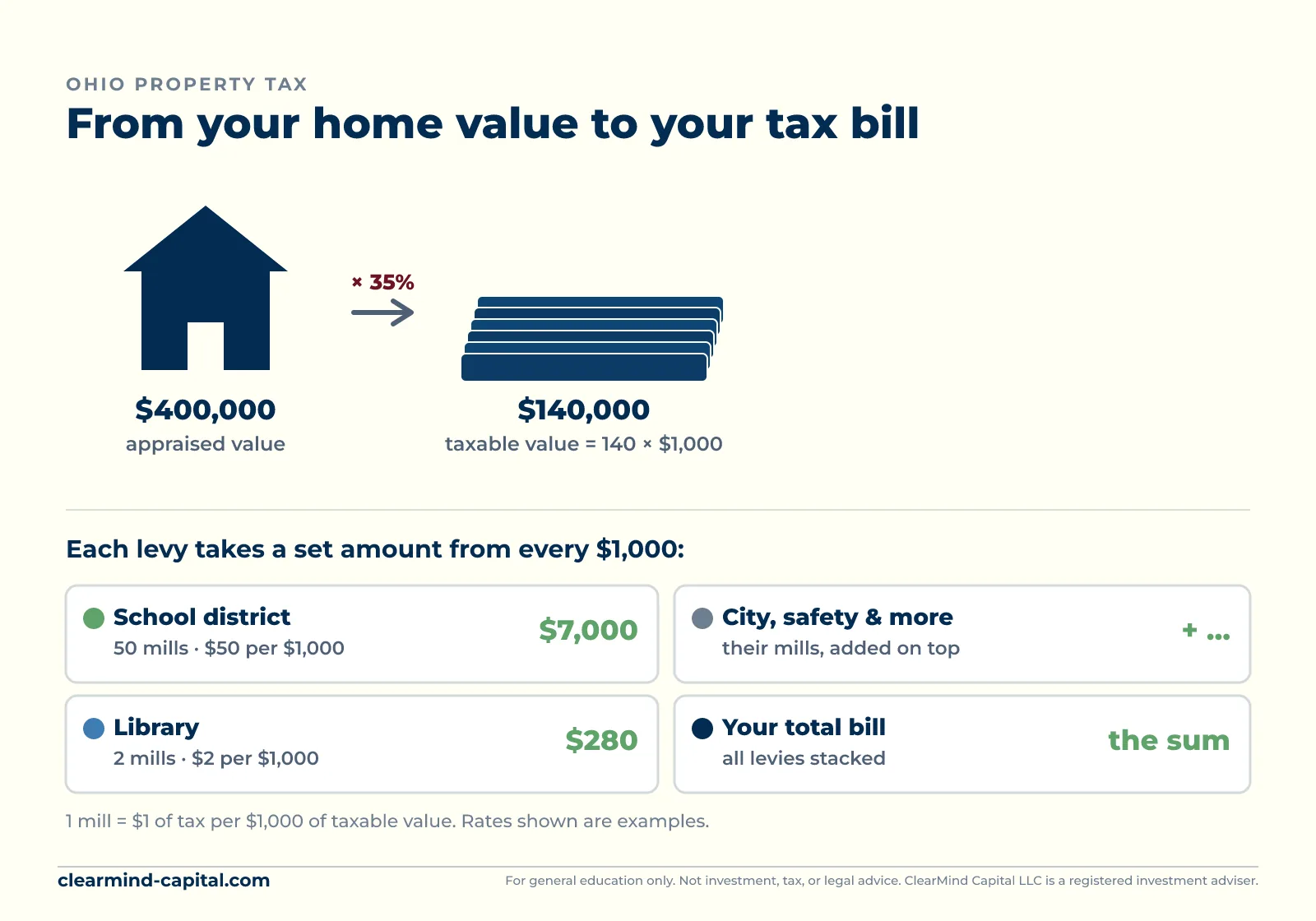
Ohio only calculates property taxes using 35% of your home's appraised value. If the county auditor decides your house is worth $400,000, you are only taxed as if it were worth $140,000. That $140,000 is your taxable value, and it is the starting point for every calculation. Alright cool, step 1 done.
Once the county finds your taxable value, they apply the tax rate using a unit called a mill. The word "mill" comes from the Latin word for a thousand. In property taxes, one mill means you pay exactly $1 of tax for every $1,000 of your home's taxable value.
Instead of one single property tax rate, your total rate is a combination of smaller taxes added together. It's perfectly normal if you are confused...
The 1976 Law Doing the Heavy Lifting
In 1976, Ohio passed a protection law called House Bill 920. To understand why it exists, you have to look at what happens when you vote on a local tax. When voters approve a school or township tax, they are agreeing to give that group a specific, fixed pool of money... say, exactly $10 million a year to run the schools. You are not signing a blank percentage check that grows automatically every time the local housing market booms.
Because of this law, when a countywide update pushes everyone’s property values up at the exact same time, the state steps in and automatically lowers the tax rate. The paperwork says your home is worth more, but the tax rate drops to keep the total cash collected by the school or township exactly the same.

Why Does Your Bill Still Climb?
So if that law protects your wallet, why does your property tax bill still tick upward over time? It comes down to three specific exceptions that the law cannot block:
- The Unvoted Tax (Inside Millage): Every local district has a small tax rate baked into the system that was created generations ago and never requires a public vote. House Bill 920 is legally banned from touching this slice. Because the rate stays fixed, the money you owe here rises directly alongside your property value.
- Brand-New Taxes: Any brand-new tax levy that voters approve on election night bypasses the old protections. It hits your bill at its full, unreduced rate based on your highest home value.
- Home Improvements: If you finish your basement, add a bathroom, or build a deck, you are increasing your individual home value on your own terms.
The 2026 Update and Your Appeal Window
Ohio counties update property values on a rolling three-year schedule. Franklin County did its major reset in 2023, which caused that highly publicized 41% average jump. Right now, the county is running its mid-cycle 2026 update.
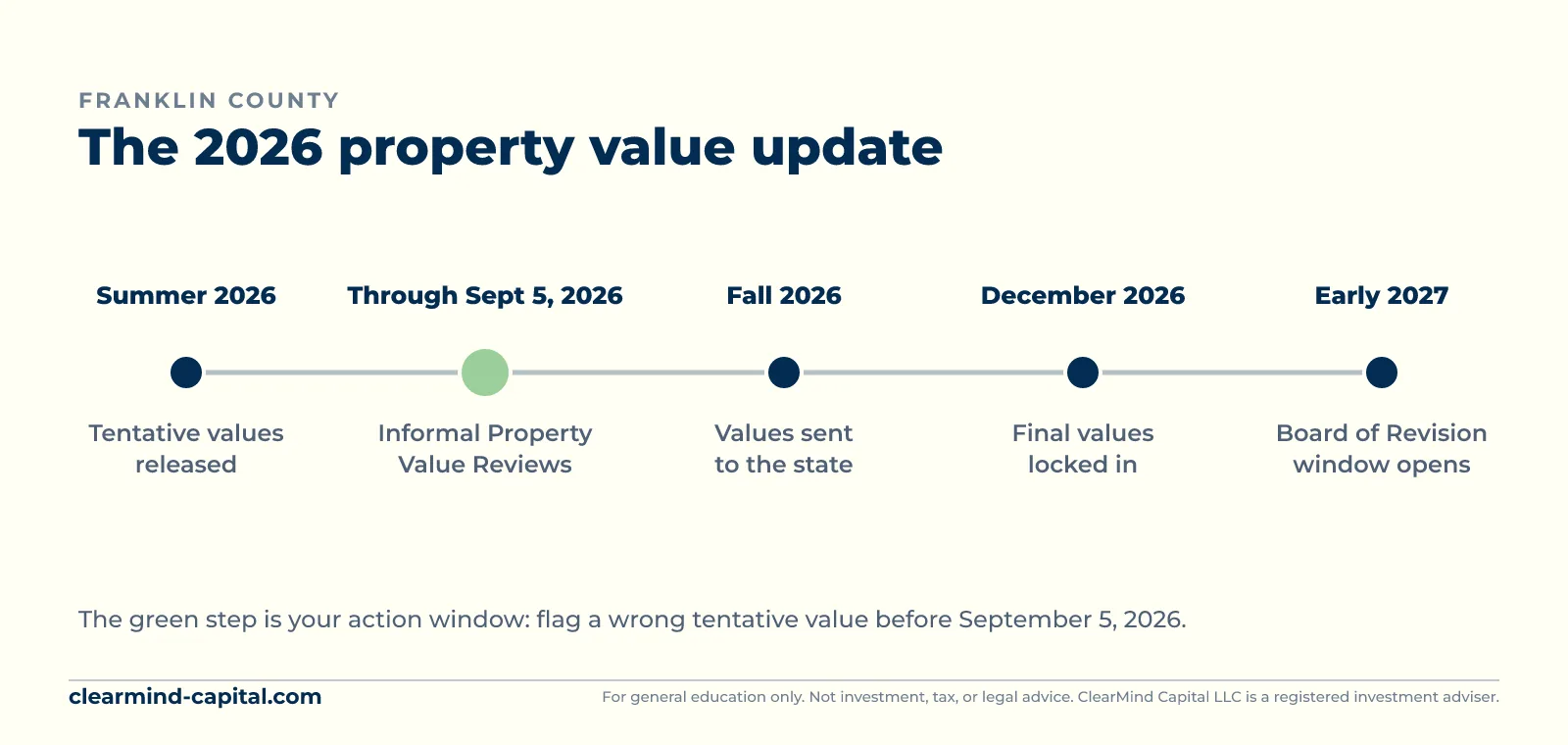
The Auditor has released these tentative 2026 values online. Homeowners have a window until September 5, 2026, to file an informal Property Value Review. After this date, the numbers are sent to the state, and the final values lock in this December.
If the county's new estimate looks completely wrong based on what houses are actually selling for on your street, you get two separate chances to fight it:
- The Informal Review (Easiest-ish): You can flag the value on the Auditor's website before September 5, 2026, and submit simple proof. This can be a recent appraisal, contractor quotes for structural problems like a cracked foundation, or photos of major damage you haven't fixed.
- The Formal Complaint: If you miss the September deadline, you have to file a formal paperwork challenge with the Board of Revision between January and March 31.
Tax Credits
A few specific programs cut down your bill directly, though many homeowners leave money on the table by failing to apply for them.
- The Homestead Exemption: This is designed for seniors aged 65 and older, or permanently disabled residents. If your income is under the state limit (roughly $41,000 for recent applicants), the state completely shields the first $29,000 of your home's value from being taxed. Disabled veterans can qualify for an enhanced version that shields $58,000. You must apply for this manually through the Auditor's office; it never switches on automatically.
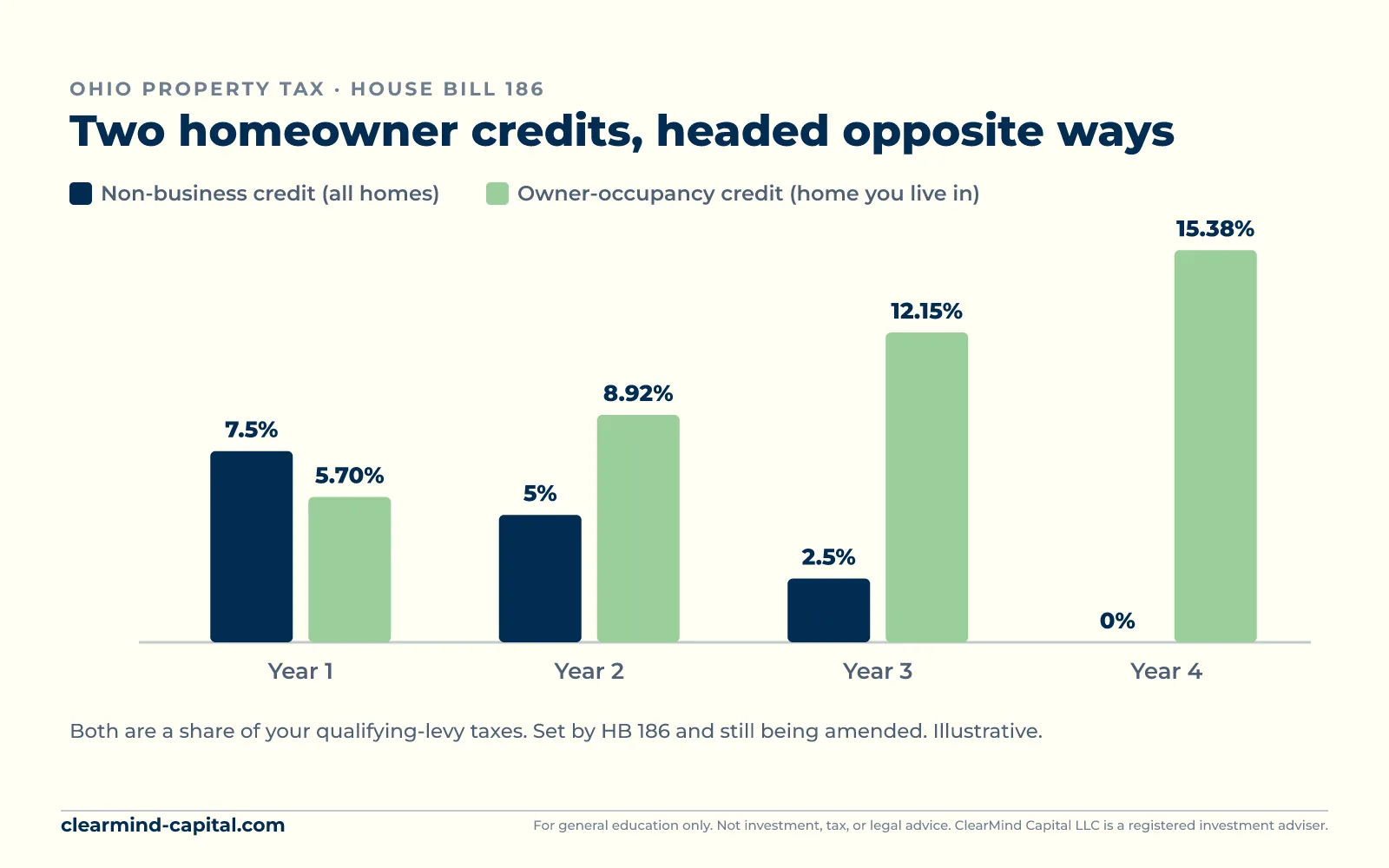
- The Primary Homeowner Shift: Ohio recently changed how it handles baseline residential credits. The old 10% tax break that applied to all residential properties is being phased out. To offset this, the owner-occupancy credit, which applies strictly to the home you actually live in, is stepping up significantly. This moves the tax breaks toward primary homeowners and away from corporate landlords or out-of-state investors.
Why Intel and Data Centers Impact Your Property Taxes
Central Ohio is experiencing an unprecedented construction boom. Intel is building a massive chip campus in neighboring Licking County, alongside a wave of multi-billion-dollar data centers from Amazon, Microsoft, and Google. This massive influx of regional corporate spending drives up land demand and residential home values across the entire Columbus area.
Whether this regional growth is a good or bad thing depends entirely on your situation:
- The Good News: If you plan to sell your home soon, this corporate boom has given you a massive amount of equity. Your home is worth significantly more on the open market than it was a few years ago.
- The Bad News: If you plan to stay in your home long-term, you don't benefit from that paper equity right now. Instead, the higher land values mean your property tax bill will likely tick upward.
The Tax Break Conflict
There is one detail that frequently frustrates local homeowners: these mega-corporations are generally not paying standard property taxes yet. To secure these massive investments, local cities granted them long-term tax breaks, including a 30-year, 100% building tax exemption for Intel.
While it can feel unfair that a multi-billion-dollar company gets a tax break while your residential bill goes up, these deals usually include a compromise. The corporations make alternative, direct cash payments directly to the local school districts to offset the lost tax revenue.
Ultimately, it means the regional boom is a double-edged sword: it makes your biggest asset worth more on paper, but it increases the cost of holding onto it.
Common Questions
If my home value went up 41%, will my property taxes go up 41%?
No. Ohio's House Bill 920 automatically lowers the tax rate on voter-approved levies as property values rise. Your bill will likely increase slightly due to unvoted inside millage or newly passed community levies, but it will not match the headline percentage jump of your home value.
How is property tax calculated in Ohio?
Your tax is calculated using 35% of your home's total appraised value. This taxable amount is multiplied by your local area's total millage rate. Local tax credits are then deducted to determine your final annual bill.
What is a mill in property taxes?
One mill equals one dollar of tax for every $1,000 of taxable property value. Your total local tax rate is calculated by stacking the individual mills of your school district, library, and city services together.
When will Franklin County's 2026 property values be final?
Tentative values are available for review now, and informal appeals are open until September 5, 2026. The state approves and finalizes the numbers in December 2026.
Why do giant data centers pay less property tax than residential homeowners?
Local governments use long-term tax abatements to attract major corporate investments to the region. While these companies often make alternative, direct payments to local schools, the overall economic boom raises demand and increases surrounding residential property values.
 Written byNick GeorgeCFP®, ChFC®, CLU®, IWA™FounderView bio →
- Franklin County Auditor (auditor.franklincountyohio.gov): 2023 reappraisal median residential increase of 41%, the 2026 value update process and timeline, Property Value Reviews open through September 5, 2026, the 35% assessment ratio, and homestead exemption amounts ($29,000 standard, $58,000 enhanced, about $41,000 income limit for 2025).
- Ohio Revised Code Section 319.301: House Bill 920 tax reduction factors that hold voted-levy revenue roughly flat as values rise, and the exclusion of unvoted inside millage and debt levies.
- Ohio Revised Code Section 319.302 (effective March 20, 2026, House Bill 186): non-business credit of 10% for farming and a residential phase-out of 7.5% stepping down to 0%.
- Ohio Revised Code Section 323.152 (effective March 20, 2026, House Bill 186): owner-occupancy credit rising from 5.70% toward 15.38% of qualifying-levy taxes, plus an optional county add-on up to 2.5%, and the homestead exemption structure.
- Ohio Capital Journal (ohiocapitaljournal.com), 2025: the DeWine property tax working group, the December 2025 relief package including House Bill 186, and the failed ballot effort to abolish property taxes.
- Columbus Dispatch, NBC4 (WCMH), 10TV (WBNS), and CNBC, 2022 to 2026: Intel's New Albany property tax abatement and delayed construction timeline, and the Amazon and Microsoft data center abatements in Licking County.
The information presented in this article is for informational purposes and should not be intended as tax, accounting or legal advice, nor is it an offer or solicitation to buy or sell, or as an endorsement of any company, security, fund, or other offering. Please consult your legal, tax, or accounting professional regarding your specific situation. Investments involve risk and have the potential for complete loss. It should not be assumed that any recommendations made will necessarily be profitable.
The opinions expressed in any commentary posted on this site are solely those of the individual author and do not necessarily reflect the views or opinions of ClearMind Capital, LLC. These opinions are based on information available at the time of posting and are subject to change without notice. ClearMind Capital, LLC, does not commit to updating any posted positions or commentary to reflect subsequent developments. While the information and reasoning used to form these opinions are believed to be from reliable sources, ClearMind Capital, LLC, does not verify this information, and no guarantee is provided regarding its accuracy, completeness, or validity. ClearMind Capital, LLC, disclaims any and all liability for actions taken or not taken based on the content of this site. No warranty, express or implied, is given in connection with the content provided.
Certified Financial Planner Board of Standards Center for Financial Planning, Inc. owns and licenses the certification marks CFP®, CERTIFIED FINANCIAL PLANNER®, and CFP® (with plaque design) in the United States to Certified Financial Planner Board of Standards, Inc., which authorizes individuals who successfully complete the organization’s initial and ongoing certification requirements to use the certification marks.