Words with this mark have a quick definition. Tap one to read it without leaving the article.
Not many surprising changes as we near 2027. The Glossary of Financial ClarityIRSThe IRS, or Internal Revenue Service, is the federal agency that collects taxes and enforces the tax code. It processes returns, sends refunds, and runs audits. Most of what feels like a tax rule in everyday life is the IRS turning the laws Congress writes into forms, deadlines, and instructions.General education only. Not tax or investment advice. Read the full story, Glossary of Financial ClaritySocial SecuritySocial Security is the federal program that sends monthly checks to retirees, along with some disabled workers and survivors. You pay into it through payroll taxes your whole working life, and what you eventually collect depends on your earnings history and the age you start claiming. For most retirees it's the one paycheck that lasts as long as they do.General education only. Not tax or investment advice. Read the full story and Medicare have all published their 2027 numbers, and most of them moved about 3% with inflation, like they do every year.
As a result, if your income stays about the same (although we hope you get that raise), you'll owe a little less federal tax in 2027.
And if you are enrolled in Medicare, be sure to check what your 2027 premium will be.
Will I pay more or less federal tax in 2027?
Less, if your income doesn't change (glass half full or half empty?). The seven tax rates stay the same, 10% up to 37%. The brackets and the standard deduction each got about 3% wider, so more of your income lands in the lower brackets.
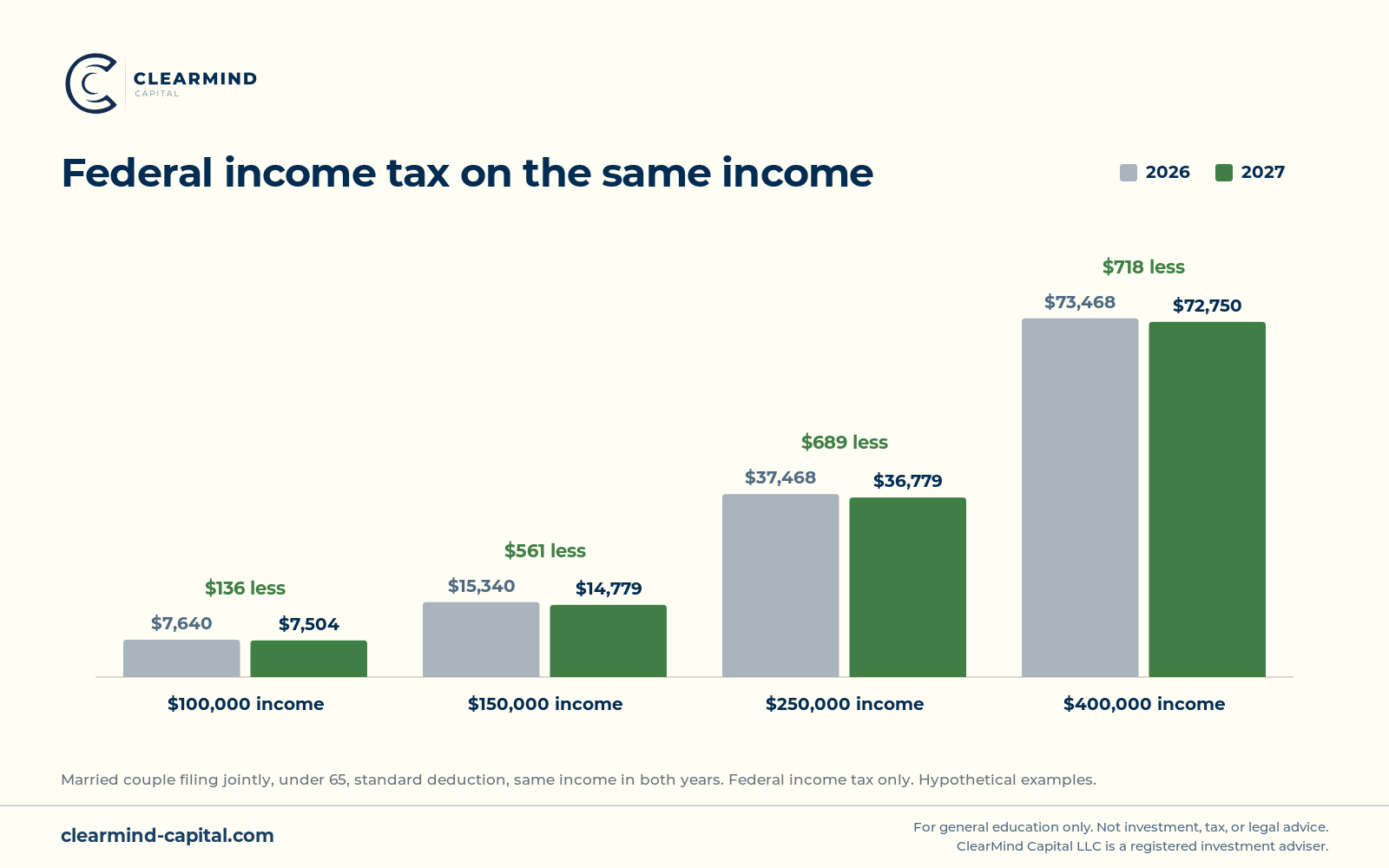
If your pay goes up about 3% too, your federal bill should land close to where it was this year.
| 2027 tax rate | Married filing jointly | Single |
|---|---|---|
| 10% | Up to $25,600 | Up to $12,800 |
| 12% | $25,600 to $104,050 | $12,800 to $52,025 |
| 22% | $104,050 to $218,250 | $52,025 to $109,125 |
| 24% | $218,250 to $416,650 | $109,125 to $208,325 |
| 32% | $416,650 to $529,100 | $208,325 to $264,550 |
| 35% | $529,100 to $793,650 | $264,550 to $661,375 |
| 37% | Over $793,650 | Over $661,375 |
The brackets apply to taxable income, which is your income after the standard deduction (or your itemized deductions).
| Standard deduction | 2026 | 2027 |
|---|---|---|
| Married filing jointly | $32,200 | $33,200 |
| Single | $16,100 | $16,600 |
| Head of household | $24,150 | $24,925 |
| Extra at 65 or older, per spouse | $1,650 | $1,700 |
| Extra at 65 or older, single | $2,050 | $2,100 |
| Senior deduction at 65 or older, per person | $6,000 | $6,000 |
The $6,000 senior deduction runs through 2028 and shrinks once income passes $75,000 for single filers or $150,000 for married couples.
If you want to see your own income in the new brackets, our Columbus and Ohio tax estimator has a 2027 switch.
How much can I save in 2027?
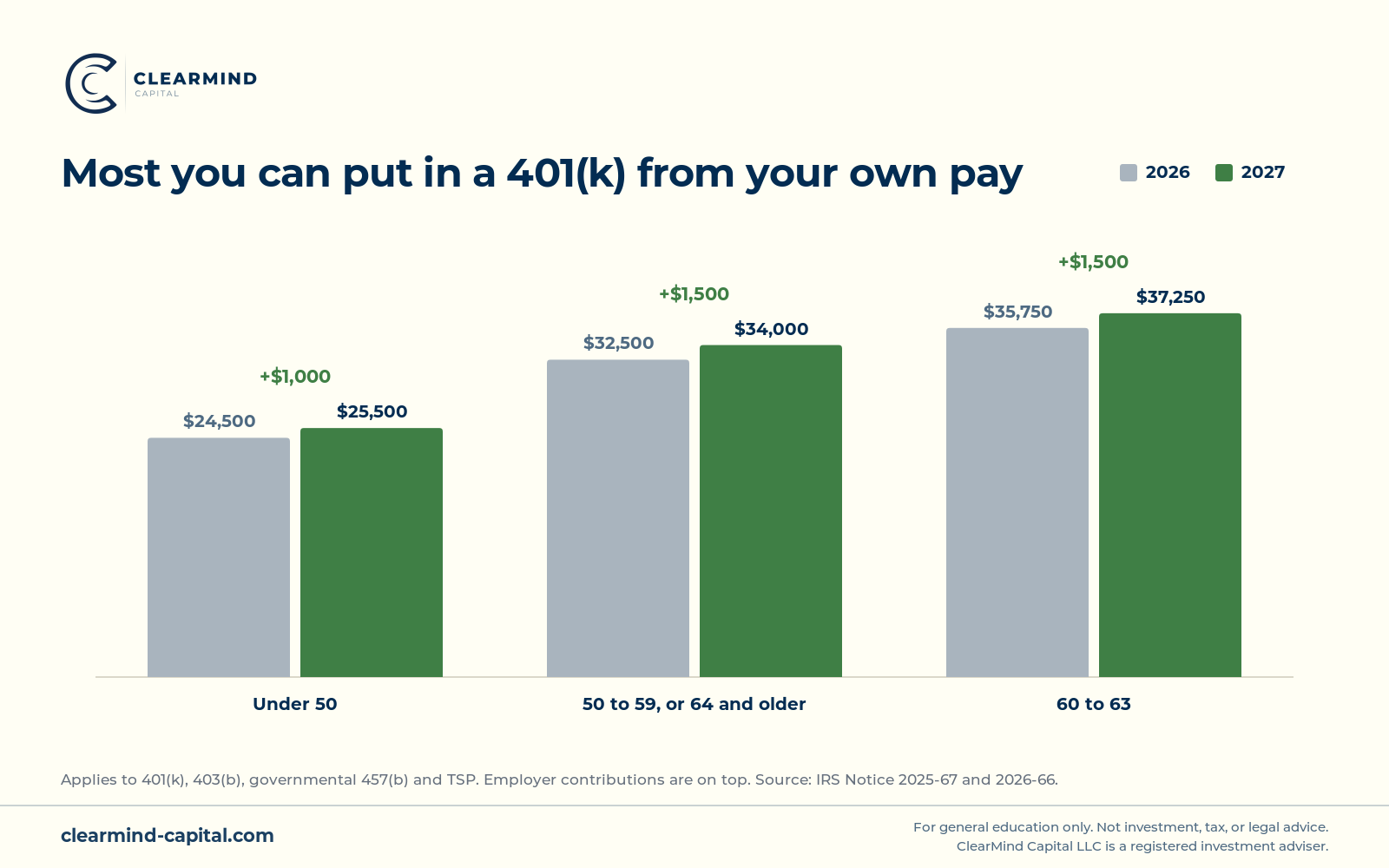
A little more in a 401(k) or an Glossary of Financial ClarityHealth savings account (HSA)A savings account paired with a high-deductible health plan, and arguably the best tax deal going: money goes in tax-free, grows tax-free, and comes out tax-free for medical costs. Some people treat it as a stealth retirement account and pay today's doctor bills out of pocket. You need the right kind of health plan to open one.General education only. Not tax or investment advice. Read the full story. The IRA limit stays where it is.
| Account | 2026 | 2027 |
|---|---|---|
| 401(k), 403(b), 457(b) and TSP | $24,500 | $25,500 |
| Catch-up, ages 50 to 59 or 64 and older | $8,000 | $8,500 |
| Catch-up, ages 60 to 63 | $11,250 | $11,750 |
| IRA, traditional or Roth | $7,500 | $7,500 |
| IRA catch-up, 50 and older | $1,100 | $1,100 |
| HSA, self-only / family | $4,400 / $8,750 | $4,500 / $9,000 |
| Roth IRA phase-out, married filing jointly | $242,000 to $252,000 | $250,000 to $260,000 |
| Roth IRA phase-out, single | $153,000 to $168,000 | $158,000 to $173,000 |
One wrinkle for higher earners 50 and older: if your wages from your employer topped $155,000 in 2026, your 2027 catch-up contributions have to go in as Roth.
If you save a set dollar amount from each paycheck, December is a good time to bump it for January.
What happens to Social Security and Medicare in 2027?
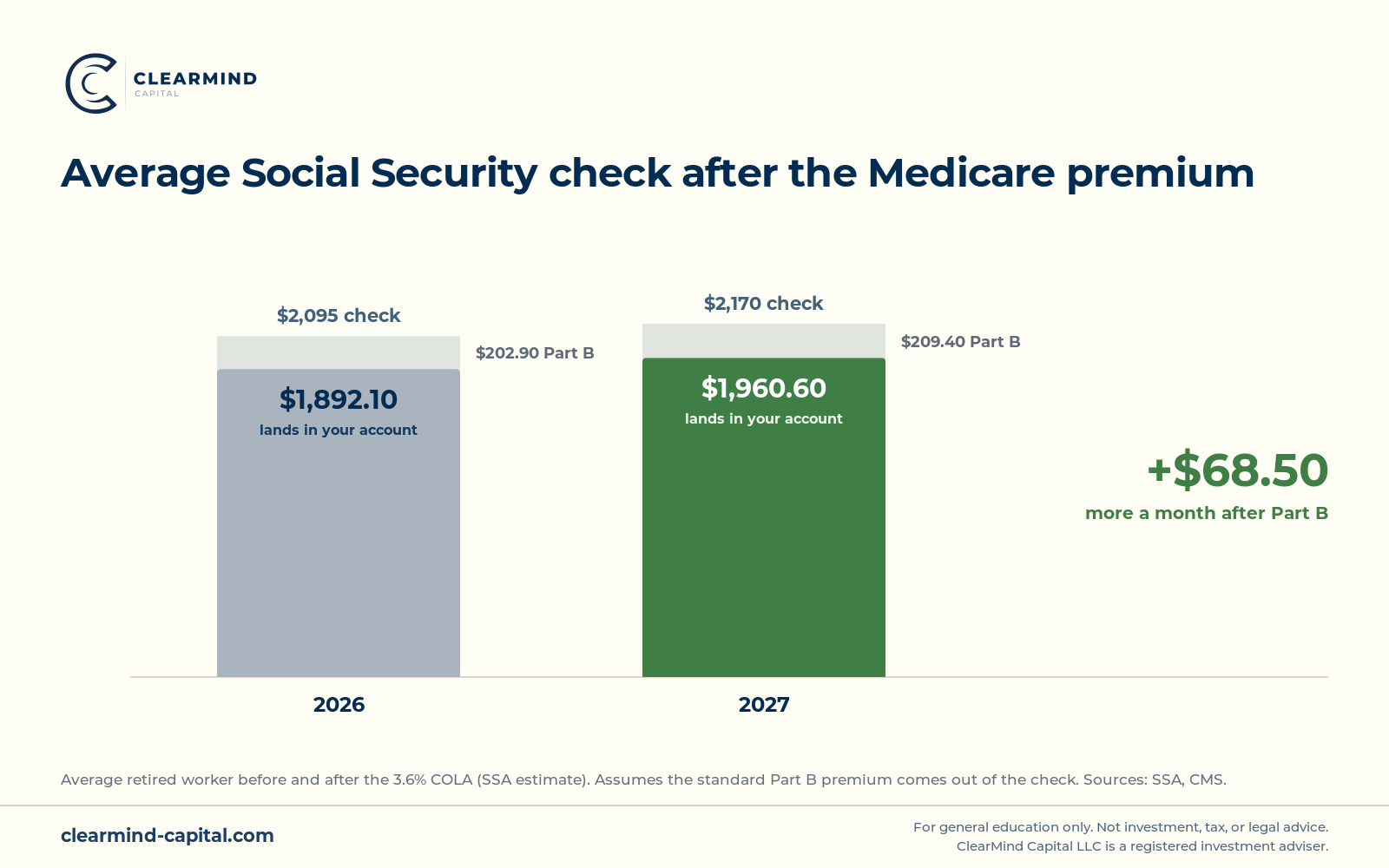
Social Security checks go up 3.6% in January. The standard Medicare Part B premium goes up $6.50 a month, to $209.40. For the average retiree, the raise covers the higher premium with room to spare.
Medicare charges higher earners more for Part B, and it looks back two years to decide. Your 2025 tax return sets your 2027 premium.
| 2025 income, married filing jointly | 2025 income, single | 2027 Part B per person, per month |
|---|---|---|
| $224,000 or less | $112,000 or less | $209.40 |
| $224,001 to $282,000 | $112,001 to $141,000 | $293.10 |
| $282,001 to $354,000 | $141,001 to $177,000 | $418.80 |
| $354,001 to $424,000 | $177,001 to $212,000 | $544.40 |
| $424,001 to $749,999 | $212,001 to $499,999 | $670.00 |
| $750,000 or more | $500,000 or more | $711.80 |
The higher tiers also add a surcharge to your drug plan premium. If your income has dropped since 2025 because you retired, you can ask Social Security to use your newer income with Form SSA-44.
| Social Security | 2026 | 2027 |
|---|---|---|
| Cost-of-living raise | 2.8% | 3.6% |
| Earnings limit if you collect before full retirement age | $24,480 | $25,560 |
| Most pay that gets the 6.2% Social Security tax | $184,500 | $192,300 |
| Medicare Part B deductible | $283 | $292 |
Does anything change for Ohio and Columbus?
Not yet. Ohio's income tax stays at a flat 2.75% on income above $26,050 (income at or below that isn't taxed), and the Columbus city tax stays at 2.5%. Ohio paused its yearly inflation adjustment for 2025 and 2026 only, so the $26,050 may be raised in August 2027 unless lawmakers extend the pause.
Everything else that changed
| Item | 2026 | 2027 |
|---|---|---|
| Gift you can give each person without filing a gift tax return | $19,000 | $20,000 |
| Estate and lifetime gift exclusion, per person | $15,000,000 | $15,480,000 |
| State and local tax (SALT) deduction cap | $40,400 | $40,804 |
| Child Tax Credit, per child | $2,200 | $2,300 |
| Charitable gifts straight from an IRA, age 70½ and older | $111,000 | $114,000 |
| 0% capital gains rate, married filing jointly, up to | $98,900 | $102,100 |
| 0% capital gains rate, single, up to | $49,450 | $51,050 |
Every 2027 figure is in our free 2027 tax reference guide, with a PDF you can print. Filing your 2026 return this spring? The 2026 guide has those numbers.
If you want to see what 2027 means for your own plan, we're here in Columbus, and you can get in touch here.
Common questions
Will I pay less federal tax in 2027?
If your income stays the same, yes, a little. The brackets and standard deduction rose about 3% for inflation while the rates stayed the same. A married couple filing jointly with $150,000 of income would owe about $561 less in federal income tax.
What is the 401(k) contribution limit for 2027?
$25,500 of your own pay, up from $24,500. Add $8,500 if you're 50 to 59 or 64 and older, or $11,750 if you're 60 to 63. If your wages from that employer topped $155,000 in 2026, the catch-up has to go in as Roth.
How much is the Medicare Part B premium in 2027?
$209.40 a month, with a $292 deductible. Higher earners pay more based on their 2025 tax return, starting above $112,000 of modified AGI for single filers and $224,000 for married couples filing jointly.
What is the Social Security cost-of-living adjustment for 2027?
3.6%, starting with January 2027 checks. For the average retired worker that's about $75 more a month before the Part B premium increase, and about $68.50 more after it.
Is Ohio's income tax changing in 2027?
Not under current law. The rate stays at 2.75% on income above $26,050. Ohio paused its inflation adjustment for 2025 and 2026 only, so the $26,050 threshold may be raised for inflation in August 2027.

 Written byNick George & Shane DuckworthClearMind Capital | Private WealthView bio →
- Internal Revenue Service, Revenue Procedure 2026-35, and Revenue Procedure 2025-32, for the 2027 and 2026 brackets, standard deduction, capital gains thresholds, Child Tax Credit, gift and estate exclusions.
- Internal Revenue Service, Notice 2026-66, for the 2027 401(k), catch-up, Roth catch-up wage threshold, IRA, Roth IRA phase-out and QCD limits.
- Internal Revenue Service, Revenue Procedure 2026-24, for the 2027 HSA limits.
- Social Security Administration, 2027 Social Security Changes fact sheet, for the COLA, average benefits, wage base and earnings limit.
- Centers for Medicare & Medicaid Services, 2027 Medicare Parts A & B Premiums and Deductibles, for the Part B premium, deductible and income tiers.
- Social Security Administration, Form SSA-44, for asking to use lower income after a life-changing event like retiring.
- Internal Revenue Code section 151(d)(5)(C), for the senior deduction, and section 164(b)(7), for the SALT cap.
- Ohio Revised Code section 5747.02, for Ohio's 2.75% rate, the $26,050 threshold and the August inflation adjustment.
- Tax figures in the federal tax chart are hypothetical examples computed from the IRS brackets and standard deduction.
The information presented in this article is for informational purposes and should not be intended as tax, accounting or legal advice, nor is it an offer or solicitation to buy or sell, or as an endorsement of any company, security, fund, or other offering. Please consult your legal, tax, or accounting professional regarding your specific situation. Investments involve risk and have the potential for complete loss. It should not be assumed that any recommendations made will necessarily be profitable.
The opinions expressed in any commentary posted on this site are solely those of the individual author and do not necessarily reflect the views or opinions of ClearMind Capital, LLC. These opinions are based on information available at the time of posting and are subject to change without notice. ClearMind Capital, LLC, does not commit to updating any posted positions or commentary to reflect subsequent developments. While the information and reasoning used to form these opinions are believed to be from reliable sources, ClearMind Capital, LLC, does not verify this information, and no guarantee is provided regarding its accuracy, completeness, or validity. ClearMind Capital, LLC, disclaims any and all liability for actions taken or not taken based on the content of this site. No warranty, express or implied, is given in connection with the content provided.
Certified Financial Planner Board of Standards Center for Financial Planning, Inc. owns and licenses the certification marks CFP®, CERTIFIED FINANCIAL PLANNER®, and CFP® (with plaque design) in the United States to Certified Financial Planner Board of Standards, Inc., which authorizes individuals who successfully complete the organization’s initial and ongoing certification requirements to use the certification marks.