

"My recordkeeper handles that."
We hear it in most first conversations with a business owner, and it gets stretched to cover the fees, the investment menu, and whether the plan still fits the company. Your recordkeeper's contract covers none of that.
That isn't a knock on recordkeepers. They do the job they signed up for. But four companies each doing a narrow job adds up to less coverage than it looks like from the outside, and the way to see it is to walk the contracts one at a time.
What your recordkeeper does
The recordkeeper is the plumbing. Every dollar that comes off a paycheck has to land in the right person's account, in the right bucket (pre-tax, Glossary of Financial ClarityRoth IRANamed after Senator William Roth, who pushed it into law in 1997. The design is clever on both ends: you pay the tax now instead of later, so the government collects its revenue up front, and in exchange your money grows and comes out completely tax-free in retirement. You put in dollars you've already been taxed on, let them grow for years, and qualified withdrawals down the road owe nothing. You're basically betting your tax rate later will be higher than it is today, which is why it tends to shine early in a career or in a low-income year.General education only. Not tax or investment advice. Read the full story, employer match), invested the way that person chose. The recordkeeper does that, runs the site your employees log into, processes loans and distributions, and produces the statements.
Pull up your service agreement and you'll find that list written out, and you'll find where it stops. Judging whether the funds on your menu are any good sits outside that contract, and so does telling you how your costs compare to other plans your size.
A bundled arrangement, where the same company does the recordkeeping and the testing, puts two of these jobs under one roof without widening either one.
What your third party administrator does
Your administrator keeps the plan document current and amended, runs the annual compliance testing, tracks eligibility and vesting, and prepares the Form 5500.
There is a naming problem buried in this one. ERISA uses "plan administrator" for a specific legal role, and the statute defines it as the person the plan document names, or the plan sponsor if the document names nobody. On most small plans, the document names the company. So the third party administrator you pay is doing administration work, and the plan administrator under the law is usually you.
Some firms will take that statutory role on as a separate service, priced separately. Your agreement will say so if yours has.
What your custodian or trustee does
The custodian holds the assets, settles the trades, and keeps plan money separate from company money. On a lot of bundled plans it's affiliated with the recordkeeper and you may never deal with it directly. Nothing in that role involves an opinion on what the money is invested in or what the plan is paying for it.
When an auditor gets involved
An independent audit attaches to your Form 5500 once the plan is large enough, and the counting rule changed in a way that helped a lot of small employers. For plan years beginning on or after January 1, 2023, a defined contribution plan counts the participants who have account balances at the start of the year instead of everyone eligible. The old method swept in employees who had never deferred a dollar, which pushed plans over the line years before they had the assets to match.
Cross 100 participants with balances and the audit requirement generally applies. If you filed as a small plan last year and had 120 or fewer participants at the start of this one, you can usually keep filing the same way.
The auditor's work is backward-looking: an annual check that what happened got reported correctly. The auditor's also a vendor you hired and have to monitor like any other.

What a plan advisor does
The advisor's scope is the plan rather than a piece of it, which means a written standard for how investments get chosen and removed, extra attention on the default fund where employees land when they never make a choice, costs compared against plans of similar size on a schedule, the design walked before each plan year, education run on a calendar, and decisions written down at the time they get made.
Picking funds is one line in that. The part that's hard to buy anywhere else is the coordination, because every other party is looking at its own slice correctly and nobody is looking across them.
Why that gap lands on you
The Department of Labor is direct about where responsibility sits. In its guide for employers it says "Glossary of Financial ClarityFiduciarySomeone legally required to put your interests ahead of their own paycheck. Sounds like the bare minimum, and yet a lot of the financial world doesn't work that way. When an advisor is a fiduciary, “is this good for me or good for them” has a clearer answer.General education only. Not tax or investment advice. Read the full story status is based on the functions performed for the plan, not just a person's title," and that "hiring a service provider in and of itself is a fiduciary function." The same guide tells employers to "establish and follow a formal review process at reasonable intervals to decide if it wants to continue using the current service providers or look for replacements."
Read that against your own plan. Choosing your recordkeeper was a decision you answer for, and the DOL expects you to look at that choice again on a schedule.
It's also the clean way to think about handing work off. Responsibility moves where discretion moves, so a firm that takes discretion over the investment menu answers for those decisions, and an arrangement where someone recommends and you approve leaves the decision with you. Picking that firm and keeping an eye on it afterward never transfers either way.
This should be reviewed with your ERISA counsel before acting.
What your providers already owe you
Most of this is answerable without a phone call, because the information has already been sent to you.
Under the service provider disclosure rule, any covered service provider expecting $1,000 or more from your plan has to give the responsible plan fiduciary a written description of its services, a statement of whether it is acting as a fiduciary or as a registered investment adviser, and a breakdown of what it is paid, including compensation that comes from somewhere other than your plan. The disclosure is due reasonably in advance of signing, and updates are due within 60 days of a change.
Somebody at your company received those documents.
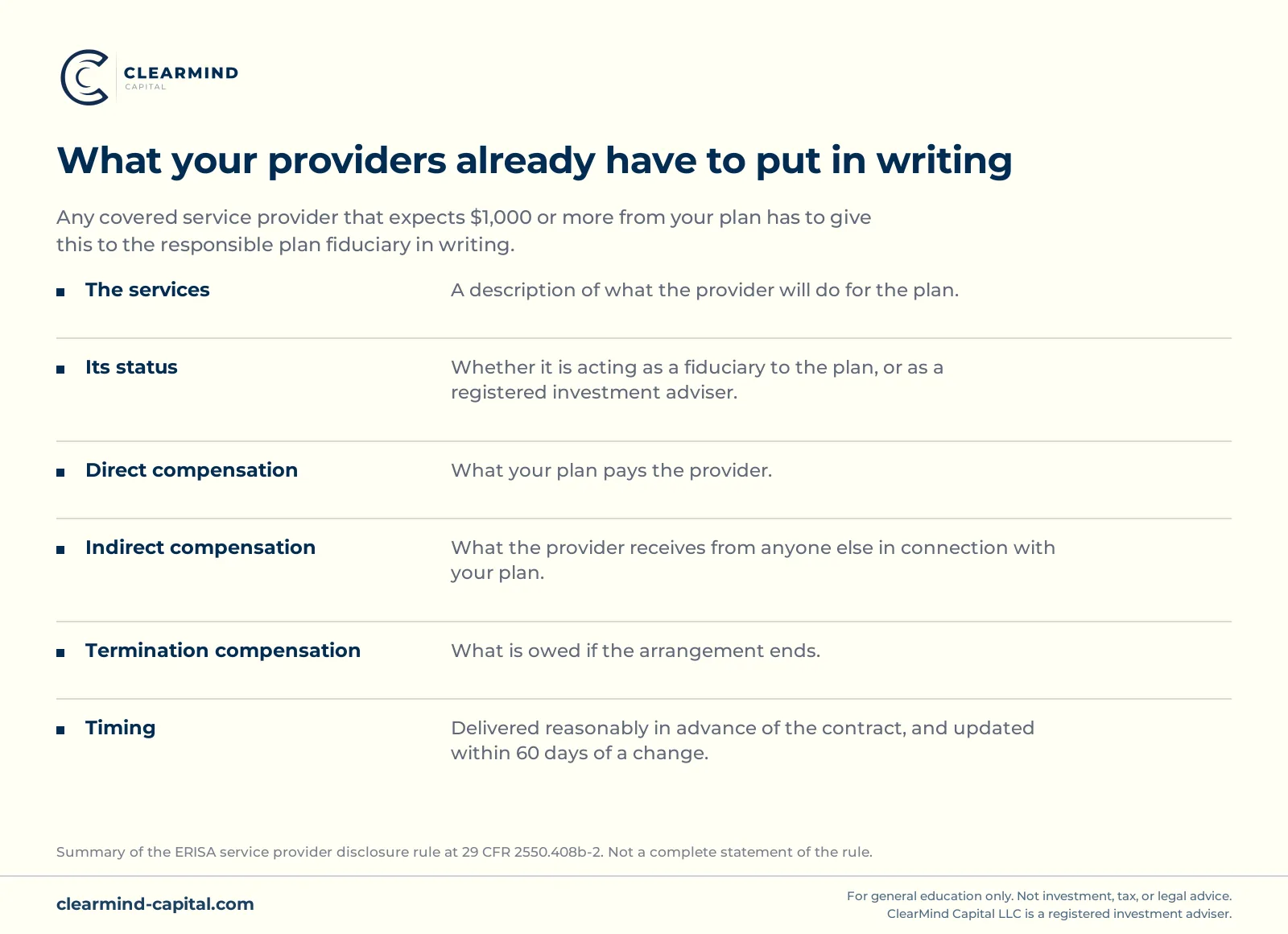
Pull them, lay them next to each other, and the gaps show up on their own. If you want a second set of eyes on what you find, that's a conversation we're glad to have.
Next in this series: what happens when nobody revisits any of it for a decade.
Common questions
What is the difference between a 401(k) recordkeeper and a third party administrator?
The recordkeeper handles day-to-day account activity: deferrals, investment elections, loans, distributions, statements, and the participant website. The administrator handles the compliance side: the plan document, annual testing, eligibility and vesting tracking, and the Form 5500. Some providers do both under one contract, which is usually called a bundled arrangement.
Who is the plan administrator for a 401(k)?
ERISA defines the plan administrator as whoever the plan document names, and if the document names nobody, the plan sponsor. On most small business plans that is the company itself. The third party administrator you pay is a service provider doing administration work, which is a different thing from holding the statutory role.
Is my recordkeeper a fiduciary?
Usually not for most of what it does, though some providers take on specific fiduciary services under a separate agreement. Your service provider disclosure has to state whether the provider is acting as a fiduciary or as a registered investment adviser, so the answer for your plan is already in writing.
If I use a bundled provider, is everything covered?
Bundling reduces the number of companies you deal with. It doesn't widen any one contract. A bundled provider doing recordkeeping and administration still has no obligation to tell you whether the menu is competitive or whether your costs are reasonable for what you are getting.
When does a 401(k) plan need an audit?
Generally when the plan has 100 or more participants with account balances at the beginning of the plan year, for plan years starting on or after January 1, 2023. A plan that filed as a small plan the previous year and had 120 or fewer participants at the start of the current year can usually continue filing as a small plan. New plans count balances at the end of the first year instead.
Can I hand the fiduciary responsibility off entirely?
Part of it. Responsibility follows discretion, so a firm that takes discretion over the investment menu answers for those decisions, while an arrangement built on recommendations you approve leaves the decision with you. Choosing the firm and monitoring it afterward stays with the plan sponsor in either case.

 Written byAustin Wolfe & Joe AndersonClearMind Capital | Workplace RetirementView bio →
- U.S. Department of Labor, Employee Benefits Security Administration, Meeting Your Fiduciary Responsibilities), on fiduciary status by function, hiring a service provider as a fiduciary act, and the formal review process for monitoring providers.
- ERISA section 3(16)(A) and section 3(21)(A), 29 U.S.C. 1002), defining the plan administrator and defining a fiduciary by function.
- 29 CFR 2550.408b-2), the covered service provider disclosure rule, including the $1,000 threshold, the required description of services, fiduciary and registered investment adviser status, direct and indirect compensation, and the 60-day update requirement.
- U.S. Department of Labor, Changes for the 2023 Form 5500 and Form 5500-SF Annual Return/Reports), on the participant-counting change for defined contribution plans effective for plan years beginning on or after January 1, 2023.
- U.S. Department of Labor, Instructions for Form 5500-SF), on counting participants with account balances and the 80-120 participant transition rule.
- ClearMind Capital, Who Is Responsible for Your Company's 401(k)?), the first post in this series.
The information presented in this article is for informational purposes and should not be intended as tax, accounting or legal advice, nor is it an offer or solicitation to buy or sell, or as an endorsement of any company, security, fund, or other offering. Please consult your legal, tax, or accounting professional regarding your specific situation. Investments involve risk and have the potential for complete loss. It should not be assumed that any recommendations made will necessarily be profitable.
The opinions expressed in any commentary posted on this site are solely those of the individual author and do not necessarily reflect the views or opinions of ClearMind Capital, LLC. These opinions are based on information available at the time of posting and are subject to change without notice. ClearMind Capital, LLC, does not commit to updating any posted positions or commentary to reflect subsequent developments. While the information and reasoning used to form these opinions are believed to be from reliable sources, ClearMind Capital, LLC, does not verify this information, and no guarantee is provided regarding its accuracy, completeness, or validity. ClearMind Capital, LLC, disclaims any and all liability for actions taken or not taken based on the content of this site. No warranty, express or implied, is given in connection with the content provided.
Certified Financial Planner Board of Standards Center for Financial Planning, Inc. owns and licenses the certification marks CFP®, CERTIFIED FINANCIAL PLANNER®, and CFP® (with plaque design) in the United States to Certified Financial Planner Board of Standards, Inc., which authorizes individuals who successfully complete the organization’s initial and ongoing certification requirements to use the certification marks.


