
Retirement planning for people in and near retirement
Retirement is the payoff for decades of saving. We help families turn that saving into a steady paycheck and spend it with confidence while travel and time with family are easiest to enjoy, with fee-only, fiduciary advice from real people.
The goal is the confidence to enjoy what you saved.
After decades of putting money in, taking it out can feel wrong, even when the plan says it's fine. Spending from savings is a different muscle than spending a paycheck. We build the paycheck, what to draw, from which account, and in what order, and we show you what the plan can support so saying yes to the trip gets easier.
We help you figure out what to tackle first and stay with you for every decision after that.
Nick George, CFP®, ChFC®, CLU®, IWA™ | Founder
Retiring brings a handful of decisions that all connect: when to claim Social Security, how to turn 401(k)s and IRAs into a paycheck, how to keep taxes and Medicare premiums in check, and how much you can spend without worrying about it. We start with what you want the next ten or twenty years to look like. Then we walk you through your options, and you pick the one that fits your family, even when a calculator would pick something else. We work with people roughly 55 and up, from our office in Columbus, with families across Ohio and nationwide.

Spending in your go-go years
We think about retirement in three stretches. The go-go years run from retirement into your mid-70s, when you're healthy and finally have the time, so the big trips happen here. The slow-go years stay closer to home, and the no-go years bring more time at home and more health care. Research by David Blanchett in the Journal of Financial Planning found retiree spending falls about 1% a year after inflation, on average.
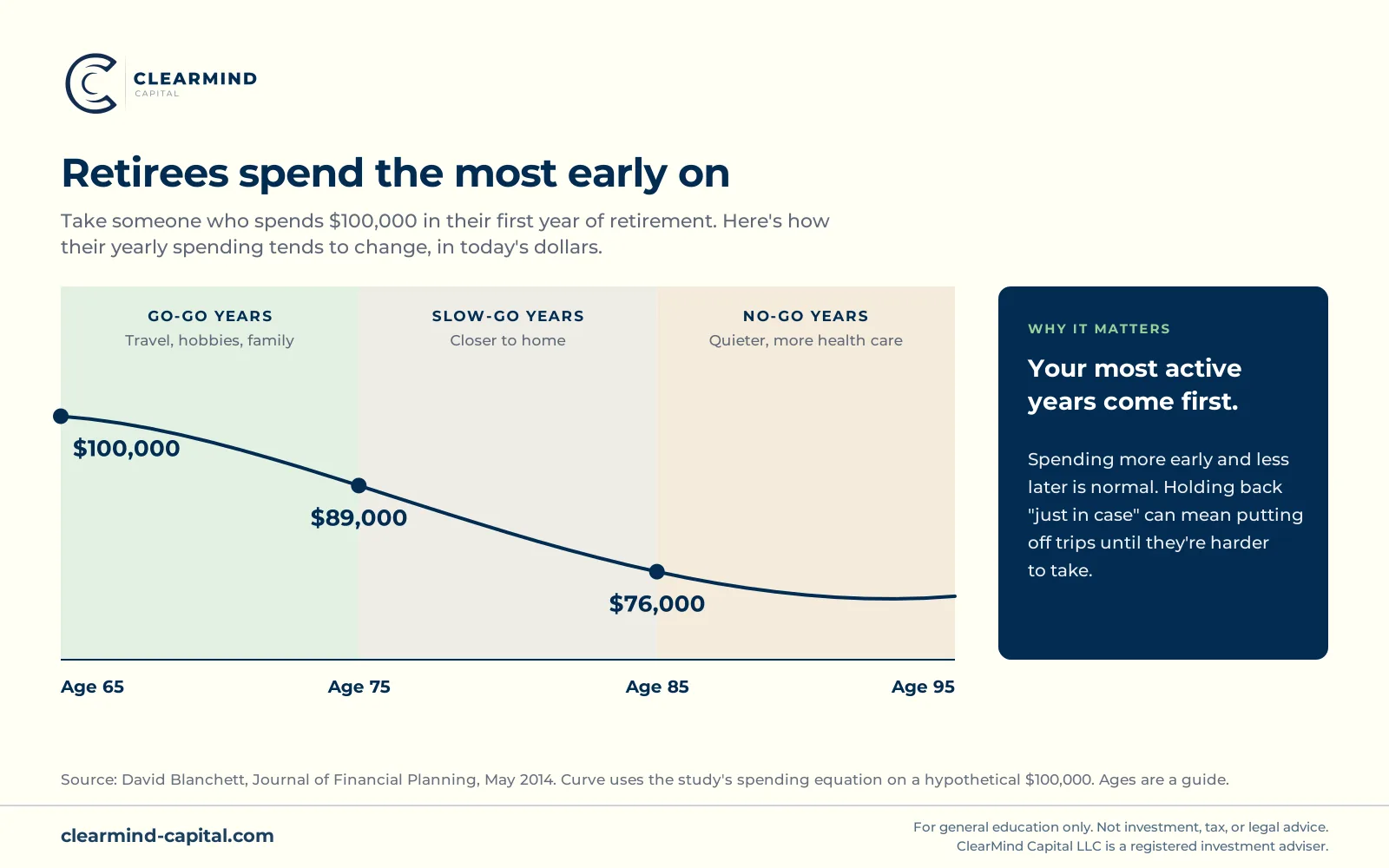
A dollar spent on a trip with the grandkids at 66 means more than the same dollar at 88, so we plan for higher spending early. And when we run the numbers, a lot of families can afford more than they think. An Employee Benefit Research Institute study found that retirees who started retirement with $500,000 or more had spent only about 12% of it after 20 years.
Turning savings into a paycheck
Your salary stops, so we build a new one. Social Security and any pension come first, and they show up every month no matter what the market does. Savings cover the rest, in an order that keeps your tax bill in check: the joint investment account first for the gap and extras like travel, pre-tax 401(k)s next with Roth conversions along the way, and Roth accounts last so they keep growing tax-free. The paycheck lands in your checking account on the same day every month with taxes withheld.
Retirement paycheck
Sample household. Monthly income in today's dollars, once Social Security starts at 67.
Behind the scenes, your next two years of paychecks sit in cash and Treasuries, so nothing gets sold low to pay you, and we refill cash from whatever is up. See how we manage your investments.
Social Security and the age that fits your life
You can start Social Security as early as 62 or as late as 70, and every year you wait makes the check bigger for life. For a married couple, the bigger of the two checks keeps going to whoever lives longer, so the higher earner's choice is also a decision about the surviving spouse. Waiting also means pulling more from savings in your first years, right when travel is easiest.
We show you what you'd get at each age, check whether the life you want already works, and help you pick the age that fits. If the plan works with room to spare, there's little reason to wait years for money you won't need. We walk through how we think it through with one couple in When Should We Take Social Security?
Taxes, Roth conversions, and Medicare
The years between retiring and starting required withdrawals are often the best tax-planning window you will ever have. We look at Roth conversions, capital gains, and how income affects your Medicare premiums, and we build a multi-year plan aimed at lowering the taxes you pay across your whole retirement.
Knowing the plan holds up
We test your plan against a long life, down markets, inflation, and health costs, and we show you what a bad year looks like in dollars before one shows up. We adjust as life changes, so you can spend on the things that matter without second-guessing every choice. Still deciding whether you can retire? Start with Am I ready to retire?
What this can look like
Illustrative examples, not actual clients, and not a promise of results.
The retirement paycheck
A couple retiring at 63 has savings spread across two 401(k)s, an IRA, and a brokerage account. We line up Social Security first, build a withdrawal order for the rest, and show them what lands in checking each month and why.
The trip they kept putting off
A couple at 65 had talked about Italy for a decade and kept waiting for the right time. Their plan showed their travel budget for the next ten years already worked with room to spare, so the trip went on the calendar for next spring.
The Social Security decision
One spouse wants to claim at 62, the other at 70. We show them what they'd get at each age, including the check the surviving spouse would keep, and they pick the ages that fit how they want to spend the next ten years.
How we work with you
We lead families through their biggest money decisions and show them what’s possible. We start by learning what matters to your family, then stay in your corner as life changes, with one plan that covers your investments, taxes, insurance, and estate. Pick your two money questions.
Why fee-only and fiduciary matters
Fee-only means the only pay we receive comes from the families we work with, so the advice stays about you. Fiduciary means we are legally bound to act in your best interest, at all times. We work with clients in Columbus, across Ohio, and nationwide, and everything can be done virtually.
Common questions
Do you help people who are about to retire, and people already retired?
Yes, and the years just before you retire are often the most valuable time to plan. We work with people roughly 55 and up, in Columbus, across Ohio, and nationwide, to get the income, tax, and Social Security decisions right before they are locked in.
When should I claim Social Security?
It depends on what you want your first years of retirement to look like, your health and family history, your spouse, and your other income. We show you what you'd get at each age, including the check a surviving spouse would keep, and help you pick the age that fits your life.
What are the go-go, slow-go, and no-go years?
They're the three stretches of retirement. The go-go years, from retirement into your mid-70s, are for travel and family. The slow-go years, roughly the mid-70s to mid-80s, stay closer to home. The no-go years bring more time at home and more health care. Spending tends to be highest early, so we plan for that.
How do I turn my 401(k) and IRA into income?
We start with Social Security and any pension, then build a withdrawal plan for the rest that decides how much to take and from which accounts, in an order that keeps taxes in check. The money lands in your checking account on the same day each month, like a paycheck.
What is a Roth conversion and should I do one?
A Roth conversion moves money from a pre-tax account to a Roth and pays the tax now so it grows tax-free later. In lower-income years, often right after retiring, it can save a lot over time. We run the numbers to see whether and how much makes sense for you.
Do I have enough to retire?
That is the first question we answer. We start with the life you want, check whether your savings, Social Security, and any pension can carry it, and test it against down markets and a long life. When we run the numbers, a lot of families find they can afford more than they thought.
What does retirement planning cost if my money is still in my 401(k)?
The minimum is $300 a month ($3,600 a year), or the yearly rate on anything we manage if that’s higher. That covers your written plan, guidance on your 401(k) and pension where they sit, Social Security and Medicare timing, and tax planning every year. When you retire and roll over your 401(k), the yearly rate on what we manage takes over.
Do you only work with people in Ohio?
No. We are in Columbus and work with retirees and pre-retirees nationwide, virtually. Fee-only and fiduciary means the advice is the same wherever you are.
Let's build the plan for your retirement.
This page is general information for people exploring our services and is not investment, tax, or legal advice or a recommendation for any specific person or situation. The examples are illustrative, are not based on actual clients, and are not a promise of results. Strategies such as S-corp elections, backdoor and mega-backdoor Roth contributions, equity-comp decisions, and deferred compensation depend on your specific situation and current law, so confirm the details with a qualified professional before acting. ClearMind Capital LLC is a registered investment adviser; registration does not imply a certain level of skill or training. Past performance is not indicative of future results.
