Words with this mark have a quick definition. Tap one to read it without leaving the article.
When should we take Glossary of Financial ClaritySocial SecuritySocial Security is the federal program that sends monthly checks to retirees, along with some disabled workers and survivors. You pay into it through payroll taxes your whole working life, and what you eventually collect depends on your earnings history and the age you start claiming. For most retirees it's the one paycheck that lasts as long as they do.General education only. Not tax or investment advice. Read the full story?
Like... what's the right age? 62? 67? 70?
It seems as if there is a different answer or opinion everywhere you turn. Somebody at work took theirs at 62 and says to "get it while it's still there." If you research online or ask AI, it says it's better to wait as long as you can. There's a few ways to think through this to determine YOUR answer... because after all... everyone is so different. There is not a one-size-fits-all answer.
Meet Mark and Julie. Their story is an example of how we think this through. They're both 62 and live in Columbus. Mark just retired after 35 years in sales. Julie works part time at a dental office and wants to give it one more year. Their daughter is expecting their first grandkid in Cincinnati, and the two of them have been staring at their Social Security statements at the kitchen table, trying to figure out what they should do.
What your Social Security statement is telling you
If you haven't looked at yours in a while, you can pull it up anytime at ssa.gov/myaccount. Your statement has a chart with a different monthly amount for every age from 62 to 70. Here's what Mark's looks like, redrawn so it's easier to read.

The earliest Mark can start is 62, and he'd get $2,100 a month. If he waits until 67, his full retirement age (it's 67 for anyone born in 1960 or later), he gets his full $3,000. Each year he waits past that adds 8%, up to $3,720 a month at 70, and then the check stops growing.
Whatever age he picks, that's his check for life, plus a cost-of-living raise every year. (Social Security just announced 3.6% for 2027.) Julie's statement works the same way. Her full amount at 67 is $1,800.
When does waiting pay off?
Waiting is a tug of war. Mark skips checks now, and every check he gets later is bigger. If he waits until 70, those bigger checks catch up with everything he'd have collected starting at 62 right around age 80.

So if Mark lives past 80, waiting comes out ahead. If he dies at 75, starting at 62 would have paid him about $104,000 more.
That's useful to know, but it only helps if you know how long you'll live, and nobody does. So we treat the breakeven age as one reference point and spend most of the conversation on Mark and Julie themselves.
How we think it through with Mark and Julie
When a couple like this sits down with us, the first questions are about them.
What do you want the next ten years to look like?
Mark and Julie want to travel while they both feel good, and they want to be in Cincinnati a lot once the baby comes.
We think about retirement in three stretches: the go-go, slow-go and no-go years.
The go-go years run from retirement into your mid-70s. You're healthy and you finally have the time, so this is when the big plans happen. For Mark and Julie, that's long weekends in Cincinnati with the grandkid and the trip to Italy they put off while their own kids were in school.
The slow-go years are roughly the mid-70s to mid-80s. You still get out, but the trips get shorter and closer to home... a week at the lake instead of two weeks in Europe.
The no-go years come after that. You're home more, and more of the budget goes to health care and help around the house. Comfort and simply being around the people you love starts to take precedent.
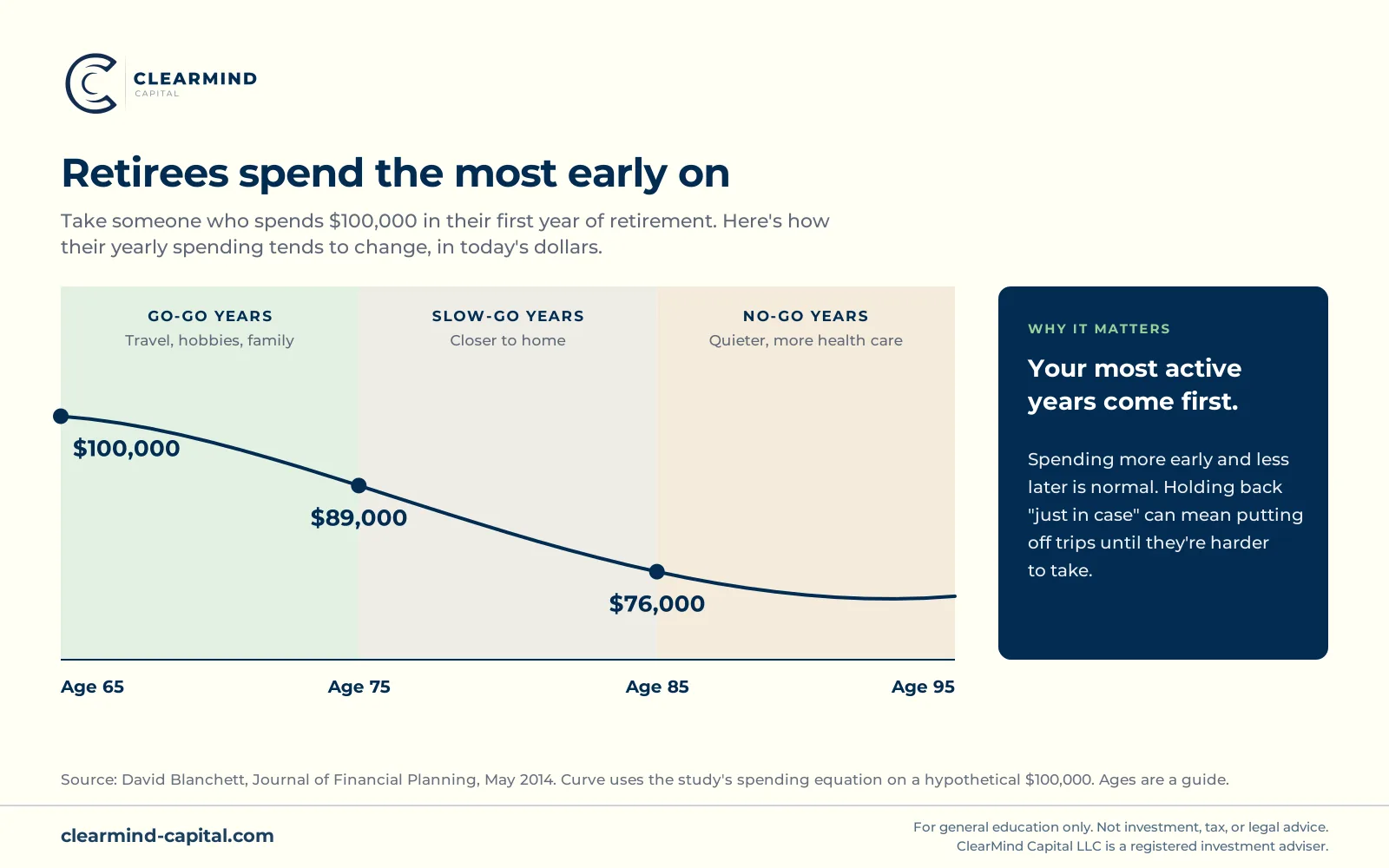
The research lines up with what we see. David Blanchett, writing in the Journal of Financial Planning, found that retiree spending falls about 1% a year after inflation, on average.
So think about that for a second... what's the point of holding back now for more money later, in a stretch of life where travel and experiences get harder? A dollar spent in Cincinnati at 64 means more to Mark and Julie than the same dollar at 88, and we treat that as part of the plan. This is a crucial concept.
How long do people in your family tend to live?
Mark's dad died at 74, and Mark figures he's on a similar clock. That's a reason to lean toward starting sooner. Julie's mom, on the other hand, is 91 and still lives on her own.
That's where the conversation turns, because Mark's check doesn't stop when Mark does.
What happens to Julie if Mark dies first?
When one spouse dies, the survivor keeps the bigger of the two checks and the smaller one goes away. So if Mark dies first, Julie's own check stops and she gets Mark's instead, at whatever size he locked in. Stick with me for a second here.

Say Mark dies after Julie turns 67. If he started at 62, her check as a widow would be $2,475 a month (the rules give her a bit more than he was getting). If he waited until 70, it's $3,720, for the rest of her life. If he dies before she's 67, her widow's check is somewhat smaller.
Social Security's own life tables give a 62-year-old woman about a 1 in 3 chance of reaching 90. For a couple who are both 62, the odds that at least one of them makes it to 90 are about even.
Why waiting works like insurance
I think this is an interesting perspective lens. For Mark and Julie, the premium is about $202,000. That's the checks Mark doesn't collect between 62 and 70 if he waits.
The payout shows up if one of them lives a long time. Say Mark dies at 78 and Julie lives to 95. Because he waited until 70, Julie gets $3,720 a month instead of $2,475. That's $1,245 more every month for 17 years, or about $254,000, on top of the bigger checks Mark collected himself from 70 on. And it arrives in her 80s and 90s.
If they both die in their 70s, they paid for coverage they never used. That's the trade with any insurance policy.
Julie's own check is a different story. It only matters while both of them are alive, so there's less to gain by waiting on hers.
Can you see how many variables there are already? That's what makes this question so hard to answer... and there's still one more to go.
How would you feel pulling more from savings early on?
If Mark waits until 67, the checks he skips from 62 to 67 (about $126,000 in today's dollars) come out of their savings instead. If he waits until 70, it's about $202,000.
Mark and Julie can afford either one, so we ask how it would feel. Spending from savings is a different muscle than spending a paycheck. After 35 years of putting money in, taking it out feels wrong to a lot of people, even when the plan says it's fine. Helping with that is a big part of what we do.
A Social Security check feels different. It shows up every month like a paycheck, and people spend it without a second thought. So if starting Social Security a little sooner gives Mark and Julie the confidence to go enjoy their go-go years, that's a win, even if waiting would have meant a bigger check on paper.
What each choice costs Mark and Julie
There's a cost to every option.
| If Mark starts at | What it costs them | What they get |
|---|---|---|
| 62 | The smallest check for life, and a smaller check for Julie if she outlives him | Less coming out of savings early, so more room to spend in the go-go years |
| 67 | About $126,000 from savings between 62 and 67 | $3,000 a month for life, and $3,000 for Julie if she outlives him |
| 70 | About $202,000 from savings between 62 and 70, in their best travel years | $3,720 a month for life, and $3,720 for Julie if she outlives him |
What Mark and Julie decided
Julie works one more year and starts her own check at 63, once the paycheck stops.
On paper, the numbers point to Mark waiting all the way to 70. Julie's family history and the survivor check both lean that way.
So we run their plan. We take what Mark and Julie want to spend in each stretch, the go-go years included, and test whether their savings and Social Security can carry it. With Mark starting at 67, it works with room to spare. Even with Italy and all those weekends in Cincinnati, the plan still has them leaving a lot behind.
Their plan isn't unusual. When we run the numbers, a lot of couples can afford more than they think, and retirees as a group tend to treat their savings like an emergency fund they never touch. A study from the Employee Benefit Research Institute found that retirees who started retirement with $500,000 or more had spent only about 12% of it after 20 years (that's the typical retiree in the group). About a third of all the retirees in the study had more money than when they started.

So if Mark and Julie already have enough to live the life they want, why wait until 70 for more money they likely won't need? Starting at 67 means less coming out of their savings in the go-go years, and that paycheck feeling shows up three years sooner. It's a lot easier to say yes to Italy when a check lands every month.
They still protect Julie, too. If she outlives Mark, she gets a much bigger check than she would if he'd started at 62. It's a bit like picking an insurance policy with a smaller premium and a smaller payout... they still have good coverage. The years between 62 and 67 are also lower-income years, which gives us room for some Roth conversions (moving money into a Glossary of Financial ClarityRoth IRANamed after Senator William Roth, who pushed it into law in 1997. The design is clever on both ends: you pay the tax now instead of later, so the government collects its revenue up front, and in exchange your money grows and comes out completely tax-free in retirement. You put in dollars you've already been taxed on, let them grow for years, and qualified withdrawals down the road owe nothing. You're basically betting your tax rate later will be higher than it is today, which is why it tends to shine early in a career or in a low-income year.General education only. Not tax or investment advice. Read the full story while their tax bill is low).
We're good with that, and we're comfortable because the plan backs it up. They saw what each option costs, and they picked 67 for reasons that matter to them. We'll look at it again every year, and if something changes before then, Mark can still wait longer.
That's how The ClearMind Clarity Method™ works on any big decision. We start with what matters to the family and lay out what each choice costs, so the one they make is best for them, even if a calculator would pick something else.
If you're a few years from this decision and want to think it through for your own family, we work with people planning for retirement in Columbus and across Ohio. You can get in touch here, and our page on retirement planning in Columbus has more on how we work.
Common questions
How much is the average Social Security check in 2027?
After the 3.6% cost-of-living raise, Social Security estimates the average retired worker's check at $2,170 a month starting in January 2027, up from $2,095. The largest check for someone claiming at full retirement age in 2027 is $4,188 a month, and waiting past full retirement age can push it higher.
Can I work and collect Social Security before full retirement age?
Yes, with an earnings limit until you reach full retirement age. Social Security holds back $1 of benefits for every $2 you earn above $24,480 in 2026 ($25,560 in 2027). In the year you reach full retirement age, it's $1 for every $3 above a higher limit ($65,160 in 2026 and $67,920 in 2027), and only earnings before the month you reach it count. At full retirement age, Social Security recalculates your check to credit you for the months it held back.
What is full retirement age for Social Security?
It's the age when you get 100% of your full benefit, the amount your statement shows at full retirement age. It's 67 for anyone born in 1960 or later, and between 66 and 67 for people born from 1955 through 1959. You can start as early as 62 for a smaller check, or wait as late as 70 for a bigger one.
Can I change my mind after I claim Social Security?
Within 12 months of your checks starting, you can withdraw your application once, but you have to pay back everything you and your family received on it. After you reach full retirement age, you can also ask Social Security to suspend your checks until 70, and they grow by the same 8% a year while they're paused.
Is Social Security taxed in Ohio?
No. Ohio doesn't tax Social Security benefits. The Glossary of Financial ClarityIRSThe IRS, or Internal Revenue Service, is the federal agency that collects taxes and enforces the tax code. It processes returns, sends refunds, and runs audits. Most of what feels like a tax rule in everyday life is the IRS turning the laws Congress writes into forms, deadlines, and instructions.General education only. Not tax or investment advice. Read the full story can tax up to 85% of them, depending on your other income, and we walk through how that works in how Social Security is taxed.
This is one of the questions families bring us most. See how we plan around it.
 Written byNick GeorgeCFP®, ChFC®, CLU®, IWA™FounderView bio →
- Social Security Administration, my Social Security account, where you can see your statement.
- Social Security Administration, Retirement age and benefit reduction, on full retirement age of 67 for anyone born in 1960 or later and the 30% reduction at 62.
- Social Security Administration, Delayed retirement credits, on the 8% yearly increase for waiting past full retirement age, which stops at 70.
- Social Security Administration, 2027 Cost-of-Living Adjustment fact sheet and October 14, 2026 announcement, on the 3.6% COLA, average and maximum benefits, and the 2026 and 2027 earnings test limits.
- Social Security Administration, Office of the Chief Actuary, Actuarial Life Table, the 2023 period life table used in Social Security's 2026 Trustees Report. Survival odds computed from age 62. The couple figure assumes the two lifespans are independent.
- Congressional Research Service, Social Security: The Widow(er)'s Limit Provision, on survivors receiving at least 82.5% of the deceased worker's full benefit and inheriting delayed retirement credits.
- Social Security Administration, Receiving benefits while working and Withdrawing or suspending your retirement benefits.
- David Blanchett, Exploring the Retirement Consumption Puzzle, Journal of Financial Planning, May 2014. Real retiree spending fell about 1% a year on average; the chart applies the study's equation to a hypothetical $100,000.
- Sudipto Banerjee, Employee Benefit Research Institute, Asset Decumulation or Asset Preservation? What Guides Retirement Spending?, Issue Brief 447, April 2018. Median share of pre-retirement non-housing assets spent: about one-quarter (under $200,000) and 27.2% ($200,000 to $500,000) in the first 18 years, and 11.8% ($500,000 or more) in the first 20 years. About one-third of retirees had increased their assets.
- Ohio Revised Code, section 5747.01, which deducts Social Security benefits from Ohio adjusted gross income.
The information presented in this article is for informational purposes and should not be intended as tax, accounting or legal advice, nor is it an offer or solicitation to buy or sell, or as an endorsement of any company, security, fund, or other offering. Please consult your legal, tax, or accounting professional regarding your specific situation. Investments involve risk and have the potential for complete loss. It should not be assumed that any recommendations made will necessarily be profitable.
The opinions expressed in any commentary posted on this site are solely those of the individual author and do not necessarily reflect the views or opinions of ClearMind Capital, LLC. These opinions are based on information available at the time of posting and are subject to change without notice. ClearMind Capital, LLC, does not commit to updating any posted positions or commentary to reflect subsequent developments. While the information and reasoning used to form these opinions are believed to be from reliable sources, ClearMind Capital, LLC, does not verify this information, and no guarantee is provided regarding its accuracy, completeness, or validity. ClearMind Capital, LLC, disclaims any and all liability for actions taken or not taken based on the content of this site. No warranty, express or implied, is given in connection with the content provided.
Certified Financial Planner Board of Standards Center for Financial Planning, Inc. owns and licenses the certification marks CFP®, CERTIFIED FINANCIAL PLANNER®, and CFP® (with plaque design) in the United States to Certified Financial Planner Board of Standards, Inc., which authorizes individuals who successfully complete the organization’s initial and ongoing certification requirements to use the certification marks.