

Your Glossary of Financial Clarity401(k)A retirement account through your job where money leaves your paycheck before you ever see it. If your employer matches, that match is about the closest thing to free money you'll get offered at work. It comes in traditional (tax later) and Roth (tax now) flavors.General education only. Not tax or investment advice. Read the full story filed a report with the federal government this year. Somebody at your company signed it, it went off to the Department of Labor, and that was the last anyone thought about it.
It's also public. Anyone can look yours up right now, including you.
So we built something that reads it for you.
The report your plan already files
Every retirement plan files a Form 5500 once a year. Smaller plans, generally those with fewer than 100 participants at the start of the plan year, file a shorter version called the Form 5500-SF.
It's due the last day of the seventh month after the plan year ends, and filers can extend it. For a calendar-year plan, that's July 31, or October 15 with the extension.
Those filings land in a public database the Department of Labor runs called EFAST2. No login and no fee. Your plan is in there, and so is the plan at the company down the road.
The form covers how many people have money in the plan, what went in, what came out, whether payroll deposits went in late, whether the plan carries the insurance the law requires, and who signed for all of it.
The five things it scores
Each area gets its own 0 to 100 score, and the five combine by weight into one Plan Score.
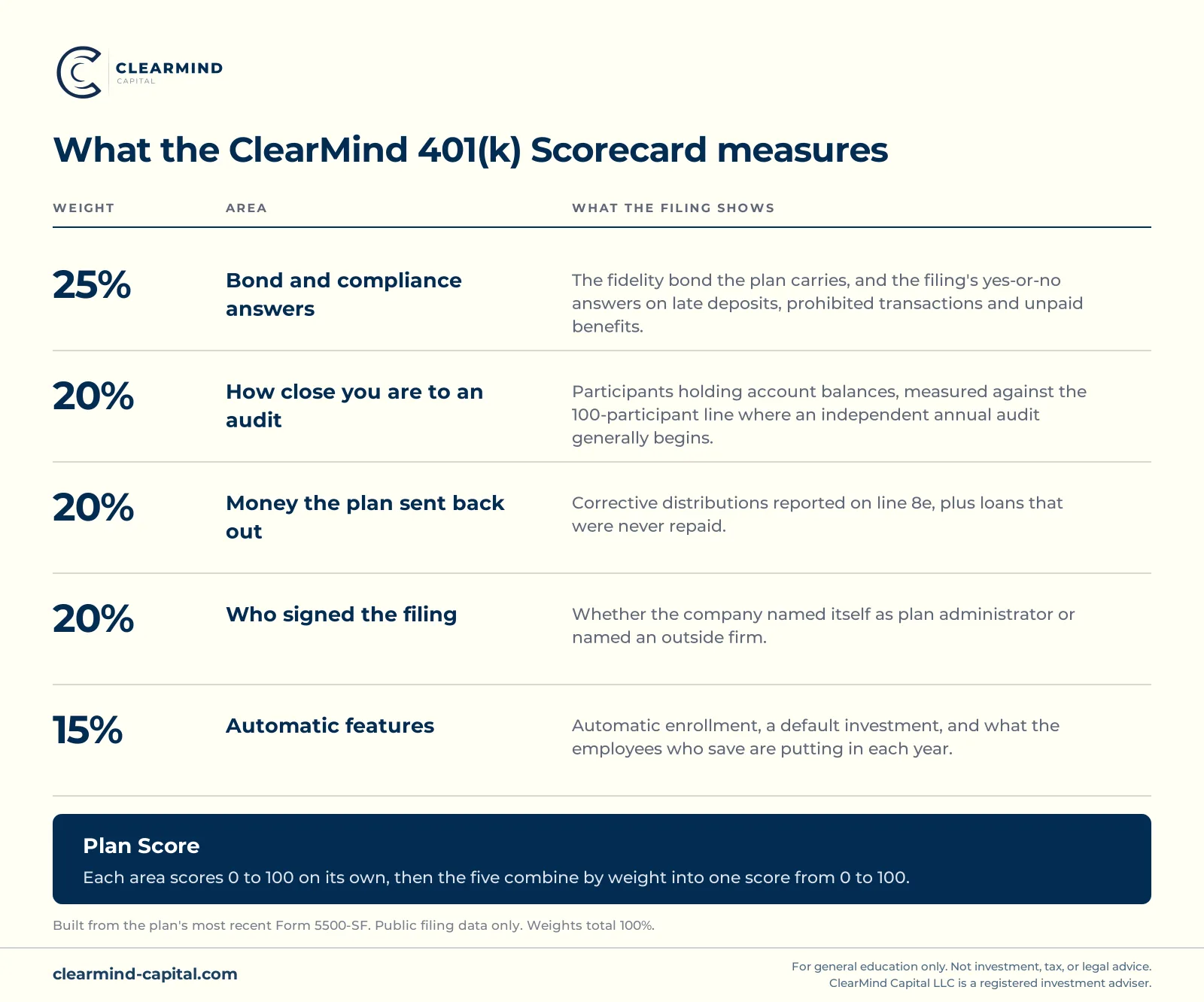
| What it scores | Weight | Why an owner cares |
|---|---|---|
| Bond and compliance answers | 25% | Whether the plan carries the fidelity bond ERISA requires, generally 10% of the funds a person handles with a $1,000 floor and a $500,000 ceiling, and how the plan answered the yes-or-no questions about late payroll deposits, prohibited transactions and benefits that went unpaid. Several of those answers carry excise taxes or penalties. |
| How close you are to an audit | 20% | Once a plan starts a year with 100 people holding account balances, an independent annual audit generally kicks in. Former employees who left their money behind still count. |
| Money the plan sent back out | 20% | Refunds the plan had to issue, often after a failed Glossary of Financial ClarityIRSThe IRS, or Internal Revenue Service, is the federal agency that collects taxes and enforces the tax code. It processes returns, sends refunds, and runs audits. Most of what feels like a tax rule in everyday life is the IRS turning the laws Congress writes into forms, deadlines, and instructions.General education only. Not tax or investment advice. Read the full story fairness test, plus loans nobody repaid. Refunds usually land on owners and highly paid employees as taxable income. |
| Who signed the filing | 20% | Whether the company named itself as plan administrator or named an outside firm. People who run a plan carry legal responsibility for how it gets run. |
| Automatic features | 15% | Automatic enrollment, a default investment, and how much the employees who save are putting in. Vanguard's 2026 report found 94% participation in plans with automatic enrollment, against 64% where employees have to sign themselves up. |
That fourth row has more behind it than one line can hold. We wrote about it separately in Who Is Responsible for Your Company's 401(k)?
Reading your score
Scores land in one of three bands, and the bands do the same work at the plan level and inside each area.
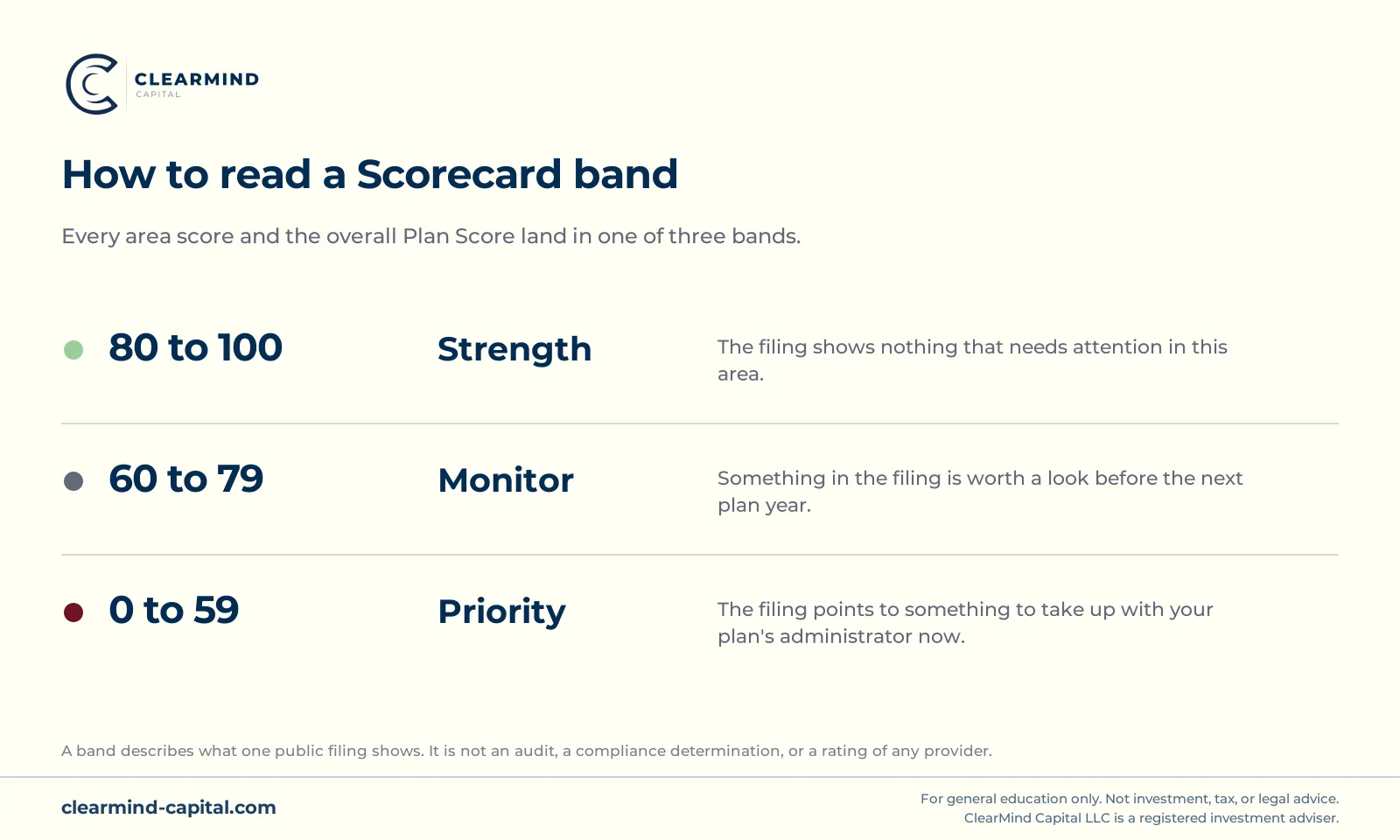
Strength runs 80 to 100. Monitor runs 60 to 79. Priority runs 0 to 59.
Alongside the numbers you get a short paragraph we call your plan's story, written from the figures in your own filing. How many people hold balances, how many eligible employees haven't started saving, what the company puts in for every dollar employees save, and how much money left the plan that year.
Every score shows its work on a second page: the line it pulled from the filing, the formula, and the result. Your Glossary of Financial ClarityCPAA CPA, or certified public accountant, is an accountant who has passed a demanding licensing exam and met state experience requirements. Not everyone who does taxes holds the license, and it lets them do things an unlicensed preparer can't, like represent you in front of the IRS and sign off on audited financial statements.General education only. Not tax or investment advice. Read the full story can check it by hand.
What it can't see
The filing says nothing about what the plan costs your employees, what sits on the investment menu or how it got picked, what your service agreements commit you to, or what signing up feels like for a new hire. All of that matters more than any single number on the form, and none of it is in there. (On the cost question, What a 401(k) Really Costs a Small Business covers the parts that stay invisible.)
So, plainly: the Scorecard is not an audit, a compliance determination, or investment, tax or legal advice. It is not a grade and not a rating of your provider. A low area score points at something on a public document that's worth a second look.
How to get yours
Go to the Plan Assessment page, search by company name or EIN, and confirm the plan that comes back is yours. The overall Plan Score takes about a minute. Adding your name and email opens all five area scores.
Plans with 100 or more participants file the full Form 5500 rather than the short form, so the search won't turn those up. Pick "None of these" on the results screen and Austin and Joe will build yours by hand.
If you'd rather go through it with someone, there's a link on the results page to book thirty minutes with us. And if you want to poke at your plan before you run anything, Is Your Company 401(k) Any Good? Seven Things You Can Check This Week is a decent place to start.
Common questions
Is the ClearMind 401(k) Scorecard free?
Yes. The overall Plan Score comes back free. Adding your name and email unlocks the five individual area scores.
Where does the data come from?
Your plan's most recent Form 5500-SF, filed with the Department of Labor and published in its public EFAST2 database. We refresh our copy monthly. Nothing in the Scorecard comes from a private or client source.
How current is the information?
It's the latest filing on record for your plan. A Form 5500-SF is due the last day of the seventh month after the plan year closes, and filers can extend that, so the numbers you see can be more than a year old.
Does a low score mean my plan is out of compliance?
No. The Scorecard reads one public form and scores what that form shows. A low area score tells you where to go look with whoever administers your plan.
My plan has more than 100 participants. Will it work?
The automatic search covers plans filing the Form 5500-SF, which is generally plans with fewer than 100 participants at the start of the plan year. Larger plans file the full Form 5500. Choose "None of these" on the search screen and we'll build your Scorecard by hand.
What if something in the filing is wrong?
Then the score reflects the error, which is worth knowing by itself. Raise it with your third party administrator, because the filing is the version the government is holding.

 Written byAustin Wolfe & Joe AndersonClearMind Capital | Workplace RetirementView bio →
- U.S. Department of Labor, 2025 Form 5500-SF Instructions: https://www.dol.gov/sites/dolgov/files/ebsa/employers-and-advisers/plan-administration-and-compliance/reporting-and-filing/form-5500/2025-sf-instructions.pdf
- U.S. Department of Labor, EFAST2 public filing search: https://www.efast.dol.gov/welcome.html
- U.S. Department of Labor, Field Assistance Bulletin 2008-04, fidelity bonding under ERISA section 412: https://www.dol.gov/agencies/ebsa/employers-and-advisers/guidance/field-assistance-bulletins/2008-04
- 29 CFR 2520.104-46 and 29 CFR 2520.103-1(d), as amended for 2023 plan years, participant counting for the small plan audit waiver
- Vanguard, How America Saves 2026, 2025 plan year data: https://workplace.vanguard.com/insights-and-research/report/how-america-saves-2026.html
- U.S. Bureau of Labor Statistics, Usual Weekly Earnings of Wage and Salary Workers, Second Quarter 2026: https://www.bls.gov/news.release/archives/wkyeng_07212026.ht
The information presented in this article is for informational purposes and should not be intended as tax, accounting or legal advice, nor is it an offer or solicitation to buy or sell, or as an endorsement of any company, security, fund, or other offering. Please consult your legal, tax, or accounting professional regarding your specific situation. Investments involve risk and have the potential for complete loss. It should not be assumed that any recommendations made will necessarily be profitable.
The opinions expressed in any commentary posted on this site are solely those of the individual author and do not necessarily reflect the views or opinions of ClearMind Capital, LLC. These opinions are based on information available at the time of posting and are subject to change without notice. ClearMind Capital, LLC, does not commit to updating any posted positions or commentary to reflect subsequent developments. While the information and reasoning used to form these opinions are believed to be from reliable sources, ClearMind Capital, LLC, does not verify this information, and no guarantee is provided regarding its accuracy, completeness, or validity. ClearMind Capital, LLC, disclaims any and all liability for actions taken or not taken based on the content of this site. No warranty, express or implied, is given in connection with the content provided.
Certified Financial Planner Board of Standards Center for Financial Planning, Inc. owns and licenses the certification marks CFP®, CERTIFIED FINANCIAL PLANNER®, and CFP® (with plaque design) in the United States to Certified Financial Planner Board of Standards, Inc., which authorizes individuals who successfully complete the organization’s initial and ongoing certification requirements to use the certification marks.


