

Words with this mark have a quick definition. Tap one to read it without leaving the article.
"We're a Glossary of Financial ClarityFiduciarySomeone legally required to put your interests ahead of their own paycheck. Sounds like the bare minimum, and yet a lot of the financial world doesn't work that way. When an advisor is a fiduciary, “is this good for me or good for them” has a clearer answer.General education only. Not tax or investment advice. Read the full story on this plan."
Angela heard it at a renewal meeting and wrote it in her notebook. Angela is made up, though the sentence is real enough that we hear a version of it most months. She runs a specialty food manufacturer in Westerville, 52 people on payroll, and the plan had been on the same platform since 2017.
Eighteen months later a shift lead asked her who picks the funds in the plan. She opened her mouth to answer and found she didn't have one. Somebody had said fiduciary, she had written it down, and she had never asked what it was attached to.
What the word is attached to
ERISA defines a fiduciary by what somebody does. A person is a fiduciary with respect to a plan "to the extent" they exercise "any discretionary authority or discretionary control respecting management of such plan," render "investment advice for a fee or other compensation, direct or indirect," or have "any discretionary authority or discretionary responsibility in the administration of such plan."
Read those four words at the front again. To the extent. The statute hands out fiduciary status in slices, measured by the job being done, which is why a provider can hold it for the investment lineup and hold none of it for the fee structure, the plan design, or the choice to keep that provider another year.
So the question a business owner wants answered is never whether a provider is a fiduciary. It's which jobs on their plan the word reaches.
When a provider's advice counts as advice under ERISA
The second route in that definition, investment advice for compensation, has its own test, and it is narrow.
The Department of Labor wrote it in 1975 and still calls it the five-part test. It spent more than fifteen years trying to replace it. The 2024 Retirement Security Rule was the most recent attempt, it never took effect, a federal court vacated it, and in March 2026 the DOL published a rule removing it and restoring the 1975 definition, effective April 20, 2026.
So the 1975 test governs. Every part of it has to be met: a recommendation about buying, selling or valuing investments, given for a fee or other compensation that can be direct or indirect, "on a regular basis," under a "mutual agreement, arrangement or understanding," that the advice "will serve as a primary basis for investment decisions," and that it is "individualized investment advice to the plan based on the particular needs of the plan."

A call center walking an employee through the enrollment screen is not clearing that bar. A model portfolio handed to every plan on the platform is not individualized to your plan. Neither of those is a knock on the service. They're a description of what the service is, and the point of the test is that the label follows the work rather than the marketing.
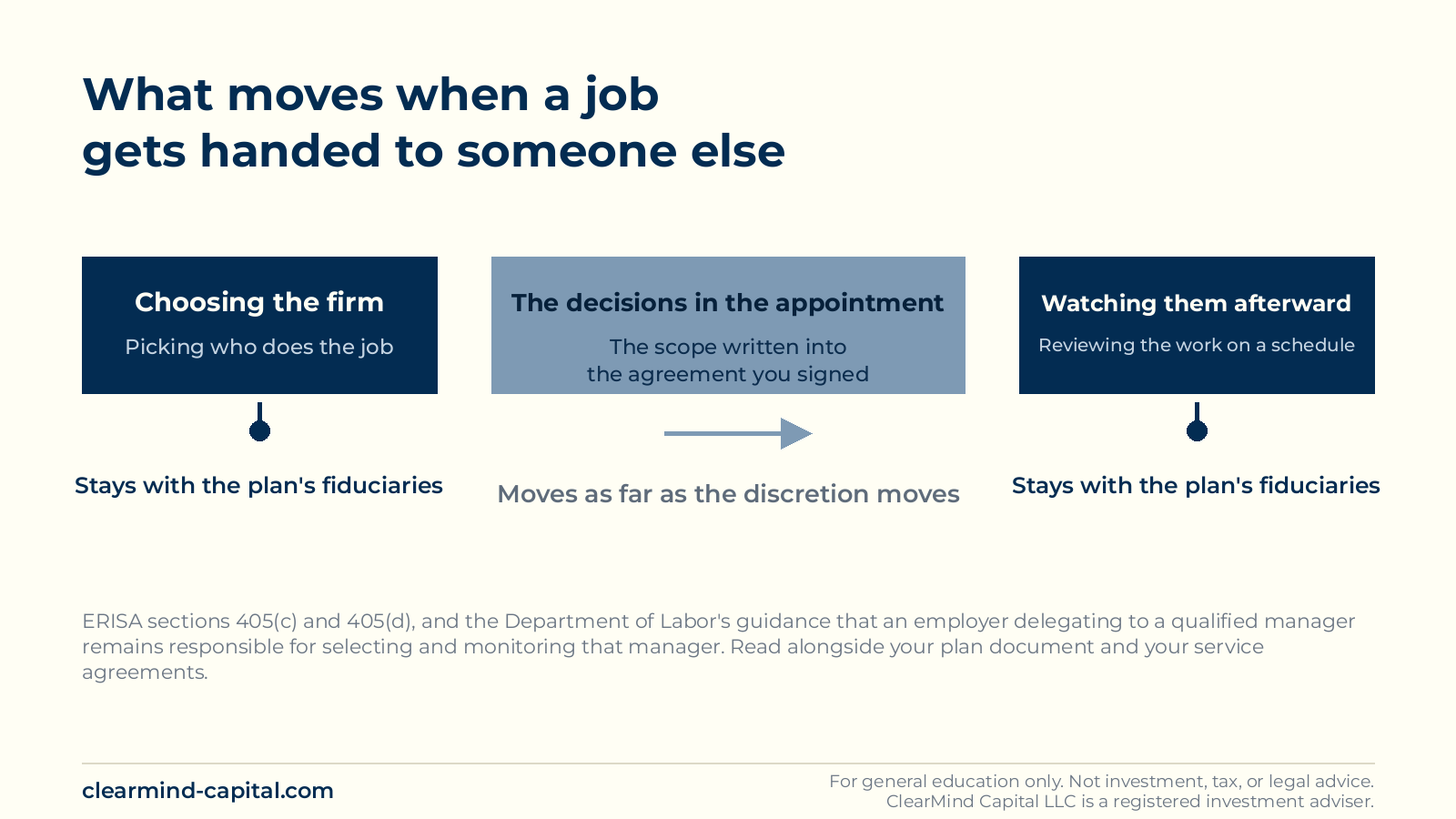
What moves when a job gets handed off
A plan can hand work to other people. The plan document can set up a procedure for allocating fiduciary duties among named fiduciaries and for designating others to carry them out, and when that happens the named fiduciary "shall not be liable for an act or omission of such person."
Then comes the part that answers Angela's question. That protection drops away "to the extent that" the named fiduciary breached the prudence duty in making or continuing the designation, or in setting up and running the procedure itself. Where a plan appoints an investment manager, "no trustee shall be liable for the acts or omissions of such investment manager or managers," and the same subsection says nothing in it relieves a trustee of liability for the trustee's own acts.
The DOL puts the practical version in its guide for employers: liability can be limited by delegating functions to a qualified manager, and the employer stays responsible for selecting and monitoring that manager.
Responsibility travels with discretion, and only as far as the discretion goes. Picking who does the job and watching them afterward is a decision the business keeps in every arrangement.
This should be reviewed with your ERISA counsel before acting.
Where your plan's answer already exists
None of this requires a phone call, because the answer was sent to you in writing before you signed.
Under the service provider disclosure rule, a covered service provider has to tell the responsible plan fiduciary whether it will provide services "as a fiduciary (within the meaning of section 3(21) of the Act)" and whether it will provide services as "an investment adviser registered under either the Investment Advisers Act of 1940 or any State law." Each statement is made if it applies. The disclosure is due reasonably in advance of signing, extending or renewing, and a change to that status has to come to you within 60 days.
That document, plus the service agreement it came with, is where the scope lives. We walked through who does what on a 401(k) and where each provider's contract stops in an earlier post, and the fiduciary statement is the line to read next to it.
What Angela found
Her disclosure said the provider acts as a fiduciary with respect to a specific investment service, and said nothing of the kind about recordkeeping, the fee structure or the plan design. Which was accurate, and had been sitting in a binder for nine years.
The gap wasn't the provider's. Nobody had been looking at the menu against a written standard, nobody had compared the plan's costs to plans the same size, and the decision to stay on that platform had been made by default every year since 2017.
She still uses the same provider. What changed is that the scope is written down where she can find it, and the decisions nobody owned now have a date on the calendar.
Austin Wolfe and Joe Anderson run Workplace Retirement at ClearMind Capital in Columbus, and set up and administer Glossary of Financial Clarity401(k)A retirement account through your job where money leaves your paycheck before you ever see it. If your employer matches, that match is about the closest thing to free money you'll get offered at work. It comes in traditional (tax later) and Roth (tax now) flavors.General education only. Not tax or investment advice. Read the full story plans for businesses across Ohio and nationwide. Book a call and we will read your disclosures with you and mark which jobs on your plan have somebody's name against them.
Common questions
Is my 401(k) provider a fiduciary?
Possibly, for part of what it does. ERISA assigns fiduciary status by function and only "to the extent" a person exercises discretion over the plan or its assets, gives investment advice for compensation, or holds discretionary authority in plan administration. Your service provider disclosure has to state whether the provider acts as a fiduciary, so the answer for your plan is already in writing.
Is a recordkeeper a fiduciary?
Usually not for recordkeeping itself, which is processing work carried out under a contract rather than discretionary decision-making. Some providers take on specific fiduciary services under a separate agreement and price them separately. The disclosure you received tells you which, if either, applies to yours.
If my provider is a fiduciary, am I off the hook?
No. Protection from a co-fiduciary's acts falls away to the extent the plan's named fiduciary was imprudent in making or continuing the appointment or in running the procedure behind it. Choosing the firm and monitoring it afterward is a fiduciary act that stays with the business in every arrangement.
What is the five-part test for a 401(k) fiduciary?
It is the Department of Labor's 1975 standard for when paid investment advice makes someone a fiduciary. Advice has to be a recommendation about investing, buying or selling, given for direct or indirect compensation, on a regular basis, under a mutual agreement or understanding, serving as a primary basis for investment decisions, and individualized to the plan's particular needs. After the 2024 Retirement Security Rule was vacated, the DOL formally restored this test effective April 20, 2026.
Does my provider have to tell me whether it is a fiduciary?
Yes, if it is a covered service provider expecting $1,000 or more from your plan. The disclosure has to state whether services are provided as a fiduciary under ERISA section 3(21) and whether they are provided as a registered investment adviser, and it is due reasonably in advance of the contract being entered into, extended or renewed, with changes disclosed within 60 days.
Who picks the investments in our 401(k)?
Whoever the plan's documents and agreements put that decision with. On a lot of small business plans it is the employer, advised by somebody, even where an outside firm has been appointed over part of the lineup. The way to find out is to read the fiduciary statement in your disclosure against the scope in the service agreement, and the two should describe the same arrangement.

 Written byAustin Wolfe & Joe AndersonClearMind Capital | Workplace RetirementView bio →
- ERISA section 3(21)(A), 29 U.S.C. 1002, defining a fiduciary by function and "to the extent" of discretionary authority over the plan, investment advice for a fee or other compensation, or discretionary responsibility in plan administration.
- 29 CFR 2510.3-21, the 1975 investment advice regulation, for the recommendation element, advice rendered "on a regular basis" under a "mutual agreement, arrangement or understanding" that it "will serve as a primary basis for investment decisions" and is "individualized investment advice to the plan based on the particular needs of the plan," advice given "for a fee or other compensation, direct or indirect," and the separate route through discretionary authority or control.
- U.S. Department of Labor, Employee Benefits Security Administration, Retirement Security Rule: Definition of an Investment Advice Fiduciary: Notice of Court Vacatur, 91 FR 13503 (March 20, 2026), RIN 1210-AC36, a final rule and technical amendment effective April 20, 2026, implementing the judicial vacatur of the 2024 fiduciary rule, removing it from the Code of Federal Regulations and putting back the 1975 regulatory text that set out the five-part test.
- ERISA section 405(c) and 405(d), 29 U.S.C. 1105, on allocating fiduciary responsibilities under a plan procedure, the named fiduciary not being liable "for an act or omission of such person," the carve-out where the named fiduciary was imprudent in making or continuing the designation, and the investment manager provisions.
- 29 CFR 2550.408b-2, the covered service provider disclosure rule, for the written statement of whether services are provided "as a fiduciary (within the meaning of section 3(21) of the Act)" or as "an investment adviser registered under either the Investment Advisers Act of 1940 or any State law," the $1,000 threshold, the timing reasonably in advance of entering, extending or renewing a contract, and the 60-day update requirement.
- U.S. Department of Labor, Meeting Your Fiduciary Responsibilities, on fiduciary status by function, prudence as a process, limiting liability by delegating to a qualified manager, and the employer's continuing responsibility to select and monitor that manager.
- ClearMind Capital, Who Does What on Your 401(k)? and Who Is Responsible for Your Company's 401(k)?, the earlier posts in this series.
- Angela, her company, her headcount and every detail attributed to her plan are a constructed hypothetical for illustration, not a client and not a quote.
The information presented in this article is for informational purposes and should not be intended as tax, accounting or legal advice, nor is it an offer or solicitation to buy or sell, or as an endorsement of any company, security, fund, or other offering. Please consult your legal, tax, or accounting professional regarding your specific situation. Investments involve risk and have the potential for complete loss. It should not be assumed that any recommendations made will necessarily be profitable.
The opinions expressed in any commentary posted on this site are solely those of the individual author and do not necessarily reflect the views or opinions of ClearMind Capital, LLC. These opinions are based on information available at the time of posting and are subject to change without notice. ClearMind Capital, LLC, does not commit to updating any posted positions or commentary to reflect subsequent developments. While the information and reasoning used to form these opinions are believed to be from reliable sources, ClearMind Capital, LLC, does not verify this information, and no guarantee is provided regarding its accuracy, completeness, or validity. ClearMind Capital, LLC, disclaims any and all liability for actions taken or not taken based on the content of this site. No warranty, express or implied, is given in connection with the content provided.
Certified Financial Planner Board of Standards Center for Financial Planning, Inc. owns and licenses the certification marks CFP®, CERTIFIED FINANCIAL PLANNER®, and CFP® (with plaque design) in the United States to Certified Financial Planner Board of Standards, Inc., which authorizes individuals who successfully complete the organization’s initial and ongoing certification requirements to use the certification marks.


